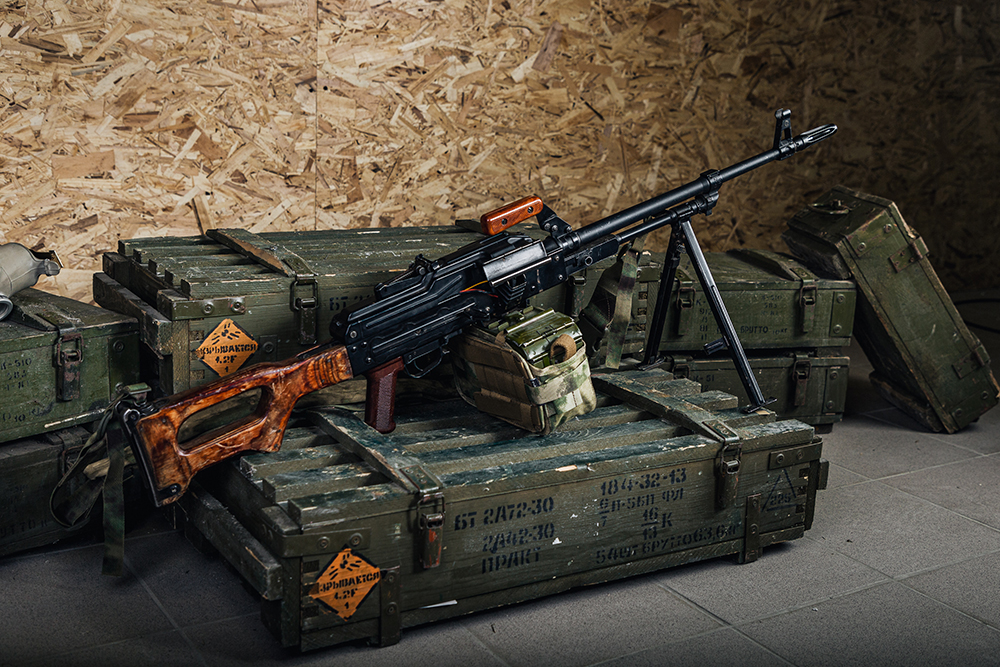


In a major legal challenge that might reshape federal firearms policy, the Temple Gun Club and three of its members filed a lawsuit yesterday in the U.S. District Court for the Northern District of Texas. The complaint directly attacks the constitutionality of 18 U.S.C. § 922(o), the federal statute that has prohibited the possession and transfer of machine guns manufactured after May 19, 1986, for more than three decades.
The case, Temple Gun Club, Inc. et al v. Bondi et al, was assigned to Judge Reed O’Connor. The plaintiffs are the Temple Gun Club (TGC), a nonprofit organization established in 1963 with more than 1,000 members focused on firearms education, safety, and competitive shooting, along with individual members Jeffrey Howard, Jason Armstrong, and Clark Miracle.
Jeffrey Howard, TGC’s president, is a retired U.S. Army Sergeant Major with 26 years of military service. Jason Armstrong is a retired firefighter and licensed gunsmith. Clark Miracle is a Fort Worth resident and firearms enthusiast. All three individuals state that they have no felony or violent misdemeanor convictions and currently own semi-automatic firearms that could be converted to full-automatic capability, but federal law prevents them from completing such conversions or acquiring post-1986 machine guns.
Named as defendants are U.S. Attorney General Pamela Bondi, Acting Director of the Bureau of Alcohol, Tobacco, Firearms, and Explosives (ATF) Daniel Driscoll, and ATF Special Agents in Charge Brian Garner (Dallas Field Division) and Michael Weddel (Houston Field Division), each sued in their official capacities. The plaintiffs maintain that these officials are responsible for enforcing § 922(o), which carries criminal penalties of up to 10 years imprisonment and a $10,000 fine for violations.
The prohibition at issue originated as a floor amendment during the 1986 debate over the Firearm Owners’ Protection Act (FOPA). Sponsored by Representative William Hughes, the amendment was introduced with little committee review or recorded debate. It passed by voice vote and was described by its sponsor as uncontroversial. The final law grandfathered in machine guns already registered with the ATF before the May 19, 1986, cutoff date. It allowed continued possession by government agencies, but it closed the registry to new civilian-owned machine guns.
This created a closed market for legal, transferable pre-1986 machine guns. Prices for these firearms have risen dramatically over the decades, with many models now selling for tens of thousands of dollars, far beyond the reach of most gun owners.
The Texas Public Policy Foundation (TPPF), which is supporting the litigation, described the lawsuit as an effort to vindicate law-abiding citizens’ rights to possess machine guns for lawful purposes, including personal defense, recreation, and training. The plaintiffs emphasize that they seek only to own and use such firearms safely and responsibly, consistent with their long-standing involvement in the shooting sports community.
The complaint’s primary claim is that § 922(o) exceeds Congress’s enumerated powers under Article I of the Constitution. The plaintiffs argue that the federal government lacks general police power to criminalize mere possession of firearms within state borders. They claim that the statute cannot be justified under the Commerce Clause because it lacks a jurisdictional hook tying the prohibited conduct to interstate or foreign commerce.
Citing Supreme Court decisions such as United States v. Lopez and United States v. Morrison, the plaintiffs assert that possessing a machine gun for personal use is not an economic activity that substantially affects interstate commerce. They further argue that the ban is not a proper exercise of congressional authority under the Necessary and Proper Clause.
Although the complaint centers on enumerated-powers arguments, it also invokes the Second Amendment, suggesting that § 922(o) impermissibly burdens the core right to keep and bear arms in common use for lawful purposes.
The plaintiffs note that ATF regulations make it effectively impossible to obtain approval for post-1986 machine guns through standard registration processes (Form 1 for making or Form 4 for transferring). They highlight that hundreds of individuals are prosecuted each year under the statute, creating a credible and ongoing threat of enforcement.
The Temple Gun Club asserts organizational standing, arguing that the ban directly harms its mission and its members’ ability to engage in firearms-related activities. The individual plaintiffs claim personal injury from being denied the ability to possess modern machine guns.
This lawsuit occurs amid heightened examination of federal firearms regulations. Recent court decisions, particularly in the Fifth Circuit, have questioned broad interpretations of federal authority over gun possession. The plaintiffs urge the court to reconsider earlier appellate rulings that upheld § 922(o) under the Commerce Clause.
If the plaintiffs prevail, the decision could invalidate the 1986 machine gun ban nationwide, possibly allowing law-abiding citizens to register and possess newly manufactured or converted full-automatic firearms. Such an outcome would dramatically expand civilian access to these weapons and likely reduce prices for transferable pre-1986 models as the market expands.
The case is filed in the Northern District of Texas, where plaintiff Clark Miracle resides, and invokes federal-question jurisdiction. The plaintiffs seek a declaration that § 922(o) is unconstitutional on its face and as applied, a permanent injunction barring enforcement against them, and an award of costs and attorney fees.
As proceedings begin, the lawsuit is expected to draw notable attention from both gun rights and anti-gun organizations. It represents one of the most direct constitutional challenges to the post-1986 machine gun prohibition in recent years. It could set the stage for appellate review in a circuit increasingly receptive to Second Amendment and enumerated-powers arguments.
About John Crump
Mr. Crump is an NRA instructor and a constitutional activist. John has written about firearms, interviewed people from all walks of life, and on the Constitution. John lives in Northern Virginia with his wife and sons, follow him on X at @crumpyss, or at www.crumpy.com.