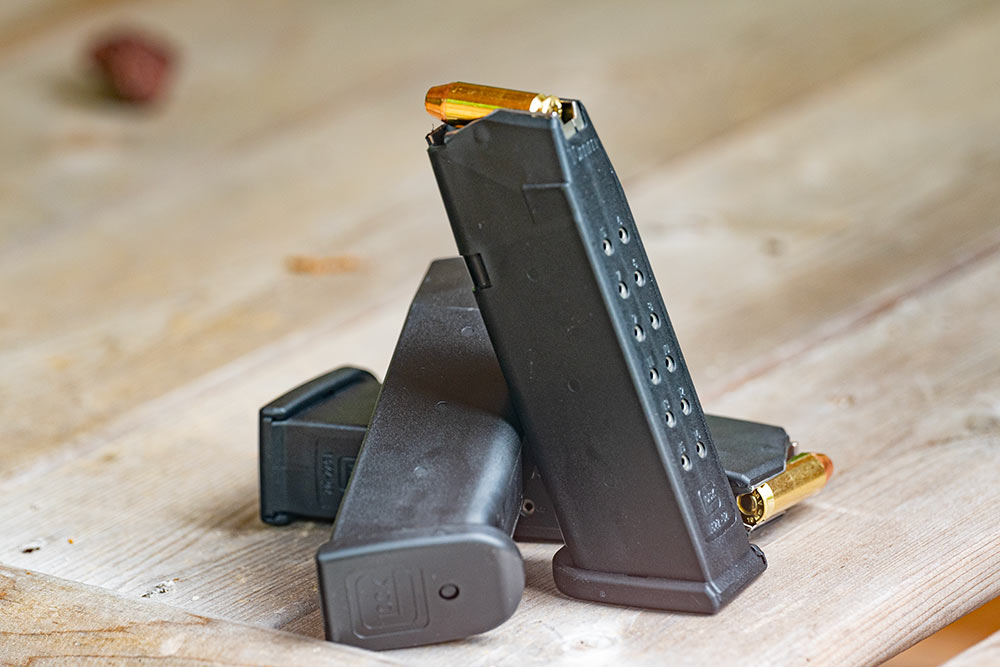

On Monday, a federal judge dismissed all plaintiffs but one in a court case challenging Washington, D.C.’s standard capacity magazine ban.
In this case, Andrew Hanson et al. v. District of Columbia et al., U.S. District Court Judge Rudolph Contreras granted in part and denied in part the District’s partial motion to dismiss. The judge dismissed all the plaintiffs from the case, except Tyler Yzaguirre, leaving him to go in alone to defeat the ban.
The decision comes more than three and a half years after the lawsuit was filed and follows a tortuous path through preliminary injunction proceedings, an appeal to the D.C. Circuit, and a petition for certiorari denied by the U.S. Supreme Court. Until recently, the Nation’s Capital banned magazines holding more than ten rounds of ammunition under D.C. Code § 7-2506.01(b). D.C. refers to these magazines as “large capacity magazines” (LCMs).
Earlier this month, another case in front of a three-judge panel from the D.C. Court of Appeals struck down the ban by a margin of 2-1 in Benson v. the United States.
D.C. asked for an expedited en banc hearing, in which the decision would be vacated, and the full bench would rehear the case. The court denied the petition, meaning D.C. must go through the normal en banc process. The federal court acknowledged but said it does not yet moot the case because the plaintiffs are seeking damages and en banc review in Benson v. United States remains pending.
The decision highlights the difficulties of bringing gun rights cases dealing with pre-enforcement in D.C. The court system in Washington is bound by a 1997 D.C. Circuit case called Navegar, Inc. v. United States. That case requires plaintiffs to show they have been “singled out or uniquely targeted” for prosecution before they can sue. Judge Contreras relied on this case to dismiss most of the plaintiffs.
“Plaintiffs have failed to identify Supreme Court precedent that ‘eviscerates’ the D.C. Circuit’s binding precedent of Navegar and its progeny,” Contreras wrote on page 12 of the opinion. “Applying that binding precedent, the Court will dismiss all Plaintiffs but Yzaguirre from this case.”
Hanson and Yzaguirre are D.C. residents who already own registered firearms inside the city. Chaney lives in Virginia, and Klun in Maryland. All four hold Concealed Pistol Carry Licenses issued by the Metropolitan Police Department (MPD). Each plaintiff alleged that they own magazines capable of holding more than 10 rounds that are stored outside D.C. and that they would possess and use those magazines inside the District, but the judge didn’t think that was enough to overcome the threat of the pre-enforcement hurdle.
While a motion for a preliminary injunction was pending, Yzaguirre attempted to register a Sig Sauer P365 pistol equipped with a 12-round magazine. MPD denied the application explicitly because owning a standard-capacity magazine is illegal in Washington. That denial became the pivotal “jurisdictional hook” that saved his claim.
The District moved to prune the case. It argued that only Yzaguirre had standing and that even his claim should be limited strictly to the denial of the 12-round magazine registration. Contreras sided with the District on standing for the three other plaintiffs. He explained that under Navegar, Seegars v. Gonzales, and Parker v. District of Columbia, generalized allegations that a plaintiff “would” possess banned items if not for the law are not enough. There must be a concrete, imminent threat of prosecution, something the three plaintiffs failed to show.
The judge did let Yzaguirre’s challenge go through because of his denial by the MPD. He ruled that Yzaguirre suffered “an injury independent of the District’s prospective enforcement of its gun laws.” The court rejected D.C.’s attempt to limit Yzaguirre’s magazine to a single 12-round magazine. Yzaguirre says he owns several magazines in D.C. that he wants to register under the city’s arbitrary 10-round limit. Contreras refused to require Yzaguirre to file futile, separate registration applications for every magazine he owns.
“Having been denied a license already, the Court sees no sound reason why Yzaguirre should be required to march through the futile act of attempting to register every other magazine he owns to vindicate his constitutional rights,” the opinion states on page 15. “The Court is aware of no authority stating that the Constitution requires such exercises of futility.”
The case now moves forward with only Yzaguirre as plaintiff. Discovery, summary judgment briefing, and possibly a trial on the constitutionality of the ban as applied to him lie ahead. The District has not yet commented publicly on the ruling, and plaintiffs’ attorneys could not be reached for comment.
D.C. Tries to Save Its Magazine Ban as Benson Sends Shockwaves Beyond the District
About John Crump
Mr. Crump is an NRA instructor and a constitutional activist. John has written about firearms, interviewed people from all walks of life, and on the Constitution. John lives in Northern Virginia with his wife and sons, follow him on X at @crumpyss, or at www.crumpy.com.