


On April 10, 2026, a three-judge panel of the Fifth Circuit issued its opinion in Morris v. DOJ, reinforcing a longstanding constitutional limit on Congress’s taxing power: it may impose taxes that raise revenue, but it cannot simply prohibit conduct under the guise of taxation.
The reasoning and precedents cited in Morris could bolster challenges to the constitutionality of the NFA’s registration scheme for suppressors, SBRs, SBSs, and AOWs now that the making and transfer tax on those items has been reduced to zero.
The case in the Fifth Circuit is Morris v. DOJ. It concerns the federal ban on home distilleries, enacted in 1868. The ban does not require a person to pay a tax on producing distilled spirits at home. Instead, the law prohibits home distilleries altogether. The relevance is that there is no tax to be paid. From page 12 of the decision:
“Congress’s authority under the taxing power is limited to requiring an individual to pay money into the Federal Treasury, no more.”
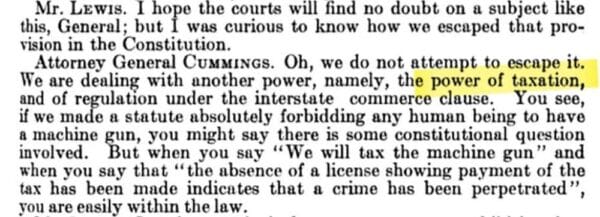
The NFA has always been justified under the authority of Congress to raise taxes. It has not been justified as an authority given to Congress by the interstate commerce clause. This was emphasized by Franklin Delano Roosevelt’s Attorney General, Homer Cummings, as shown in a previous article on AmmoLand:
Then-Attorney General Cummings was clear about this in his testimony to Congress during the debates over the bill in 1934:
Courts have consistently upheld the NFA, and its registration provision, on the grounds that it was a tax.
A separate federal case directly challenges the constitutionality of the NFA registration requirements, now that there is no tax on suppressors, SBRs, and SBSs. Brown v. ATF is at the district court level. Issues of standing are being addressed.
If Brown v. ATF proceeds to the merits, Morris v. DOJ could provide important persuasive support for the argument that Congress cannot rely on the taxing power to prohibit conduct where no tax is actually being paid into the Treasury. In the Fifth Circuit, that reasoning may carry even more weight. But Brown is pending in the Eastern District of Missouri, so Morris would not be binding there.
Congressional power to tax was used in 1934 as a workaround to avoid the Second Amendment. The NFA has always been justified as a tax act, not a use of congressional power under the commerce clause.
In 1934, the commerce clause had far less reach than it would later. In 1934, the Supreme Court had yet to rule that the power to tax could not be used to subvert the Bill of Rights.
In 2026, there is a long-standing precedent that the power to tax cannot be used to destroy the Bill of Rights, and another that the taxing power must actually impose a tax to be legitimate. The NFA tax has been eliminated for silencers, short-barreled rifles, short-barreled shotguns, and any other weapons.
The question is: how long will it take for the Supreme Court to recognize this?
DOJ Warns Virginia It Will Sue Over AR-15 Ban, Gun Control Bills
About Dean Weingarten:
Dean Weingarten has been a peace officer, a military officer, was on the University of Wisconsin Pistol Team for four years, and was first certified to teach firearms safety in 1973. He taught the Arizona concealed carry course for fifteen years until the goal of Constitutional Carry was attained. He has degrees in meteorology and mining engineering, and retired from the Department of Defense after a 30 year career in Army Research, Development, Testing, and Evaluation.