


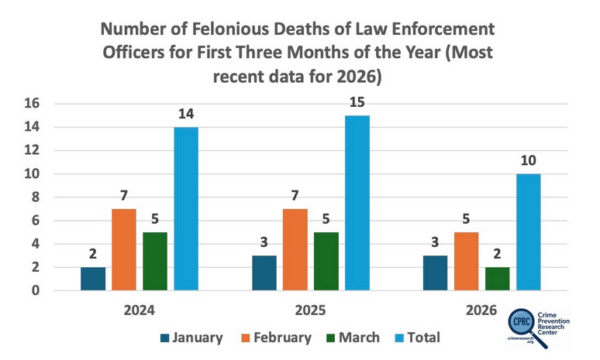
In 2025, the number of officers feloniously killed fell to its lowest level since 2020. According to the Crime Prevention Research Center’s review of FBI LEOKA data, 53 officers were feloniously killed in 2025, down 17.2% from 2024. Early 2026 data also point lower, with 10 officers feloniously killed in the first three months of the year, compared with 15 in the same period of 2025 and 14 in the same period of 2024. The FBI’s LEOKA system relies on voluntary reporting from participating law enforcement agencies.
The Officers Down Memorial Page (ODMP) appears to have more complete data than the FBI Law Enforcement Officers Killed and Assaulted (LEOKA) data. The LEOKA data depends on voluntary reporting from law enforcement agencies.
The ODMP evaluates officer deaths that are submitted to it. The largest discrepancy noticed was in 2013, where ODMP listed 37 officers feloniously killed in that year, and LEOKA lists 27. In 2025, the two numbers are the same.
The Crime Prevention Research Center has compared the first three months of 2026 with the first three months of 2024 and 2025, using the LEOKA data. You can see that 2026 is lower than the previous years for the first quarter.
The number of officers feloniously killed has been dropping since the 1970s. There are reasons for this drop. It has not been smooth. The numbers are relatively small, so there are significant changes from year to year. The chart below shows the number of officers killed feloniously with firearms from 1961 to 2013, using LEOKA data.
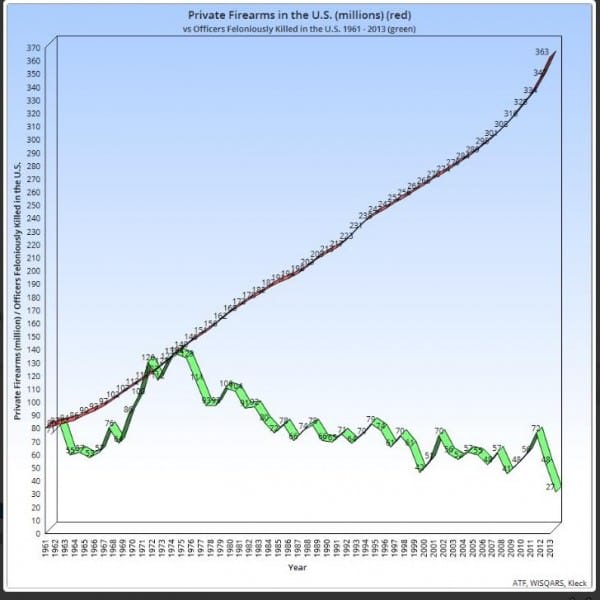
The number of officers feloniously killed with firearms is a good fit for the number of officers feloniously killed, because most homicides of officers in the line of duty are committed with firearms. However, there is no correlation between the number of officers feloniously killed and the number of privately owned firearms.
There are several reasons that may explain the drop in numbers from the early 1970s. First is the introduction of soft body armor, especially the Second Chance vest, in the early 1970s. There was better training on firearms retention and the use of retention holsters. Prior to the retention holster and better training, many homicides of police were committed with the officers’ firearm. Today, very few homicides of police officers are committed with the officers’ firearms.
We developed much better communications and emergency response systems, as well as better emergency room care. Because of this, more officers who are wounded survive. Together, these things resulted in a two-thirds drop in the number of officers killed in felonious attacks from the early 1970s to the 20-teens.
The number of officers killed tends to follow the overall homicide numbers. Overall, homicides have dropped significantly since the 1990s.
As we continuously improve the technology used by the police, the officers killed feloniously will continue to drop. Robots are already being used to search houses. Cameras everywhere make criminals easier to find and crimes easier to solve.
The attitude of a presidential administration can make a difference as well.
The number of officers feloniously killed in the first Trump administration averaged lower than the number of officers feloniously killed in the Biden administration. We will have to wait to see if those numbers are even lower during the second Trump administration.
5.7 Million Suppressors Registered: ATF Data Shows Massive Growth in Ownership
About Dean Weingarten:
Dean Weingarten has been a peace officer, a military officer, was on the University of Wisconsin Pistol Team for four years, and was first certified to teach firearms safety in 1973. He taught the Arizona concealed carry course for fifteen years until the goal of Constitutional Carry was attained. He has degrees in meteorology and mining engineering, and retired from the Department of Defense after a 30 year career in Army Research, Development, Testing, and Evaluation.