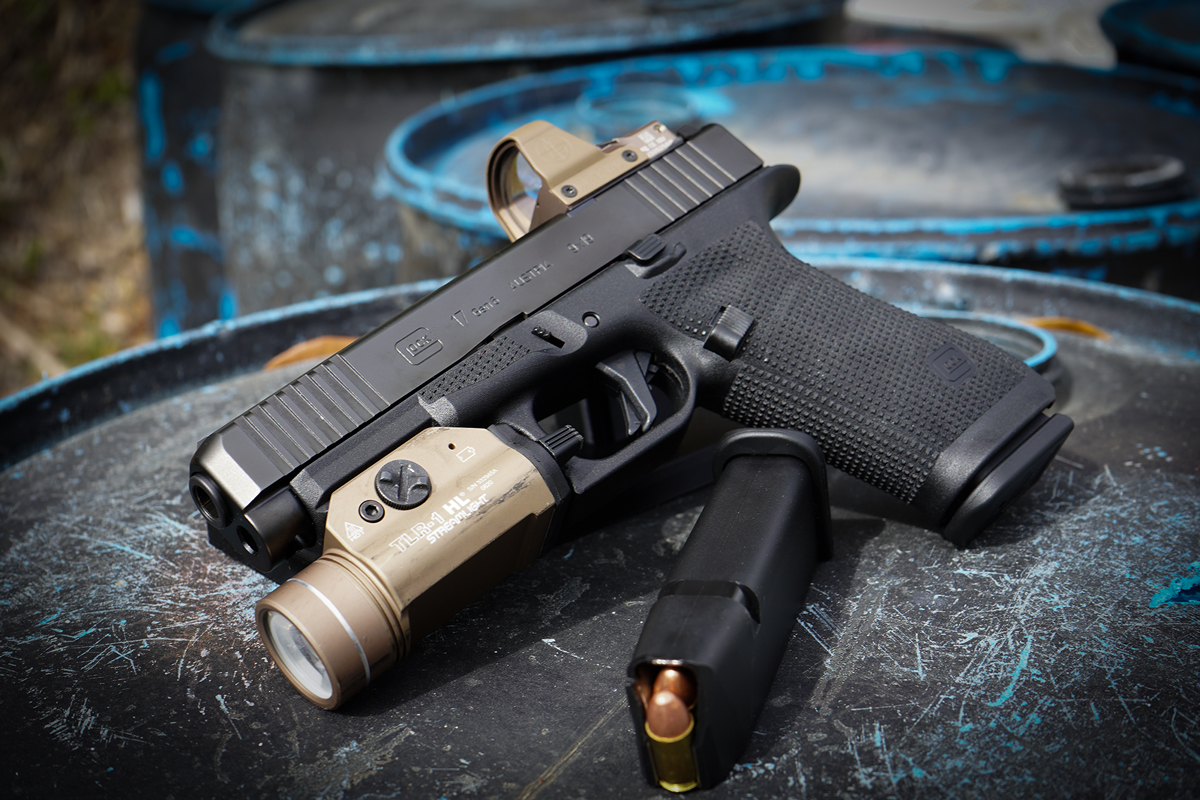

Maryland Democrats are not stopping at banning illegal Glock switches. They are moving to ban the sale and transfer of common striker-fired handguns used by countless law-abiding Americans, and now the opposition is starting to line up. NSSF said Monday it is prepared to take legal action if Gov. Wes Moore signs the legislation, while Maryland Shall Issue and NRA-ILA have already been warning that the bill sweeps far beyond criminals and squarely at ordinary gun owners.
The Maryland bill at the center of the fight is SB 334, cross-filed as HB 577. According to the Maryland General Assembly, the legislation would, beginning January 1, 2027, prohibit the manufacture, sale, offer for sale, purchase, receipt, or transfer of a “machine gun convertible pistol,” while directing the Department of State Police to publish a list of prohibited models. The bill passed the Senate 28-16 on March 19 and the House 92-39 on April 8 before heading to the governor.
Maryland lawmakers are not merely punishing possession of illegal conversion devices. Those devices are already illegal under federal law. Importing, possessing, making, or selling a machinegun conversion device can bring up to 10 years in prison and up to a $250,000 fine. Instead of hammering criminals who use illegal switches, Maryland is trying to choke off access to a whole class of commonly owned handguns.
NSSF did not mince words. The trade group said it is prepared to sue if Moore signs the bill, arguing that Maryland would be banning “the most popular selling handguns” by loosely defining them as “machine gun convertible pistols.”
NSSF’s release also stressed that the proposed prohibition would cover the same general style of pistols carried by Maryland State Police and the Baltimore Police Department, even while law enforcement is exempt from the ban. That is the usual anti-gun formula: deny the public what the government still insists its own agents need.
Maryland Shall Issue has been making a similar case from inside the state. In formal written testimony opposing SB 334 and HB 577, MSI President Mark Pennak argued the bill targets Glock-pattern pistols through the “cruciform trigger bar” language and warned that the definition reaches beyond criminals who misuse illegal devices. The revised fiscal note confirms the bill contains explicit carveouts for current law enforcement, qualifying retired law enforcement, and several transfer exceptions, including immediate-family transfers and temporary servicing by dealers or gunsmiths.
NRA-ILA has also been publicly urging opposition, warning that SB 334 and HB 577 use “vague and overly broad language” that could sweep in many commonly owned semiautomatic handguns, including Glock pistols, even though the underlying conversion devices are already illegal. After final passage, NRA-ILA urged Maryland gun owners to contact Gov. Moore and demand a veto.
Maryland is not acting alone, and anti-gun supporters of SB 334 openly told lawmakers the bill “follows the model recently enacted in California.”
Live Inventory Price Checker
California already passed AB 1127, which takes effect July 1, 2026, and prohibits licensed dealers from selling or transferring “semiautomatic machinegun-convertible pistols.” NSSF has already issued a compliance alert to members on California’s law, and NRA-ILA says it has already challenged that statute in court alongside Firearms Policy Coalition, the Second Amendment Foundation, a retailer, and individual plaintiffs in Jaymes v. Bonta.
California’s law is especially revealing because it shows exactly where this strategy goes. The state did not stop at banning illegal switches. It created a separate legal category for pistols with a cruciform trigger bar and imposed dealer-transfer restrictions, while still preserving exceptions for law enforcement, the military, private-party transfers, repairs, and preexisting dealer inventory under certain conditions.
In other words, anti-gun lawmakers are building a framework to wall off common handguns from the retail market while pretending they are only addressing criminal conversion devices.
If anti-gun states can use the criminal misuse of illegal add-on parts as the excuse to ban ordinary semiautomatic pistols in common use, they will do it again and again.
California already has. Maryland wants to be next.
These are some of the most common handguns in America, owned by millions of law-abiding citizens for self-defense, concealed carry, home protection, and everyday lawful use. Under Heller, arms that are in common use for lawful purposes sit at the core of the Second Amendment’s protection, not somewhere out on the fringe waiting for state approval.
Anti-gun lawmakers are trying to exploit the criminal misuse of illegal conversion devices as a pretext to cut ordinary Americans off from some of the most popular pistols on the market. If a state can point to criminal abuse of an already-illegal accessory and use that as an excuse to ban common handguns, then no widely owned firearm is truly safe from the next manufactured “public safety” rationale.
About Duncan Johnson:
Duncan Johnson is a lifelong firearms enthusiast and unwavering defender of the Second Amendment—where “shall not be infringed” means exactly what it says. A graduate of George Mason University, he enjoys competing in local USPSA and multi-gun competitions whenever he’s not covering the latest in gun rights and firearm policy. Duncan is a regular contributor to AmmoLand News and serves as part of the editorial team responsible for AmmoLand’s daily gun-rights reporting and industry coverage.