
The 1911 has now been with us for a century and a decade. Throughout that lifespan, there’s been no point at which it was not beloved by huge numbers of soldiers, law enforcement agents, and civilian shooters. Astonishingly, perhaps implausibly, the 1911 remains a darling of serious pistoleros: attend any defensive pistol course, and one will find it in the holsters of students and instructors alike.

The reason is not hard to ascertain. Most of the 1911’s design elements persist into the modern era due to indisputable merit. Its grip angle works for an overwhelming majority of users. The thumb button magazine release is right where we want it. I’d also be remiss not to mention that the 1911’s sliding trigger system continues to produce one of the crispest triggers possible.
Of course, there’s another signature element of the 1911 we don’t tend to talk about quite as much: the grip safety. Even the newest derivations of the 1911 incorporate it, including Springfield Armory’s TRP and Prodigy lines of pistols.

That said, it’s a part that invites a serious question: in a world where John Browning’s Model of 1911 is seen by many people as being as close to a perfect tool as possible, why don’t we see a grip safety incorporated into more pistols?
First, a Little History
Handgun scholars will note that the 1911 was not Browning’s first model to incorporate a grip safety. One can find grip safeties on the “Pocket Hammerless” models of 1903 and 1908, for example.
Fun fact: these guns did in fact have hammers, making the name something of a misnomer. However, their hammers were completely enclosed by the slide, and the operator would have no means of lowering them into a “half-cock” notch. Browning thought it prudent for these pistols to have some additional mechanism to prevent unintentional discharges, and so the grip safety was born.

When Browning submitted designs to the military for the famous pistol trials of 1907, he thought anything beyond an exposed hammer with a half-cock notch to be unnecessary. The United States Cavalry, a major stakeholder in those tests, thought otherwise. The department envisioned a good number of their horseback riders dropping or fumbling their service pistols and wanted a design that would minimize the fallout of such invariable “oopsies.”

As a result, the government placed an order for more of Browning’s guns to evaluate — provided their requested revisions were made. Chief among them was some form of “automatic” safety that would engage whenever the end user was not in the active process of shooting the gun, such as if it were holstered or dangling at the end of a lanyard. Such is the genesis of how a grip safety found its way onto the Model of 1911.
Clear Benefits
It’s hard not to see the grip safeties of Browning’s early pistols as further evidence of his ingenuity. The grip safety’s sole function on a 1911 is to block movement of the trigger bow. Only when the part is depressed can the trigger move rearward and engage the disconnector and sear.

The design’s primary benefit comes from Browning’s understanding of how human beings interface with a pistol. Pick the gun up and ready it in a firing grip, and it’s going to be hard not to depress the safety as the fingers of the hand curl around the firearm. It becomes exceptionally difficult not to engage the grip safety if the gun is fired one-handed, as was the prevailing methodology of Browning’s time.
Even today, the 1911 grip safety is something that most users do not have to think about. It will engage if the firearm is in a holster or laying on a table, and will disengage when the firearm is naturally settled into the web of the hand.

Live The Armory Life. The latest content straight to your inbox plus an automatic entry to each of our monthly gun giveaways!
It wasn’t designed to be the primary mode of rendering a pistol safe when not in use. However, in tandem with other mechanisms, it adds one additional layer of passive reassurance.
Why Don’t We See It More Often?
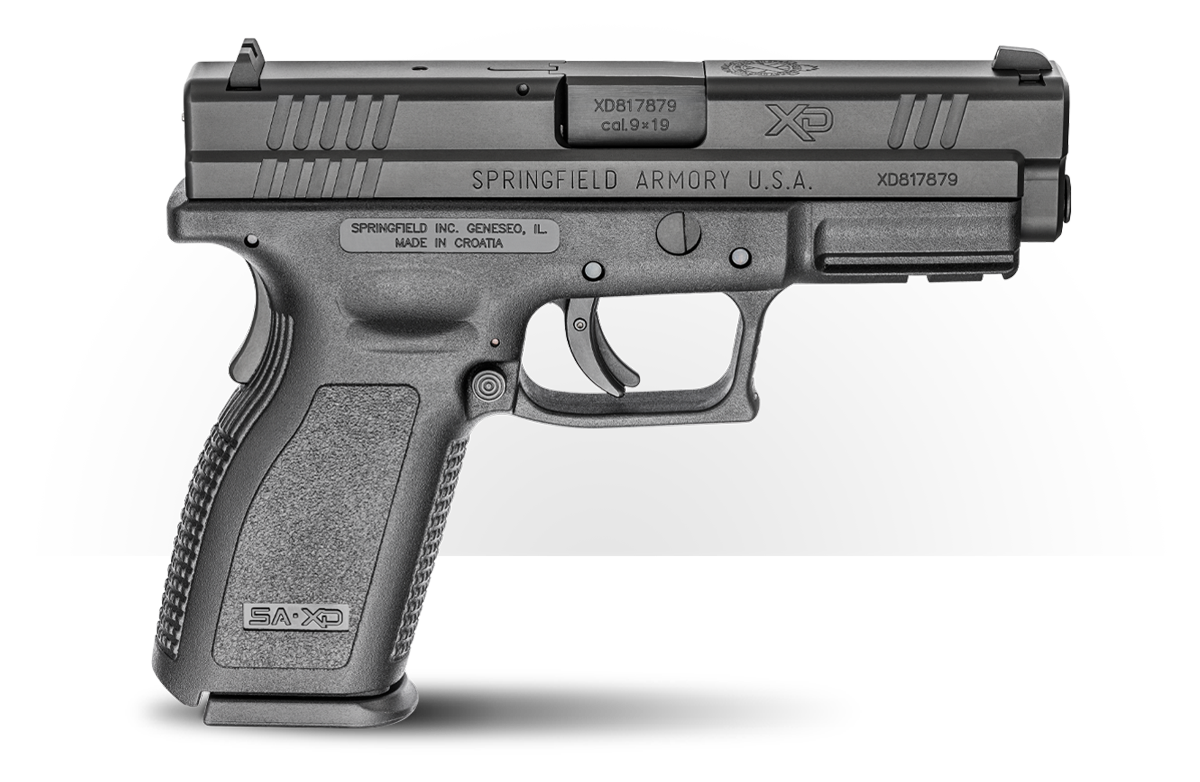
There are indeed a few other models that incorporate a grip safety beyond the 1911 family tree. You’ll find the several of them within the Springfield Armory catalog, in fact: the XD, XD-S and XD-M pistols have grip safeties. While they’re more complex in function than Browning’s original design, the basic principle and philosophy of use remains the same.

Past that? The famous Uzi submachine gun utilizes a grip safety. So too do a few relatively obscure target pistols, the Savage 1907 that originally competed against Browning’s 1911 in those early military trials, and a number of Lugers manufactured for the commercial market. There may be a few other designs that escape my memory, but I promise there aren’t many.
The primary reason for this state of affairs is that the market has figured out a similar way to achieve the same benefit as Browning’s original design. In specific, the trigger or “blade” safety accomplishes much the same benefit as the grip safety: when depressed, it allows the trigger to move to the rear. If the trigger safety is not engaged, the body of the trigger is effectively frozen in its rearward travel.

To this, some will opine: “What good is a safety if it’s located on the trigger?”
I counter that most of the trigger safeties on the market are similar in role to the 1911’s grip safety: they’re not meant to be the only thing preventing an accidental discharge, but simply one more passive feature — often in tandem with drop safeties, firing pin blocks, and manual safety latches, and even a grip safety as on the XD pistols.
Avoiding Gremlins
As pistolcraft has evolved, shooters have experimented with a number of different grips in an effort to better drive the gun and mitigate recoil. As part of that evolution, some shooters found themselves getting into trouble with respect to the 1911.

Somewhere around the 1960s to 1970s, the “high thumbs” grip became more popular. Rather than curling the thumb somewhere around the topmost grip screw, an increasing number of shooters began riding the thumb safety. (This also had the benefit of ensuring that under recoil, the 1911 wouldn’t have its “off switch” unintentionally bumped.)
For a few shooters, however, this moved the heel of the hand backwards and created a possibility that the grip safety would not engage. Some of the early gunsmiths that specialized in custom 1911 work, including Armand Swenson and Ed Brown, began to modify the grip safety with a “memory bump,” elongating the base of the part and ensuring easier contact.
Today, there are far more 1911’s in the Springfield Armory catalog that incorporate this design change than those that go without it. In fact, the only place one is likely to encounter its omission is when shopping for a G.I.-spec, deliberately “historical” 1911 — here, an extended beavertail grip safety is an unwanted historical anachronism.
My Thoughts?
Personally, I like the 1911 grip safety system. For all of my pistol shooting career, step one has been to establish my presentation by having the web of my right hand coming straight down high on the gun’s backstrap. I’ve shot about 50 different flavors of 1911’s on my time on this planet with nary a hiccup. Similarly, my XD’s have never given me a single issue.

That said, and where any safeties that could be described as “passive” or “automatic” are concerned, there’s more than one way to address the issue. I do think the 1911 grip safety is one more invention that evidences the genius of John Browning, but the hundred-plus years since the 1911’s introduction have surfaced a number of similarly excellent solutions — in particular, the “blade” style trigger safety that has become ubiquitous.
To be honest, I don’t think the 1911 grip safety is necessarily better or worse than what has increasingly come to replace it. And, you could argue it’s part of the charm of the classic design!
Editor’s Note: Please be sure to check out The Armory Life Forum, where you can comment about our daily articles, as well as just talk guns and gear. Click the “Go To Forum Thread” link below to jump in and discuss this article and much more!