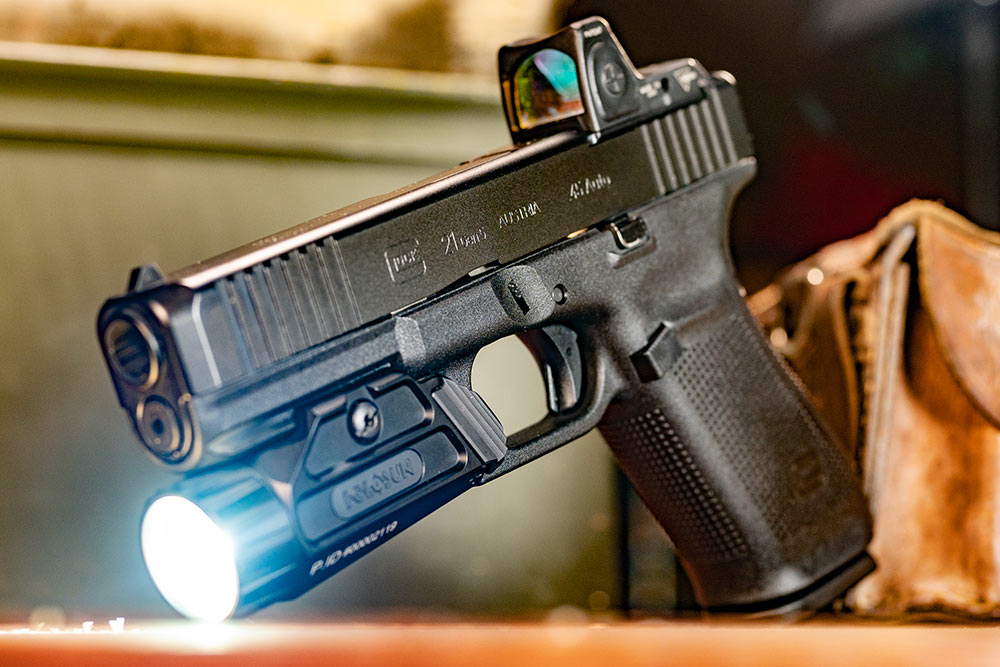


The Connecticut House of Representatives voted 86 to 64 on April 22, 2026 to pass HB 5043, legislation that would effectively ban the sale of Glock handguns and similarly designed striker-fired pistols in the state. All House Republicans and 15 Democrats voted against the measure.
Gov. Ned Lamont introduced the bill on February 5, 2026, as a governor’s bill pursuant to Joint Rule 9. He held a press conference promoting the legislation in early March and has expressed his intent to sign it. Key legislative supporters include Rep. Steven Stafstrom of Bridgeport, who led the floor debate, along with Rep. Eleni Kavros DeGraw, Rep. Josh Elliott, Sen. Derek Slap, and Sen. Martha Marx.
The bill bans the future sale, importation, distribution, and advertising of “convertible pistols” in Connecticut. The legislation defines a convertible pistol as “any semiautomatic pistol with a cruciform trigger bar that can be readily converted by hand or with a common household tool into a machine gun solely by the installation or attachment of a pistol converter.”
This definition targets Glock handguns and similarly designed striker-fired pistols, which are among the most popular handguns in the United States. Violations would be classified as a Class D felony punishable by up to five years in prison and a $5,000 fine.
The ban would take effect on October 1, 2026, under the current House-passed version. Current Glock owners could keep their firearms and sell them privately. The bill also redefines unfinished frames and receivers as firearms to target ghost guns and strengthens existing bans on bump stocks.
The stated rationale is to pressure manufacturers like Glock to redesign their pistols. Hartford police seized 51 modified Glocks between 2023 and 2024, and one such weapon was used in the killing of a 20-year-old woman and her 4-year-old son. Lamont noted that Glock already sells a modified version in Germany that is harder to convert.
Second Amendment supporters have raised serious objections. The NRA-ILA called the bill “draconian” and warned it is “on shaky constitutional footing.” The organization noted that since Glock is the most commonly owned handgun in the nation for self-defense, banning its sale is constitutionally suspect under District of Columbia v. Heller, which protects arms “in common use.”
Rep. Craig Fishbein stated, “‘Shall not be infringed’ still appears in the U.S. Constitution… I own firearms capable of being converted… None of them have been converted into machine guns.”
Rep. Doug Dubitsky raised the alarm that if the rationale of banning any firearm capable of illegal modification is accepted, it could logically extend to all semi-automatic handguns.
Rep. Greg Howard pointed out that even Glock’s redesigned V-series was found to be convertible within days of its release. “For as long as human ingenuity is going to exist… somebody, somewhere is going to find a way to manufacture, design something that can overcome the reset cycle of a pistol and make it fully automatic,” Howard argued.
House Minority Leader Vin Candelora argued the bill will not reduce violence. “They could pass every law in the books to regulate guns and restrict guns and prohibit the purchase of guns — it doesn’t actually accomplish, I think, what we want to see, and that is a reduction of gun violence.”
Opposition was overwhelming. Critics also noted that convertible pistols could still be legally purchased out of state and brought into Connecticut, and that no law enforcement exemption exists for police departments to purchase new Glocks. The NRA is already challenging California’s nearly identical law in Jaymes v. Bonta and has signaled it will pursue the same challenge if Connecticut’s law is signed.
The bill now heads to the state Senate, where it is widely expected to pass easily. If signed, Connecticut would become the third state, after California and Maryland, to effectively ban Glock sales based on the convertible pistol framework.
If Gov. Lamont signs HB 5043 into law, Connecticut residents will lose access to the most popular defensive handgun in America based on the theoretical possibility that criminals might illegally modify it. The legislation punishes law-abiding citizens for the actions of criminals who are already violating federal law by possessing machine gun conversion devices.
This bill sets a dangerous precedent that could be used to justify banning virtually any semi-automatic firearm on the grounds that some aftermarket part might someday be invented to modify it. Connecticut gun owners should recognize this for what it is: another step in the incremental disarmament of the American people disguised as a public safety measure.
NSSF, Gun Rights Groups Oppose Maryland’s New Glock-Style Pistol Ban
About José Niño
José Niño is a freelance writer based in Charlotte, North Carolina. You can contact him via Facebook and X/Twitter. Subscribe to his Substack newsletter by visiting “Jose Nino Unfiltered” on Substack.com.