

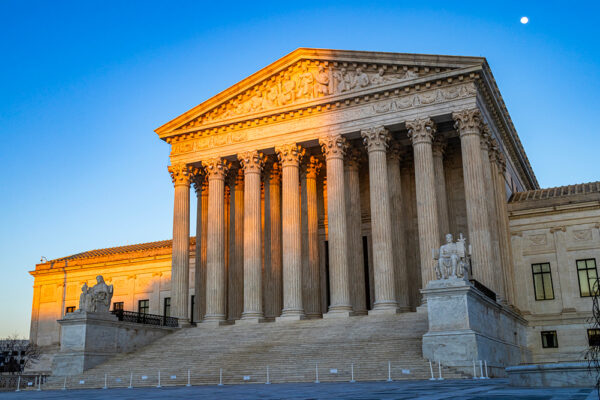
The 2025–2026 Supreme Court term marks a decisive juncture in the post-Bruen era. While administrative agencies and state legislatures have sought to circumvent the High Court’s mandates through regulatory “lawfare,” the current docket presents a fundamental challenge to these tactics. The Court is already considering major Second Amendment questions involving public carry and prohibited-person statutes, while pending cert petitions and lower-court litigation could tee up the next fights over common-use arms and NFA registration.
The current Supreme Court docket and related lower-court litigation could define the next phase of post-Bruen Second Amendment law: public carry, prohibited-person statutes, common-use arms, and the future of NFA registration after the tax was reduced to zero.
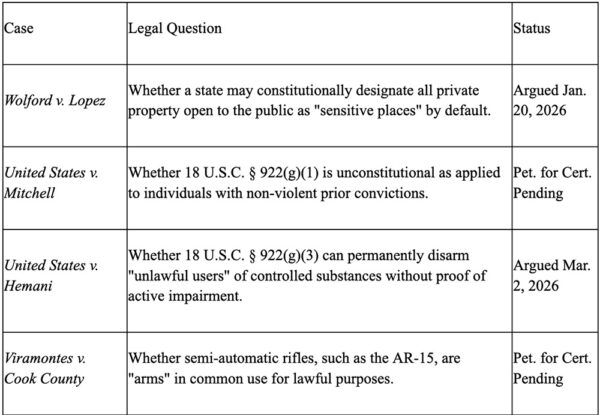
Key Firearms Cases: 2025–2026 Supreme Court Term
Case Synopses and Legal Analysis
I. The “Sensitive Places” Doctrine and Public Carry
Wolford v. Lopez – (Argued on Jan. 20, 2026).
Synopsis: Petitioners challenge Hawaii’s Act 52, which establishes a “default rule” prohibiting the carrying of firearms on all private property open to the public unless the owner provides express authorization.
Legal Analysis: This “Vampire Rule” effectively nullifies the right to “bear” arms by rendering it a presumptive trespass. The Court is tasked with deciding if such a broad-brush designation violates the standard set in N.Y. State Rifle & Pistol Ass’n, Inc. v. Bruen, 597 U.S. 1 (2022). The case could also give the Court another opportunity to address how lower courts should weigh Founding-era and Reconstruction-era history when applying Bruen.
II. The Scope of “The People” and Prohibited Persons
United States v. Mitchell (U.S. pet. for cert. filed) & United States v. Hemani (Argued on March 2, 2026).
Synopsis: These cases represent a pincer movement against the categorical disarmament of citizens under § 922(g). United States v. Mitchell involves a § 922(g)(1) felon-in-possession prosecution where the predicate felony was a prior § 922(g)(3) unlawful-user firearms conviction. The government has asked the Court to hold the case pending Hemani.
Legal Analysis: Following United States v. Rahimi, 602 U.S. 574 (2024), the government must prove a “history and tradition” for disarming individuals. In Hemani, the Court is exploring whether “habitual use” of a substance, absent a showing of physical dangerousness, is a constitutionally sufficient basis for total disarmament. This will determine whether the Second Amendment’s protections extend to all “People” who are not demonstrably “dangerous” to others.
III. Hardware Bans and “Common Use”
Viramontes v. Cook County – (U.S. pet. for cert. filed).
Synopsis: Viramontes v. Cook County challenges Cook County’s ban on so-called “assault weapons,” including AR-15-platform and similar semiautomatic rifles. The petition asks whether these commonly owned firearms are protected “arms” under the Second Amendment and whether local governments may ban them by labeling them unusually dangerous or militaristic. The case remains at the certiorari stage, meaning the Supreme Court has not yet agreed to hear it. If review is granted, Viramontes could become a major vehicle for deciding whether bans on modern semiautomatic rifles can survive Heller, Bruen, and the “common use” doctrine.
Legal Analysis: This case provides the Court an opportunity to reinforce the “Common Use” test established in District of Columbia v. Heller, 554 U.S. 570 (2008). It aims to settle the debate finally: modern semi-automatic rifles are “arms” protected by the Second Amendment text, regardless of aesthetic features or administrative labels.
Related Lower-Court NFA Litigation – The NFA and the Administrative State
Roberts v. ATF, No. 2:26-cv-91-SCM — filed Feb. 26, 2026, in the Eastern District of Kentucky.
Synopsis: I serve as counsel of record in this pivotal litigation filed on behalf of the Buckeye Firearms Association, alongside a broad coalition including the American Suppressor Association Foundation (ASAF), Jews for the Preservation of Firearms Ownership (JPFO), and individual citizens.
Legal Analysis: We submit that the ATF has exceeded its statutory authority under the National Firearms Act (NFA). Specifically, we argue that the NFA’s registration requirements for Short Barreled Rifles (SBRs) and suppressors, historically justified as a tax-collection mechanism—are unconstitutional now that the associated excise taxes have been zeroed out. In a post-Chevron environment, the administrative state lacks the “taxing power” cover to maintain a registry of constitutionally protected hardware.
Conclusion: The Front Lines of Liberty
For the American firearm owner, the landscape has shifted from defending the existence of the right to policing the boundaries of government power. Furthermore, the precedent in NRA v. Vullo, 602 U.S. 175 (2024), now acts as a vital shield, preventing state regulators from using administrative coercion to bankrupt the very organizations fighting these legal battles.
As Justice Thomas noted in Bruen, the Second Amendment is not a “second-class right.” The decisions expected in mid-2026 will likely cement this principle, ensuring that constitutional guarantees are not subjected to the whims of the administrative state.
“As the Supreme Court moves toward its final releases of the 2025–2026 term, the landscape of the Second Amendment is shifting in real-time. I will be monitoring the High Court’s orders and opinion drops daily, providing legal analysis and comprehensive follow-up articles as each of these landmark decisions is handed down. Stay tuned as we break down what these rulings mean for your rights, your hardware, and the future of American liberty.”
Nationwide Concealed Carry for ‘Elite’ Veterans Will Create a New Class of ‘Only Ones’
About Sean Maloney
Sean Maloney is a criminal defense attorney, co-founder of Second Call Defense, and an NRA-certified firearms instructor. He is a nationally recognized speaker on critical topics, including the Second Amendment, self-defense, the use of lethal force, and concealed carry. Sean has worked on numerous use-of-force and self-defense cases and has personally trained hundreds of civilians to respond safely and legally to life-threatening situations. He is a passionate advocate for restoring the cultural legitimacy of the Second Amendment and promoting personal responsibility in self-defense.