
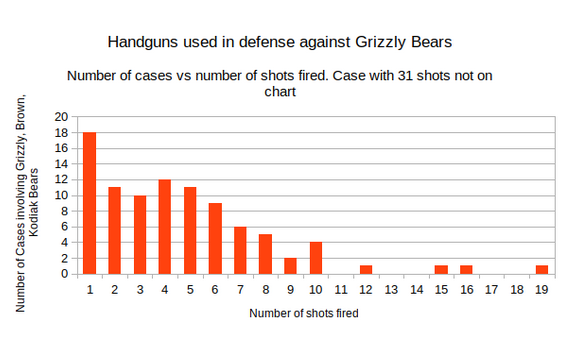
In the ongoing study of how effective handguns are when used as a defense against bears, this correspondent posted an article on AmmoLand showing the distribution of the number of shots fired vs the number of cases. The most common case was one shot fired, with the least common cases having the most shots fired. On examining the data, there is a significant difference noted among bear species.
In cases involving brown bears, grizzly bears, Kodiak bears, (ursus arctos) more shots are fired per case.
There are 109 total handgun-only cases involving Ursus arctos, of which 93 cases had known shot numbers. One case had an indeterminant outcome. There was a single failure. One case was indeterminant because both a handgun and bear spray were used, and it could not be determined which weapon was decisive.
As in the previous article, the largest number of cases involved one shot fired, but the percentages differed for brown bears. As in the previous article, unavoidable selection bias will tend to exclude successful warning shots, because many will not consider it necessary to report incidents in which no bear or human was injured. Of the 93 cases where the number of shots fired is known or reasonably inferred, the distribution is as follows:
1 shot – 18 cases or 19.4% of the cases where the number of shots is known. 5 cases involved a warning shot(s). 4 of the warning shot cases were successful. In one case where one handgun shot was fired, killing the bear, two warning shots were fired with a .22 rimfire rifle. Those shots were unsuccessful. It was decided to include the case because the .22 rifle shots were not effective and not aimed at the bear.
2 shots – 11 cases or 11.8% of cases where the number of shots is known. 8 cases involved warnings shots. There were 5 cases where the warning shots were successful, in 2 of those cases, the success was temporary. There were 4 cases where warning shots 4 were unsuccessful, in one case the effect of warning shot(s) was unknown, 1 case had an indeterminate outcome.
3 shots – 10 cases or 10.8% of cases where the number of shots is known. In 1 case warning shots were successful. In one case the defensive firing of shots failed, involving a .357 magnum in Alaska.
4 shots – 12 or 12.9% of cases where the number of shots is known. Two cases involved warning shots. 1 was temporarily successful and 2 were unsuccessful. In two cases, two handguns were involved.
5 shots – 11 or 11.8% of cases where the number of shots is known. 3 cases involved warning shots, 2 were successful, 1 temporarily, 2 unsuccessful.
6 shots – 9 or 9.7% of cases where the number of shots is known. 3 warning shots cases were successful, 1 temporarily, 1 unsuccessful.
69 cases of six shots or less, or 76.3% of the total for Grizzly bears, where the number of shots is known.
7 shots – 6 cases or 6.5% of cases where the number of shots is known. 1 case involved a warning shot case, which was temporarily successful and then unsuccessful.
8 shots – 5 cases or 5.4% of cases where the number of shots is known. No warning shot cases
9 shots – 2 cases or 2.2% of cases where the number of shots is known. No warning shot cases
10 shots 4 cases or 4.3% of cases where the number of shots is known. 1 warning shot case, unsuccessful.
12 shots 1 case or 1.1% of cases where the number of shots is known. No warning shots
15 shots 1 case or 1.1% of cases where the number of shots is known. No warning shots
16 shots 1 case or 1.1% of cases where the number of shots is known. No warning shots, 2 handguns were involved.
19 shots 1 case or 1.1% of cases where the number of shots is known. No warning shots, 3 handguns were involved.
31 shots 1 case or 1.1% of cases where the number of shots is known. No warning shots, 2 handguns were involved.
There were no cases where 11, 13, 14, 17, 18, or 20-30 shots were fired in the cases documented at the time of this writing.
There were 16 cases in which the number of shots was unknown. There were 3 warning shot cases, 1 successful, 1 unsuccessful, and 1 unknown. In two of the cases, more than one handgun was involved.
It is not surprising that brown, grizzly, and Kodiak (Ursus arctos) bears take more shots per case. The difference is not tremendously large compared to the total. But Ursus arctos accounts for the majority of cases, which skews the results toward those numbers. In the future, we will look at the numbers for black bears and polar bears. In both cases, the number of shots per case is significantly lower than for Ursus arctos.
If you wish to read about each case individually, they are available from the following links:
Last full list, published on June 2021, 104 incidents.
First update, April 11, 2022; Eleven additional cases, March 16, 2022; Second update, November 21, 2023; Third update, May 8, 2024; Fourth update, October 22, 2025.
We are always looking for more cases, especially cases where a handgun was fired in defense against a bear or bears failed. If you know of such a case, please contact AmmoLand.
Handgun or Pistol Against Bear Attacks 104 cases, 97% Effective
About Dean Weingarten:
Dean Weingarten has been a peace officer, a military officer, was on the University of Wisconsin Pistol Team for four years, and was first certified to teach firearms safety in 1973. He taught the Arizona concealed carry course for fifteen years until the goal of Constitutional Carry was attained. He has degrees in meteorology and mining engineering, and retired from the Department of Defense after a 30 year career in Army Research, Development, Testing, and Evaluation.