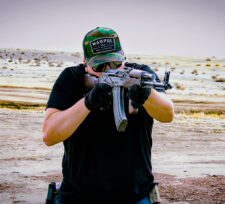

The en banc Ninth Circuit heard argument in Baird v. Bonta, and California’s position came through loud and clear: the state believes it can criminalize open carry so long as it leaves gun owners with a government-permission slip for concealed carry.
Mark Baird is challenging California Penal Code sections 25850 and 26350, which restrict the open carry of firearms. A Ninth Circuit three-judge panel previously ruled that California’s open-carry ban in counties with more than 200,000 people violated the Second Amendment. California then sought rehearing en banc, and the full court has now taken up the fight.
Baird’s attorney, Amy Bellantoni, opened by asking the court to reverse the district court and enter judgment for Baird.
“The district court never addressed the threshold constitutional defect in this case,” Bellantoni argued. That defect, she said, is California’s “criminalization of presumptively protected conduct” under the Second Amendment.
She told the court the challenged statutes “criminalize presumptively protected conduct protected by the Second Amendment right to bear arms.” When asked whether concealed carry is also protected, Bellantoni answered that the conduct at issue is public carry, while making clear that this case is focused on open carry.
“I would say it’s presumptively protected because the plaintiff’s proposed conduct is to carry in public,” she said.
California’s lawyer, Samuel Harbert, predictably, took the opposite approach. He argued that Bruen allows states to regulate the “manner of carry” so long as they do not ban public carry altogether.
California’s argument is that the state is not destroying the right to bear arms because licensed concealed carry remains available.
“Far from prohibiting public carry altogether,” Harbert argued, “California law allows for licensed concealed carry in every county across the state.”
That answer did not go unchallenged. Judge Nelson asked how many concealed carry licenses California has issued.
“For concealed carry? I’m not sure, Your Honor,” Harbert answered.
California wants the court to accept its limited “shall-issue” concealed carry license as a substitute for open carry, but its lawyer could not tell the court how many people are actually getting licenses.
The court also spent considerable time on the procedural posture of the case. Judges pressed Bellantoni on whether Baird was bringing a facial challenge, an as-applied challenge, or something in between. Bellantoni emphasized that the case is not a challenge to one sheriff’s licensing decision, but a challenge to criminal statutes as they apply to open carry.
“This is not a licensing challenge,” she said. “This is a challenge to criminal statutes.”
California argued that Baird is seeking facial relief, which would trigger a tougher standard. Harbert said California views the test as the Salerno “all applications” standard. That issue could give the en banc court an off-ramp if it wants to avoid directly admitting that California’s historical argument is weak.
The strongest part of Baird’s case came in history. Bellantoni argued that even if Bruen allows one form of carry to be regulated, the historical tradition supports restrictions on concealed carry, not open carry.
“There’s no longstanding tradition of affecting or infringing on or regulating the open carriage of weapons,” she told the court.
That is the problem California cannot get around. The historical record goes against the state. Old laws and cases disfavored concealed carry because it was seen as stealthy. Open carry was the accepted mode of bearing arms. California is now trying to flip that tradition upside down.
Judge Lee pressed California hard on that point. He noted that “open carry was not regulated at all in the founding era or post-14th Amendment,” while concealed carry was restricted. He later pointed out the obvious distinction: “One was regulated, one was not.”
California’s response was to broaden the level of generality. Harbert argued that under Rahimi, courts should not look for a perfect historical twin but should instead identify a broader principle. The broader principle California wants is that governments historically regulated the manner of carry.
That kind of argument is exactly how anti-gun states try to water down Bruen. If the government can define the historical tradition broadly enough, almost any modern restriction can be squeezed into some vague category of “regulation.”
When asked whether California treats open carry and concealed carry as essentially interchangeable, Harbert answered, “I think that is the practical consequence of our view.”
California does not have a founding-era tradition of banning peaceable open carry. Instead, it wants the court to say concealed carry is good enough, and therefore open carry can be criminalized.
California also leaned on public safety. Harbert argued that modern firearms are “far more dangerous,” “more accurate,” and “more fast-loading.” He also argued open carry creates problems for police responding to shootings because officers must quickly determine “who the bad guys are and who the good guys are.”
Bellantoni rejected that kind of interest balancing on rebuttal.
“The Supreme Court has been very clear that the interest balancing took place at the time that the Second Amendment was ratified,” she said. “This Court respectfully cannot consider public safety concerns.”
In closing, Bellantoni noted that open carry went unregulated in California for 117 years after statehood.
“That just leaves us with no protected right at all if the government can just flip-flop on exactly what the right means,” she argued.
If the Second Amendment protects the right to bear arms, and the historical record protects open carry rather than banning it, then California should not be allowed to criminalize open carry by pointing to concealed carry as a government-approved substitute.
California’s entire theory depends on stretching Bruen beyond what the Supreme Court actually said. The state insists Bruen, through footnote 9, allows a government to “lawfully eliminate one kind of public carry,” so long as another form remains available. But that language came in the context of historical restrictions on concealed carry and modern shall-issue licensing, not a green light for states to criminalize open carry.
Baird’s counsel correctly pointed out that the historical examples discussed in Bruen involved concealed weapons, which were viewed as stealthy and dangerous, while open carry was treated as the protected and accepted mode of bearing arms.
California’s reading turns that history on its head. It takes a discussion about concealed-carry restrictions and converts it into permission to ban open carry, even though the state could not identify a comparable historical tradition of banning peaceable open carry. That is not applying Bruen; it is rewriting it.
The case is now submitted. The Second Amendment Foundation, watching the argument live and posting a thread on X, was not optimistic. SAF’s thread suggested the vote count may be “maybe 3 votes for Baird, 4 at very best,” calling it a “likely loss.” That is only a prediction, not a ruling, but it tracks the danger in this case. The Ninth Circuit may use the facial-challenge issue or California’s broad “manner of carry” theory to uphold the ban.
If that happens, the transcript will still clearly show the issue. Baird had the history. Under Bruen, that should matter. Whether the en banc Ninth Circuit will let it matter is the question gun owners are now waiting to see answered.
Virginia Prosecutors Refuse to Enforce Spanberger’s Gun Ban — and They’re Dead Right
About Duncan Johnson:
Duncan Johnson is a lifelong firearms enthusiast and unwavering defender of the Second Amendment—where “shall not be infringed” means exactly what it says. A graduate of George Mason University, he enjoys competing in local USPSA and multi-gun competitions whenever he’s not covering the latest in gun rights and firearm policy. Duncan is a regular contributor to AmmoLand News and serves as part of the editorial team responsible for AmmoLand’s daily gun-rights reporting and industry coverage.