

The Brief:
Demetrio Daga was convicted in Albany, New York, on 15 felony charges related to possessing and assembling unserialized, privately made firearms and 3D-printed gun components. The former real estate professional faces up to 40 years in prison under the state’s strict gun control statutes.
Trial proceedings revealed no evidence of violent behavior or illegal trafficking. Daga’s legal team claims he was unfairly targeted as part of a regional law enforcement test run, and they plan an immediate constitutional appeal following his formal sentencing.
ALBANY, NY — In 47 states across the country, building a personal firearm in a home workshop for private use is a lawful exercise of Second Amendment rights with deep historical roots. In New York, that exact same activity can result in a functional life sentence.
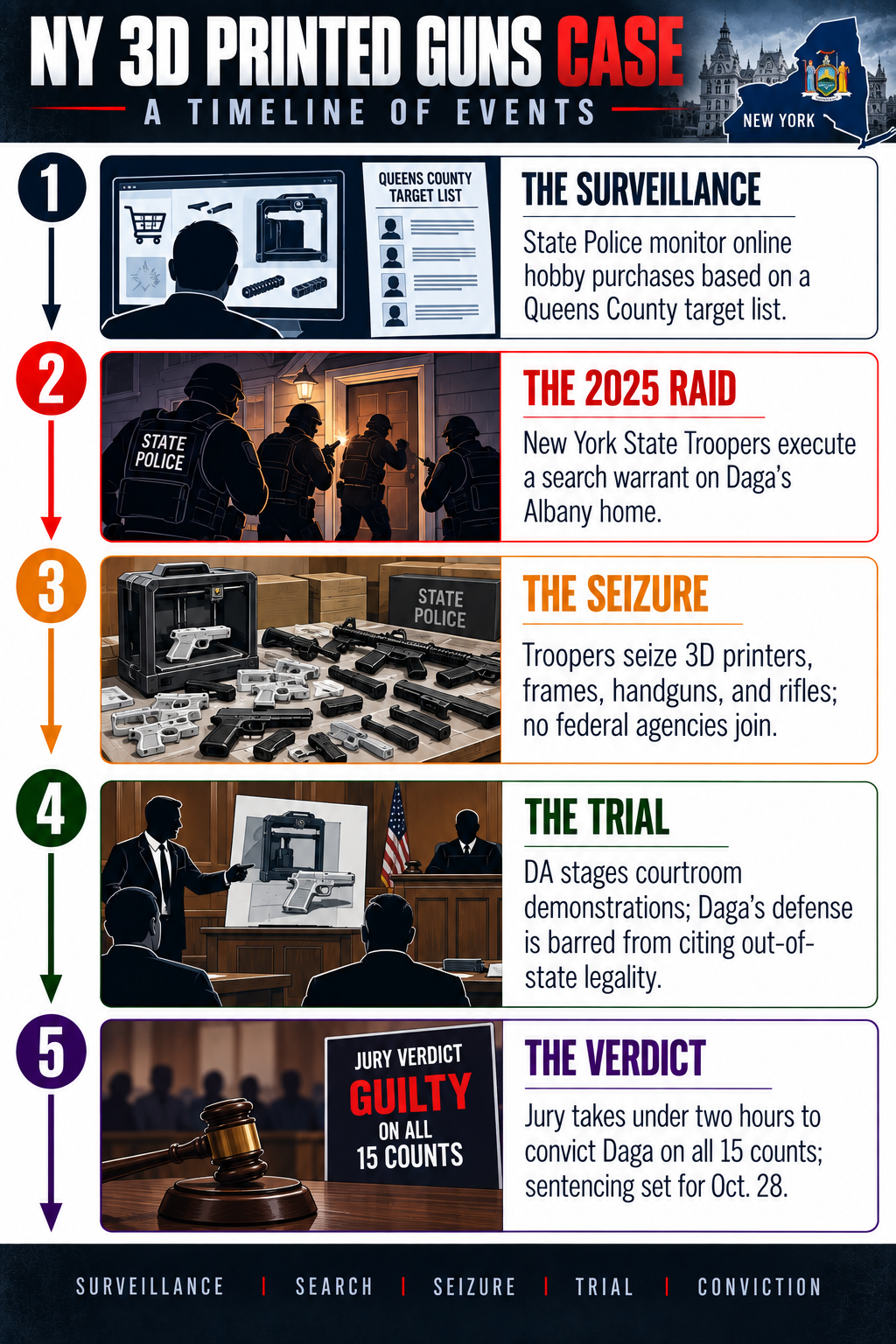
Demetrio Daga, 44, found that out firsthand last month inside an Albany County courtroom. Following a seven-day trial, an Albany jury deliberated for less than two hours before finding him guilty of all 15 state felony charges brought against him:
- One count of Criminal Possession of a Weapon in the First Degree
- Two counts of Criminal Possession of a Weapon in the Second Degree
- Three counts of Criminal Possession of a Weapon in the Third Degree
- Nine counts of Criminal Possession of a Firearm
With his formal sentencing date set for October 28, Daga remains in county custody facing a potential cumulative term of 40 years behind bars.
The “Arsenal” and Courtroom Theatrics
During closing arguments, Deputy Chief Assistant District Attorney Jessica Blain-Lewis framed Daga not simply as a hobbyist, but as a dangerous manufacturer.
“Demetrio Daga was buying and producing gun parts and building weapons in his home,” Blain-Lewis told jurors. “And he wasn’t just someone who builds guns, he was building an arsenal.”
To drive her point home to the jury, Blain-Lewis pulled out a box of ammunition and slowly poured the cartridges onto the courtroom floor. Blain-Lewis, who competed on the CBS reality series “Survivor: Millennials vs. Gen X” in 2016 and is known locally for pairing conservative courtroom attire with flamboyant footwear, did not call federal agents to testify. In fact, federal authorities completely bypassed the case.
The physical items seized by New York State Police during the 2025 search warrant included:
- 13 unserialized handguns
- 22 unserialized AR-pattern rifles
- 18 serialized AR-pattern rifles
- Two standard pump-action shotguns
- Multiple active 3D printers
- Approximately 200 3D-printed lower handgun receivers and rifle frames
- Standard-capacity magazines, ammunition, and assorted manufacturing tools
There was zero evidence or testimony presented during the trial indicating that Daga had ever threatened anyone, brandished a weapon, sold firearms unlawfully, or used any of the items in the commission of a violent crime. Under New York’s strict statutory scheme, the mere unlicensed possession and assembly of an unserialized firearm is treated as an egregious felony.
The “Test Run” Memo and Unequal Enforcement
The foundation of the case against Daga has drawn sharp criticism from his defense team, led by attorney Kevin O’Brien.
Records introduced during trial revealed that New York State Police began monitoring Daga following communications with the Queens County District Attorney’s Office. An investigator in Queens had emailed state police in Albany outlining a plan to expand enforcement models upstate:
“We’ll provide you with a list of 10-20 viable targets to focus your efforts on as we try to bring our ghost gun model to the Capital Region as a test run.”
According to O’Brien, the target list handed to troopers included prominent names, including former regional politicians and the son of an active local sheriff. Yet Daga and his legal team maintain that he was the only private citizen on that entire list who was raided and prosecuted by state authorities.
O’Brien argued that when troopers realized Daga had no ties to trafficking networks or street violence, they shopped the investigation to federal agencies. When federal prosecutors declined to pick up the case, state officials pressed forward with an aggressive local prosecution.
“Everything he purchased was legal. There were no illegal purchases, but it put him on a list,” O’Brien remarked during a recent appearance on the “Meet the Pressers” podcast. “I’ve had clients in the same court who have shot at cars with people in them, and they have been given probation or another chance. With Demetrio, they want to put him in a cage, and it makes no sense to me. This feels fully political.”
Voices from the Inside
Speaking from a recorded line at the county correctional facility, Daga described the profound emotional toll of his sudden incarceration.
“I am doing okay,” Daga said. “It’s all a bit of a shock for me, but it’s definitely not what my previous life was. That’s for sure. The one thing that kills me is being away from my family. That’s been the toughest part. My boys were my constant companions. The only time I get really upset is when thinking about them. I was mainly doing okay until my seven-year-old asked me when I was coming home. He said, ‘Life is not so regular without you here.’ That hit me like a freight train.”
Before his arrest, Daga worked as a residential and commercial real estate professional, having previously served his community as a police paddy wagon driver and a municipal 911 dispatcher. His mother, Domenica Greco, recalled his dedication to his household, noting that he had served as her primary caregiver while she underwent cancer treatments.
Daga voiced severe frustration with the trial process, noting that defense attorneys were barred by evidentiary rulings from informing jurors that the items he built are completely lawful in the vast majority of the country.
“We weren’t allowed to discuss how privately made firearms were legal in 47 other states,” Daga said. “These are our rights. The Constitution is the most beautiful document ever created and they’re perverting it. Everyone should be terrified of anyone trying to disarm you. You are your own First Responder.”
According to the defense team, one juror became visibly distraught after the verdict was entered, stating that had she understood the draconian mandatory minimum sentences attached to the state charges, she would never have voted to convict.
The Constitutional Dilemma
Legal scholars and gun rights advocates see Daga’s plight as a direct conflict between state legislation and the Supreme Court’s Second Amendment jurisprudence.
Kostas Moros, Director of Legal Research and Education for the Second Amendment Foundation, emphasized that federal constitutional protections are supposed to reign supreme over contradictory state codes:
“Article VI of the Constitution asserts that ‘This Constitution … shall be the supreme Law of the Land; and the Judges in every State shall be bound there.’ The right to keep and bear arms is no exception to that. As the Supreme Court explained in McDonald v. Chicago, the Second Amendment is not a second-class right, subject to an entirely different body of rules than the other Bill of Rights guarantees that we have held to be incorporated into the Due Process Clause. Where New York law conflicts with the Second Amendment, it is void.”
The situation echoes the case of Patrick “Tate” Adamiak, who was serving a 20-year federal prison sentence for nonviolent firearm-related charges until he was granted an executive pardon by President Donald Trump.
However, because Daga was tried and convicted exclusively under New York state statutes, a federal presidential pardon cannot help him. His only route to executive clemency lies in the hands of the Governor of New York, leaving an appellate constitutional challenge as his primary avenue for relief.
Daga’s defense team plans an immediate appeal following his formal sentencing on October 28.

