

The Brief:
A federal judge issued a preliminary injunction blocking Connecticut from enforcing a law that banned handguns with cruciform trigger bars. The statute targeted popular striker-fired pistols, like Glocks, by defining them as convertible pistols subject to felony sales prohibitions due to potential illegal modifications.
The court ruled that the state failed to show a historical tradition of banning common defensive firearms based on potential criminal misuse. With the enforcement stayed, lawful sales and transfers of these standard handguns can continue while litigation over the law’s constitutionality proceeds.
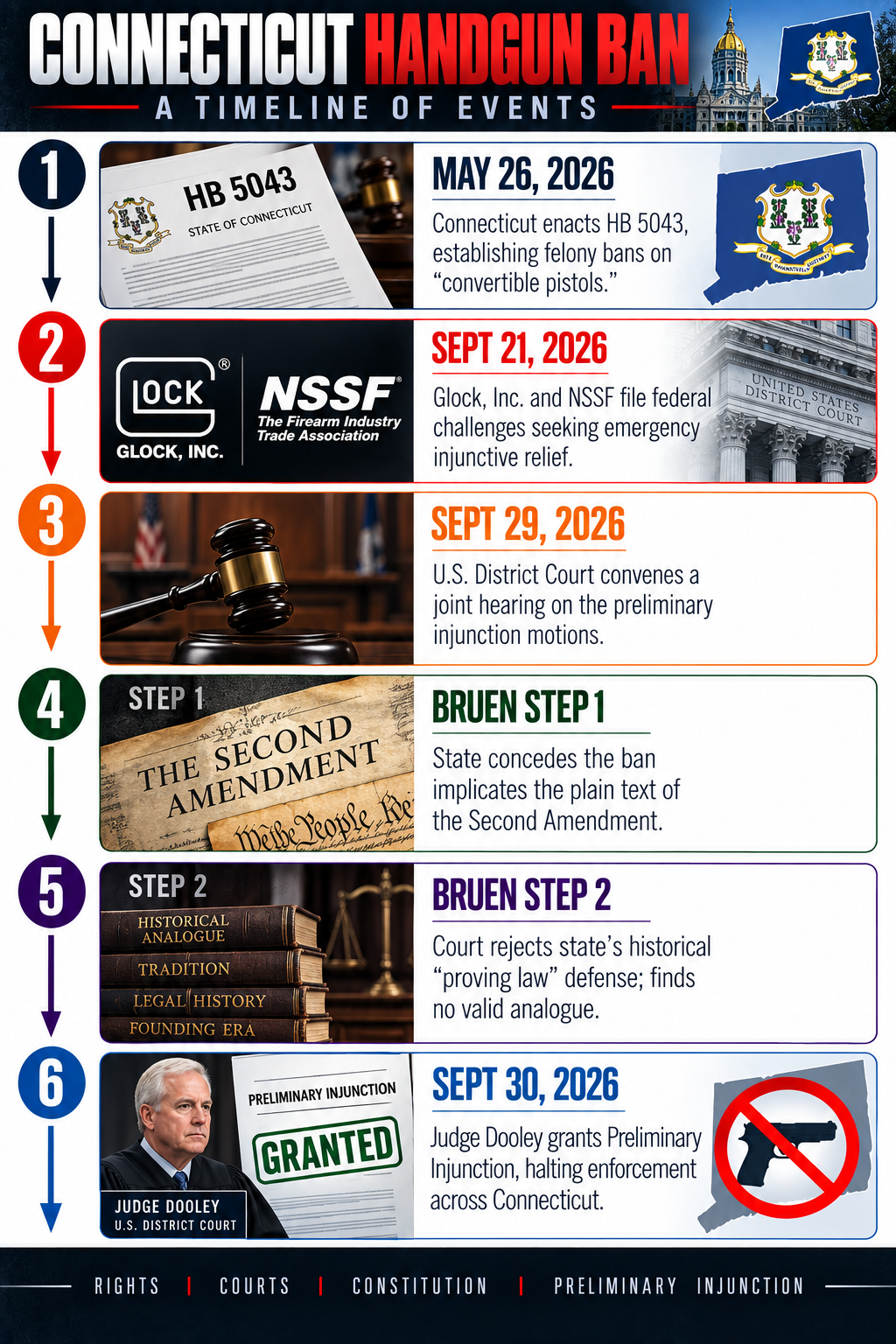
BRIDGEPORT, CT — Gun owners, retailers, and manufacturers secured an essential legal victory in federal court when U.S. District Judge Kari A. Dooley issued an order granting a preliminary injunction blocking the state of Connecticut from implementing a sweeping ban on popular semiautomatic handguns.
The challenged measure, enacted on May 26, 2026, as House Bill 5043 (Public Act 26-41), targeted firearms featuring a “cruciform trigger bar”—the standard internal mechanical linkage found in Glock pistols and similar striker-fired designs. Under the statute, any handgun that could theoretically be modified into an automatic firearm using an aftermarket conversion device was defined as a “convertible pistol” and subjected to felony distribution and sale prohibitions.
Faced with a mandatory effective date of October 1, 2026, Glock and industry plaintiffs filed emergency challenges on September 21, asserting that the law violated the Second and Fourteenth Amendments by outlawing handguns in common use for self-defense.
The Flawed “Proving Law” Defense Under Bruen
Because the defendants conceded for the purposes of the preliminary injunction that HB 5043 implicates the plain text of the Second Amendment, the statute was deemed presumptively unconstitutional under the framework established in New York State Rifle & Pistol Ass’n, Inc. v. Bruen.
The legal burden shifted entirely to the state to show that the ban aligned with the nation’s historical tradition of firearms regulation[cite: 7]. To defend the law, Connecticut prosecutors attempted to pair historical “proving laws”; colonial-era statutes from Pennsylvania, New Jersey, New Hampshire, and Massachusetts requiring commercial firearms to undergo quality testing before entering commerce, with historical restrictions on machine guns.
Judge Dooley rejected that argument, concluding that early proofing regulations have no logical connection to banning pistols because third-party criminals might unlawfully modify them later:
“Each of the proving laws discussed were designed to ensure safety before the firearm enters the stream of commerce. They were not designed to, and indeed could not, forestall future misuse of the firearm (even if predictable) after it enters the stream of commerce. Here, there is no dispute that handguns with a cruciform trigger bar (in an unconverted state) are not only safe, but extremely popular for purposes of self-defense, and their possession and carry rights are protected by the Second Amendment.”
The court also noted a fundamental contradiction in the state’s logic, highlighting that the defendants offered no rational explanation for how a handgun manufactured on September 30, 2026, was deemed safe and legal to sell, while the exact same model manufactured 24 hours later on October 1 was declared so inherently dangerous as to warrant felony criminalization.
Irreparable Harm to Industry and Citizens
In evaluating the necessity of immediate injunctive relief, the court observed that Plaintiffs demonstrated severe and irreversible injury. Retailers like Blue Trail Range Corporation showed that existing inventories of cruciform-trigger pistols would be exhausted within weeks, with HB 5043 already forcing them to halt regular distributor orders.
Beyond retail disruptions, the court recognized that the statute caused irreparable damage to customer goodwill, unconstitutionally chilled commercial advertising across state lines, disrupted contracts, and unlawfully curtailed the Second Amendment rights of Connecticut citizens seeking standard defensive handguns.
With the preliminary injunction formally entered on September 30, the enforcement of HB 5043 is stayed while the litigation moves forward on the merits, ensuring that lawful transfers and sales of Glock pistols and comparable firearms remain operational across the state.
Tactical & Legal Context: Regulating the Alteration vs. Banning the Platform
This ruling underscores a fundamental distinction in Second Amendment jurisprudence: penalizing unlawful modifications versus banning common firearms outright.
- Targeting the Illicit Conversion: As plaintiffs highlighted, historical firearm regulation addresses dangerous modifications by outlawing the illicit accessory or the altered platform itself, such as federal prohibitions on illegal machine gun conversion devices or sawed-off shotguns, without banning the underlying, lawful firearm.
- The Common Use Standard: Because striker-fired pistols utilizing cruciform trigger components represent some of the most widely owned defensive handguns in the country, attempting to reclassify standard sidearms as machine guns solely based on potential future criminal tampering fails the historical inquiry mandated by Heller and Bruen.
Safety & Compliance Tip: While the federal preliminary injunction maintains the status quo for lawful sales, gun owners should remember that preliminary injunctions are non-final procedural orders designed to preserve the landscape during litigation. Handgun owners and FFLs in Connecticut should follow ongoing trial docket filings closely as the state explores its evidentiary record and potential appellate options.

