

Editor’s Note: Be aware of your local and state as well as federal laws and how they apply to carrying firearms and self-defense. This article does not represent training advice nor legal guidance. Please seek the advise of qualified legal counsel on all legal matters. Ammunition performance opinions presented are those of the author and are offered here for discussion.
For personal defense, jacketed hollow point ammunition remains the overwhelming favorite and it’s easy to understand why. Modern jacketed hollow point ammunition from the leading manufacturers has been extensively tested, and it strikes an ideal balance between penetration and expansion.

Rounds that fail to penetrate deep enough to impact vital organs may not shut down a determined adversary fast enough to prevent them from harming you or others. A well-designed hollow point bullet will often expand to 1.5 times its original diameter when passing through tissue, creating a larger wound cavity and leading to rapid incapacitation.
Another advantage of hollow point ammunition is the fact that it is less likely to over penetrate the torso of an adversary and put others at risk. Other bullet styles such as full metal jacket or even old school lead bullets have been known to pass entirely through a human body and injure or kill others.

The fact that a jacketed hollow point (JHP) offers greater stopping potential and less risk to innocent bystanders has made it the overwhelming choice for law enforcement agencies here in the U.S. With the law enforcement stamp of approval, JHPs have also become the top choice for armed citizens carrying a firearm about polite society.
[Be sure to read Massad Ayoob’s rationale for defensive hollow points.]
But what if you were denied the option of carrying a jacketed hollow point in the handgun that you utilize for personal defense? Would you be handicapped carrying a non-hollow point round for personal defense? That was the dilemma I faced when I retired from active-duty law enforcement status and became a private citizen legally authorized to carry a concealed firearm.
Misguided Efforts
Sometime in the 1970s, my home state of New Jersey passed legislation making it illegal for anyone other than the police to carry hollow point ammunition. In some respects, it was a moot point because very few citizens were able to obtain a concealed carry permit in the bad old days of “may issue”. You could possess hollow point ammunition in your home, for target shooting, or for some very limited hunting applications, but you did not want to get caught with it on your person or in your vehicle.

Of course, all this silly feel-good legislation defies logic because it makes us less safe. What presents the greater risk? A pair of well-placed hollow points in the body of an assailant or a half dozen less-effective full metal jacket rounds that might not work and are more likely to over penetrate?
But all is not lost. There are alternatives that perform as well as JHPs and are legal under the law. Another advantage is that many of these alternative rounds may feed more reliably in older pistols. Before 1980, many autoloading pistols would not reliably feed hollow point ammunition and this is one of the reasons revolvers remained the choice of American law enforcement for many years.
Let’s look at a few alternative rounds and see how they stack up.
Black Hills HoneyBadger
Several years ago, Black Hills introduced their HoneyBadger line of handgun ammunition that featured a non-fragmenting, non-deforming bullet. Crafted of solid copper, the bullet features wide, sharp flutes which have proved very effective in ballistic gelatin. Another advantage of this bullet is the fact that it cuts through intermediate barriers that may cause some hollow points to fail.
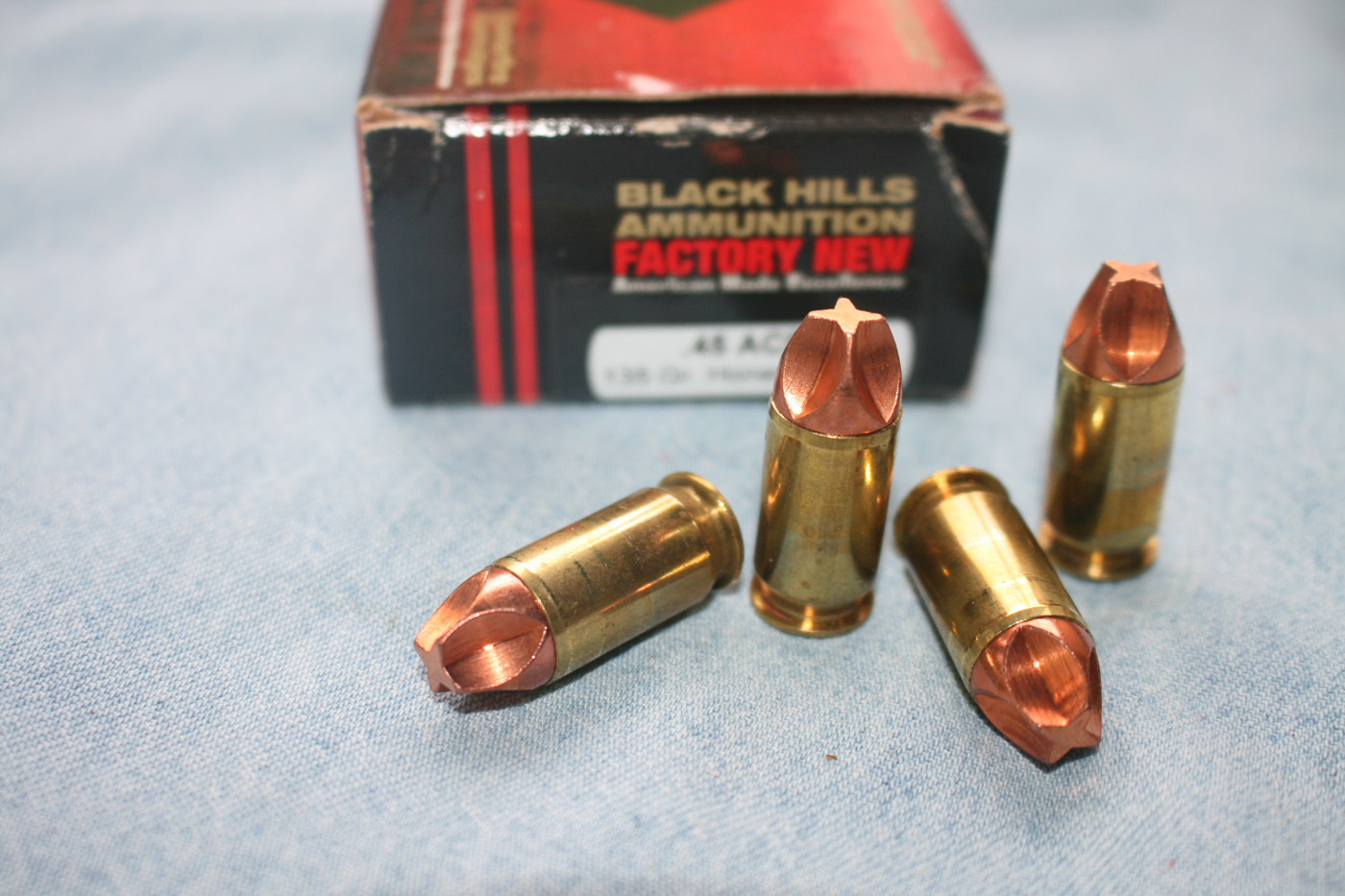
HoneyBadger ammunition is available in all the most popular pistol and revolver cartridges including .380 ACP, 9mm, 10mm and .45 ACP. The subsonic 125-gr. 9mm load clocked 960 fps and penetrated 16.25” of 10% ballistic gelatin. Upping the ante to .45 ACP proved to be even more impressive. The light-for-caliber 135-gr. Honey Badger bullet hit 1,177 fps and navigated 16.75” of denim-covered gelatin.
The wound channel created by both loads looked very similar to one created by a JHP bullet. To date, these rounds have proved 100% reliable in all pistols I have shot it through.
[Read Roy Huntington’s review of Black Hills Honeybadger 10mm ammo for additional information on these rounds.]
Hornady Critical Defense/Critical Duty
Hornady, an industry innovator in ammunition development, offers two lines of hollow point alternative ammunition including Critical Duty and Critical Defense. Both feature Hornady’s Flex-Tip (FTX) bullet technology where the hollow cavity of the bullet is packed with a red elastomer filling to promote expansion and prevent the hollow cavity from clogging with clothing fibers and retarding expansion.

Since the bullet cavity is filled with polymer, the New Jersey State Police has traditionally not classified these loads as prohibited hollow point ammunition. While the current website no longer lists specific loads, as recently as 2025 the NJ State Police indicated that “Ammunition lacking a hollow cavity at the tip, such as those with a polymer filling, are not considered to be hollow point ammunition.” It further provided the Hornady Critical Defense and Critical Duty loads as being not hollow point ammunition. You can see this on the Internet Archive here.
Critical Defense ammunition was created for use in short-barreled handguns often used for discreet carry. Ideal for close-quarters encounters, it reduces the likelihood of over-penetration, making it a great choice for the armed citizen.
Hornady used a similar formula in creating their Critical Duty line. However, that bullet features the InterLock band to prevent jacket core separation when passing through common barriers such as windshield glass, sheet metal and plywood.

Live The Armory Life. The latest content straight to your inbox plus an automatic entry to each of our monthly gun giveaways!
Critical Duty ammo was initially crafted for law enforcement applications and is in wide use by police agencies. I have attended a demonstration of Critical Duty ammo put on by a representative of the company, and it is indeed barrier blind and delivers the goods after passing through common obstacles.
From my Springfield XD Compact .45 ACP with a 4” barrel, Critical Duty 185-gr. FTX bullets penetrated12.5” of gelatin after passing through a four-layer denim barrier. Expanded diameter was .62 caliber. Muzzle velocity was 965 fps. It remains a great load for old-school 1911s that may have a problem cycling JHP ammunition.

I’m pretty fond of the Critical Duty 9mm +P 135 grain, which punches through 16” of gelatin covered in a heavy clothing barrier with nearly 100% weight retention. Bullet expansion with this load is very reliable.
Other manufacturers that offer rule-beating, non-hollow point high-performance ammunition include Speer and Winchester. Speer Gold Dot G2 ammunition 9mm 147-gr. ammunition features a bonded bullet with clear elastomer filler in the cavity. Winchester USA Ready Defense ammunition is available in 9mm, .40, 10mm and .45 ACP with the Hex-Vent rigid insert in the bullet cavity to prevent obstruction and channel material flow for bullet expansion.
[Read our Hornady Critical Defense 9mm ammo review for more information on these rounds.]
Glaser PowR’Ball
A unique offering within the CORBON family is the PowR’Ball line. PowR’Ball ammunition features a lead core enveloped in a copper cup jacket. The bullet jacket secures a polymer ball captive inside of a hollow cavity. When the bullet strikes tissue, the ball helps facilitate expansion and the end result is performance similar to that of a conventional hollow point bullet.

Like the Hornady Critical Defense and Critical Duty, NJ State Police previously named PowR’Ball as being not hollow point ammunition. Presumably the ammunition is still considered legal in New Jersey.
Bullet weights are typically light-for-caliber, and the result is higher muzzle velocity. In 9mm, I was able to clock muzzle velocities in the 1,350 fps range while the .45 ACP +P 165 grain achieved a muzzle velocity of over 1,100 fps. Expanded diameter is roughly 1.5x greater than the original caliber with almost 100% weight retention.
Fort Scott Tumble Upon Impact
Fort Scott Munitions has taken a very different approach to bullet performance with their innovative line of Tumble Upon Impact (TUI) offerings. Available for a wide range of handgun and rifle cartridges, the TUI design is specifically engineered to tumble when striking water-based tissue, maximizing damage. Fort Scott TUI handgun rounds utilize a solid copper spun SCS bullet which do indeed flip end over end, creating highly effective results.

Fort Scott TUI rounds are available for all popular handgun cartridges including .380 ACP, 9x19mm Parabellum, .40 S&W, 10mm Auto and .45 ACP. Fort Scott offers a few different bullet weights for the world-standard 9mm. From my Springfield Armory Hellcat OSP with a 3” barrel, the 9mm load posted a muzzle velocity of 1,328 fps. Although I have not done any testing in ballistic gelatin, informal feedback shows the TUI bullet performs just as advertised.
Final Thoughts
In a perfect world, there would be no need to trouble ourselves about the legality of the ammunition in our carry handgun, but we play the cards that we are dealt. Considering some of the very solid alternatives to jacketed hollow point ammunition, I wouldn’t lose a wink of sleep if I were once again forbidden to carry JHP ammunition. I would simply load up with one of the forementioned types of loadings discussed above and go about my business.
Considering the political climate of my home state, I don’t see any rolling back of hollow point restrictions any time soon. I don’t know of any other jurisdictions here in the U.S. that forbid the use of hollow points, but their use is restricted in some foreign countries, even by the police. Should you find yourself restricted, you can still realize some very good performance with these alternatives.
But as indicated earlier, if you have an old classic selfloader or even a pre-1980 DA pistol that is a finicky feeder, the rounds reviewed herein will deliver the goods. When your life may be on the line, you don’t have to settle for ball ammunition.
Editor’s Note: Please be sure to check out The Armory Life Forum, where you can comment about our daily articles, as well as just talk guns and gear. Click the “Go To Forum Thread” link below to jump in and discuss this article and much more!


