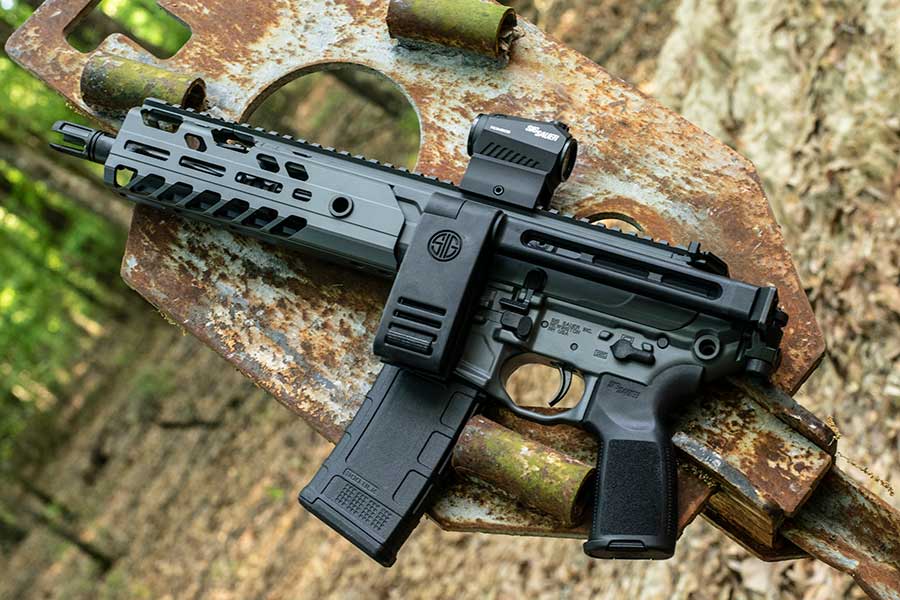

In a blunt court filing from Monday, March 16, the Bureau of Alcohol, Tobacco, Firearms and Explosives (ATF) urged a federal judge to dismiss a high-profile challenge to its now-defunct pistol stabilizing brace rule, arguing the case has become completely moot. At the same time, the agency made clear it has no intention of abandoning enforcement against certain braced pistols under the National Firearms Act (NFA) and Gun Control Act (GCA).
The 6-page reply brief, filed in State of Texas et al. v. Bureau of Alcohol, Tobacco, Firearms and Explosives et al., marks the latest twist in a legal saga that began three years ago. The plaintiffs, led by the State of Texas and joined by Gun Owners of America (GOA) and several Texas citizens, had sued to block the ATF’s January 31, 2023, “Factoring Criteria for Firearms With Attached ‘Stabilizing Braces’” rule (88 Fed. Reg. 6478). That rule used a complex points-based system to reclassify many popular braced pistols as short-barreled rifles (SBRs), subjecting owners to NFA registration, a $200 tax stamp, and potential felony charges for non-compliance.
But the landscape changed dramatically when another federal court issued a universal vacatur of the entire rule, a decision that became final in mid-2025. With the rule formally nullified and revoked nationwide, the ATF now argues that nothing remains for this Texas court to enjoin or declare unlawful.
“The case became moot,” the ATF’s lawyers wrote. “Plaintiffs appear to accept that the Court can no longer grant them meaningful relief in relation to the Rule, which has already been formally nullified and revoked through universal vacatur.”
The agency’s earlier motion to dismiss cited Fifth Circuit precedents holding that, once an agency rule is vacated, APA challenges lose their live controversy. Plaintiffs’ opposition brief sought to keep the case alive by insisting the court could still block the “legal theories” that underpinned the rule, specifically the ATF’s position that at least some pistols equipped with stabilizing braces qualify as NFA-regulated short-barreled rifles.
The ATF’s reply delivered a sharp rebuttal, and this section has drawn immediate attention from Second Amendment advocates. The government explicitly acknowledged that it continues and will continue to enforce the underlying NFA and GCA provisions against braced pistols that meet the statutory definition of a short-barreled rifle.
“Plaintiffs also make much of the fact that defendants continue to enforce the NFA’s and the GCA’s regulation of short-barreled rifles against some brace-equipped pistols, even though the Rule has been universally vacated,” the filing states. “But that should come as no surprise, as that is consistent with how defendants have always explained how things work if a court vacated the Rule or enjoined its enforcement.”
The brief then quotes from an earlier ATF filing in the same case: “Even if this Court were to enjoin the Rule’s enforcement, that would not change Brown’s or any other GOA member’s statutory obligations.” It added that “the Rule imposes no criminal sanctions; any penalties for possessing an unregistered short-barreled rifle flow from the NFA. So, enjoining the Rule’s enforcement would not immunize Brown or any other GOA member from those penalties.”
In plain language, the ATF is telling the court and the public that the vacatur of the 2023 rule does not create a safe harbor for braced pistols. If a pistol with a stabilizing brace is designed to be shouldered and meets the NFA’s definition (rifle with a barrel less than 16 inches or overall length less than 26 inches), it remains a short-barreled rifle. Owners must still register it, pay the tax, or face prosecution. The factoring criteria may be gone, but the underlying statutory obligations are not.
This position tries to directly undercut the plaintiffs’ attempt to obtain prospective relief against the “legal theories” themselves. The ATF argued that all of the plaintiffs’ claims sound in the Administrative Procedure Act (APA). Without a final agency action still in effect, the court lacks jurisdiction to issue an advisory opinion on abstract legal interpretations or to enjoin hypothetical future enforcement.
“Plaintiffs’ claims all sound in the APA,” the reply states. “This Court has no jurisdiction to opine on or grant relief from any legal theories divorced from an existing final agency action.”
The filing also seeks to dismantle the plaintiffs’ constitutional claims. Although the complaint listed six constitutional causes of action, the ATF noted that the only private right of action cited was the APA itself (5 U.S.C. §§ 702, 706). No other statute provides a standalone right to sue, the government said, citing Fifth Circuit authority that constitutional challenges to agency action must generally proceed through the APA framework.
Plaintiffs had leaned heavily on the Fifth Circuit’s decision in Franciscan Alliance, Inc. v. Becerra to argue that courts can enjoin an agency’s statutory interpretation even after a rule is vacated. The ATF sharply distinguished that case: the Franciscan plaintiffs had a separate Religious Freedom Restoration Act (RFRA) claim that allowed the court to issue injunctive relief beyond the APA. Here, the plaintiffs have only APA claims, so the Franciscan precedent “lends no support” to their position.
The reply also rejected the plaintiffs’ claim that they had requested a broad injunction preventing enforcement of NFA regulations on braced pistols. The ATF said no such relief appears in the original complaint, and that plaintiffs cannot amend their pleading through opposition briefing. A separate request for a declaration that the chief law enforcement officer (CLEO) notification requirement in 27 C.F.R. § 479.62(c) is unlawful was deemed “unmoored from any cause of action” and insufficient to keep the case alive.
The filing ends with a simple conclusion: “The Court should dismiss this case as moot.”
The case has drawn intense interest from gun owners because stabilizing braces were once marketed as accommodations for shooters with disabilities. Millions of Americans attached them to AR-style pistols to improve accuracy without creating a legally defined rifle. The 2023 ATF rule upended that market overnight, prompting an estimated 250,000–500,000 registrations during the agency’s amnesty period and countless lawsuits.
Gun Owners of America, referenced in the filing, and other plaintiffs argued the rule was an unconstitutional power grab that effectively rewrote the NFA through administrative fiat. The universal vacatur by another court appeared to hand them a major victory. Yet the ATF’s March 16 reply signals that the practical effect may be narrower than hoped: the specific “factoring criteria” are gone, but case-by-case enforcement under the decades-old statutory definitions remains fully intact.
Legal analysts say the filing puts plaintiffs in a difficult spot. If the court agrees the case is moot, and Fifth Circuit precedent on universal vacatur strongly suggests it will, the plaintiffs lose their platform to obtain the sweeping injunction they sought. At the same time, the ATF has put gun owners on notice: braced pistols that function as shoulder-fired rifles are still subject to NFA scrutiny.
The State of Texas and co-plaintiffs have not yet filed a sur-reply, and U.S. District Judge (the presiding judge in the Victoria Division) has not set a hearing on the motion to dismiss.
For millions of Americans who purchased stabilizing braces believing they kept their firearms in the legal “pistol” category, the ATF’s filing delivers a sobering message. The rule may be dead, but the underlying law and the ATF’s willingness to enforce it live on. The agency has effectively told the court: we no longer need the 2023 rule. The National Firearms Act is enough.
Federal Judge Expands Post Office Carry Injunction to Cover Future SAF & FPC Members
About John Crump
Mr. Crump is an NRA instructor and a constitutional activist. John has written about firearms, interviewed people from all walks of life, and on the Constitution. John lives in Northern Virginia with his wife and sons, follow him on X at @crumpyss, or at www.crumpy.com.