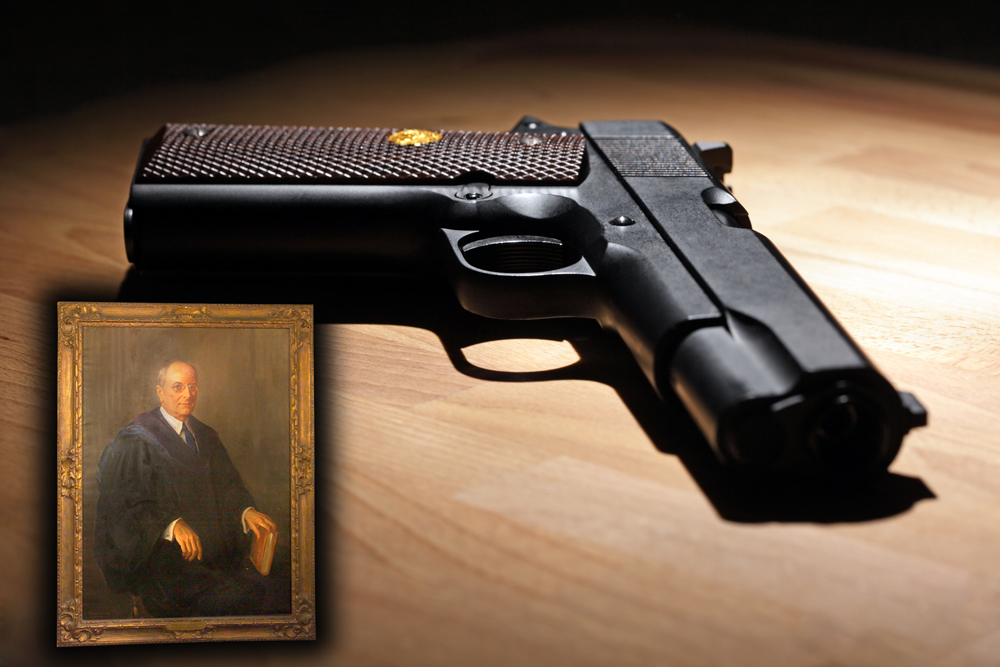

President Franklin Delano Roosevelt’s 1933 pick for Attorney General was Senator Thomas J. Walsh, born in 1859 in Two Rivers, Wisconsin. Two Rivers had a population of 1,337 in 1860. A self-made man, he graduated from the University of Wisconsin. He grew up in the West. Walsh won the election to the US Senate from Montana in 1912. He exposed the Teapot Dome scandal in 1922. His summer home was in what became Glacier National Park. On the way to his inauguration in 1933, he died of an apparent heart attack on a passenger train, as he traveled to D.C. from Florida, at the age of 73.
Homer Stillé Cummings was meant as a stopgap replacement.
Homer Stillé Cummings was a reliable political hack whom Roosevelt originally appointed as Governor General of the Philippines. After Walsh’s untimely death, Roosevelt selected Cummings as Attorney General.
Cummings was an early child of the American Urban class, born in Chicago in 1870. He grew up and prospered in the American Northeast. In 1933, he was a member of the Democratic National Committee and had previously served as its chairman. He left the office of Attorney General in 1939 and entered private law practice in Washington, D.C.
Homer Cummings became Franklin Delano Roosevelt’s Attorney General in 1933. He became the crusader who pushed hard for de facto national firearms bans and especially for handgun registration in the United States.
Cummings succeeded in passing the National Firearms Act but failed to obtain national handgun registration. In 1937, he stated his belief that all firearms must be registered.
“I am convinced of this—any practical measure for the control of firearms must at least contain provisions for the registration of all firearms.”
In an interview with Homer Stillé Cummings in 1938, much of his philosophy about gun control was revealed. Rex Collier was on the staff of the Washington Evening Star, which was the paper of record in Washington, D.C., until 1981. Cummings had pushed for national handgun registration and licensing in the National Firearms Act. At first, he did not include short barrel rifles, but was willing to do so when pressured by Minnesota Representative Harold Knutson.
After the NRA succeeded in convincing Congress to reject universal handgun registration, Cummings made several more attempts to achieve it. His last attempt was in 1938. During that attempt, he was interviewed by Rex Collier.
In the 1938 interview with Cummings, the reporter from the Washington Evening Star asked the Attorney General whether he was urging Congress to extend the NFA to cover pistols, revolvers, and gas guns.
“That is correct and I might add,” Cummings responded, “that this is not a recent inspiration with me. I have been fighting for such legislation for four years.”
Cummings goes on to say what has been one of the major talking points of those pushing for disarmament of the public in the United States. The claim is that Canada and some European countries have lower reported rates of homicide than the United States at the time. Cummings did not mention that the homicide rate stayed the same or went up after handgun registration was passed in those other countries.
In the same interview, Cummings went on to give an indication of his mindset when he said, “of the homicides in this country, almost 70 percent are committed by firearms.”
Cummings uses the generic term firearms, not handguns. His history as a Northeastern coastal urbanite suggests he had little personal experience with firearms. He went to Yale and practiced law. It is difficult to believe he did not know the proper use of “by” and “with”. Firearms have no volition. The proper usage is “killed with firearms, not killed “by” firearms.
Cummings goes on to denigrate those who claim the natural right to keep and bear arms, because it is outdated:
“And even in the year 1938 we hear the hollow argument of the inalienable right of a person to buy a pistol without leaving any form of identification.”
Later, Cummings lets slip a telling point. The group most in favor of the registration of all handguns in the country is “the press“.
Question: Can you tell me which groups are in favor of the proposal?
Atty. Gen: In the first place, I would list the press of the country.
To his credit, Rex Collier asks the obvious question:
Question: What good does it do, General, to have a large file of guns owned by persons who are not criminals?
Atty. Gen: Simply this. Tomorrow’s supply of guns for the underworld is today in the hands of honest citizens. Under this bill no honest citizen will transfer his weapon without complying with the terms of the statute, and in time the underworld supply of guns, except those secured by theft, will be cut off.
Cummings goes on to say that most guns used in crime are purchased through legitimate channels in 1938. Because criminals will not register their guns, when his subordinates find someone who has an unregistered gun, they can prosecute him, because anyone with an unregistered gun would have to be a criminal. Cummings probably believed what he said. In 2026, his words seem laughably naive.
Today, we know the small number of guns used in criminal homicides are easily obtained on the black market. Substitute weapons are commonly used. Disarming the population leaves the vulnerable at the mercy of the violent.
Congress did not agree with Homer Cummings. In Europe, firearm registration was being used against the people. In Germany, in France, in the countries occupied by the NAZI regime, registration lists were used as a means of oppression.
Today, we know gun registration is gun confiscation.
In his paper, The Power to Tax, The Second Amendment, and the Search for Which “‘Gangster’ Weapons” to Tax, Stephen Halbrook notes the winds of war were blowing against firearms registration in the USA.
Congress took notice. Reporting a bill to allow the President to requisition property, the House Committee on Military Affairs included a provision forbidding the impairment of Second Amendment rights “in view of the fact that certain totalitarian and dictatorial nations are now engaged in the willful and wholesale destruction of personal rights and liberties[.]”220 The resultant Property Requisition Act of 1941 declared in part:
Nothing contained in this Act shall be construed—
(1) to authorize the requisitioning or require the registration of any firearms possessed by any individual for his personal protection or sport (and the possession of which is not prohibited or the registration of which is not required by existing law), [or]
(2) to impair or infringe in any manner the right of any individual to keep and bear arms[.]221
Homer Cummings died in 1956, celebrated as a faithful Progressive who did what he could to register all handguns in the United States.
Cleared in Self-Defense, Charged for Carrying: Michigan Case Shows Why ‘Sensitive Places’ Fail
About Dean Weingarten:
Dean Weingarten has been a peace officer, a military officer, was on the University of Wisconsin Pistol Team for four years, and was first certified to teach firearms safety in 1973. He taught the Arizona concealed carry course for fifteen years until the goal of Constitutional Carry was attained. He has degrees in meteorology and mining engineering, and retired from the Department of Defense after a 30 year career in Army Research, Development, Testing, and Evaluation.