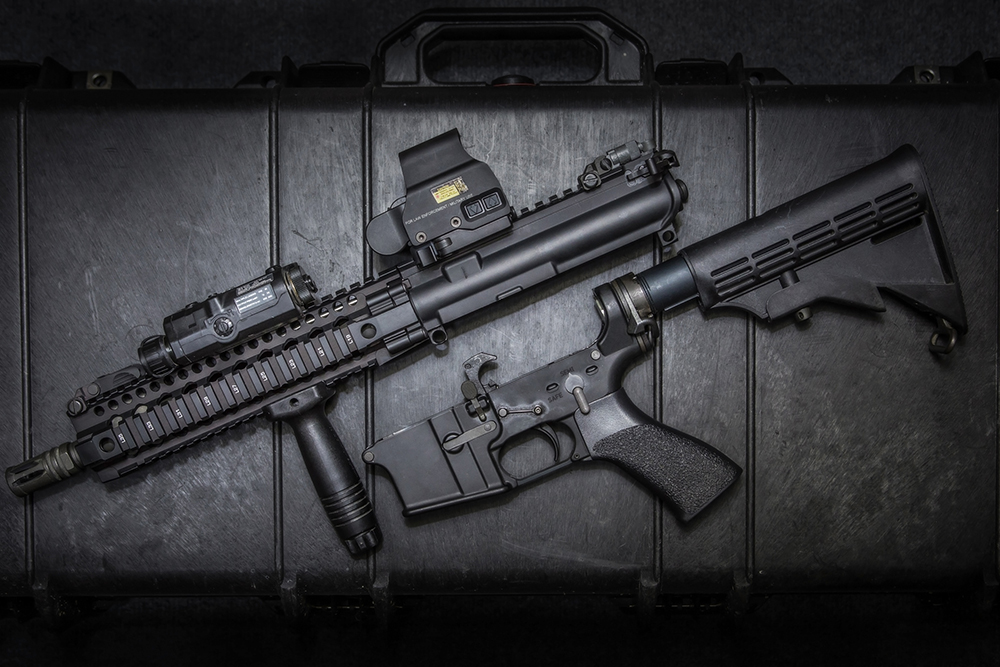

The story of how short-barreled rifles (SBRs) and short-barreled shotguns (SBSs) ended up regulated under the National Firearms Act (NFA) of 1934 is one of the clearest examples of unnecessary federal overreach, bureaucratic accident, and enduring infringement on Second Amendment rights. What began as a panicked response to 1930s gangster violence morphed into a permanent regulatory trap that punishes law-abiding Americans for owning common, useful firearms, configurations that have legitimate sporting, defensive, and historical purposes, while doing virtually nothing to stop actual crime.
In the early 1930s, America was gripped by sensational headlines about organized crime: the St. Valentine’s Day Massacre, Bonnie and Clyde’s exploits, and Al Capone’s Thompson submachine guns. Politicians and the media hyped “gangster weapons,” with sawed-off shotguns singled out as tools of the underworld. Attorney General Homer Cummings and the Justice Department pushed for federal action, but they knew an outright ban on firearms would likely violate the Second Amendment. Instead, they cleverly used Congress’s taxing power to create a de facto prohibition through heavy fees, registration, and paperwork.
The initial bill, H.R. 9066, was far broader than the bill that passed. It targeted machine guns, silencers, short-barreled shotguns and rifles (under 18 inches), handguns, pistols, and revolvers.
The $200 transfer tax (equivalent to roughly $4,800–$5,000 today) was designed to be prohibitive, pricing ordinary citizens out while supposedly tracking criminals. To close an obvious loophole, drafters added short-barreled rifles and shotguns: if handguns were taxed and registered, a criminal (or citizen) could simply buy a cheap rifle or shotgun and saw it down to handgun-like concealability, bypassing the rules entirely.
This was already problematic. Handguns were and remain the quintessential self-defense arms, protected under the Second Amendment (later affirmed in District of Columbia v. Heller). Regulating them federally would have been a direct assault on the right to bear arms for personal protection. The National Rifle Association (NRA), though smaller and less politically powerful in 1934, mobilized against the inclusion of handguns. NRA representatives like Karl T. Frederick testified that such restrictions would criminalize millions of honest sportsmen and homeowners without touching real criminals, who would ignore the law anyway.
Intense lobbying and public criticism forced a retreat. By May–June 1934, the handgun provisions were stripped from the revised bill (H.R. 9741). Congress concluded that ordinary citizens needed pistols and revolvers for home defense and should not be treated like gangsters. The NRA scored a major win here: handguns were exempted.
But the short-barrel provisions added only to plug a loophole around the now-deleted handgun ban stayed in the final law. No serious debate targeted them for removal. Sawed-off shotguns carried the stigma of crime; short rifles were lumped in as an afterthought. The 18-inch barrel threshold (later reduced to 16 inches for rifles in 1968) was arbitrary, based on vague “expert” input about concealability rather than evidence of widespread criminal misuse or inherent danger.
The result: Congress passed the NFA on June 26, 1934, regulating machine guns, silencers, short-barreled rifles (barrels under 16 inches or overall under 26 inches), short-barreled shotguns (barrels under 18 inches), and “any other weapons.” The $200 tax, fingerprints, photos, and lengthy ATF approval process became mandatory for these items. This was legislative malpractice, a provision born to prevent circumvention of a handgun restriction survived even after that restriction vanished, creating an absurd regime where handguns (more concealable) face no NFA burden, full-length rifles and shotguns are freely owned, but something “in between” triggers felony-level paperwork and taxes.
Gun rights advocates maintain a key truth: short-barreled rifles and shotguns were never a significant crime problem in 1934, and they aren’t today. No congressional testimony or evidence showed they were disproportionately used by criminals compared to handguns or standard long guns. Short rifles have historical precedent; Winchester sold “Trapper” models with 14–15-inch barrels in the late 19th century without issue. Short shotguns served practical roles in ranching, home defense, and even military scenarios (e.g., trench guns in WWI).
The concealability argument collapses under scrutiny. A 17.9-inch barreled shotgun is barely more concealable than an 18-inch one; a 15.9-inch AR-15 rifle is no more hidden under a coat than many large handguns. Yet one is a felony without paperwork, the other is not. Modern SBRs, like braced AR pistols turned rifles, are popular for home defense, vehicle carry, and training precisely because shorter barrels improve maneuverability without sacrificing much velocity or accuracy.
The United States v. Miller ruling in 1939 upheld the NFA’s shotgun provision, but only because no evidence was presented that a short-barreled shotgun had militia utility, a procedural flaw, not a substantive endorsement of the law’s wisdom. Post-Heller and Bruen, many scholars argue SBRs/SBSs are “arms” in common use, protected by the Second Amendment with no historical tradition of such regulation.
The NFA turned harmless modifications into federal felonies: add a stock to certain pistols without approval, shorten a barrel by a fraction, or forget paperwork, and face 10 years in prison. It burdens collectors, disabled veterans (who benefit from compact designs), competitive shooters, and everyday defenders. ATF inconsistencies, like flip-flopping on pistol braces, created traps that ensnared thousands until courts intervened.
Pro-gun groups like Gun Owners of America (GOA), NRA-ILA, and others have long called for repeal via bills like the SHORT Act (Stop Harassing Owners of Rifles Today), which would delist SBRs, SBSs, and AOWs from the NFA. Recent reforms (e.g., zeroing the $200 tax in 2025 legislation) chipped away at the scheme, but registration and approval remain infringements. Advocates argue the entire short-barrel category is a leftover: unnecessary, arbitrary, and unconstitutional under modern Second Amendment jurisprudence.
In short, from a pro-gun perspective, SBRs and SBSs were accidentally locked into the NFA because Congress botched a compromise. The handgun ban died, but its vestigial tail lived on, punishing responsible citizens for decades while criminals laugh at paperwork.
It’s time to finish what 1934 started: remove these common arms from federal overregulation and restore the full right to keep and bear them.
ATF Says Brace Rule Case Is Moot, Warns Some Braced Pistols Still Face NFA Enforcement
About John Crump
Mr. Crump is an NRA instructor and a constitutional activist. John has written about firearms, interviewed people from all walks of life, and on the Constitution. John lives in Northern Virginia with his wife and sons, follow him on X at @crumpyss, or at www.crumpy.com.