

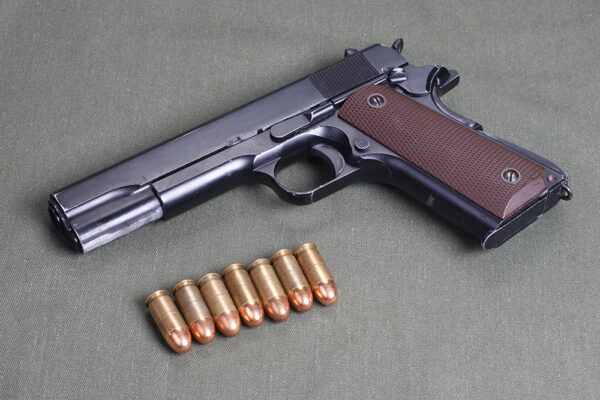
On March 29th, 1911, the US Army Ordnance Department accepted the Colt M1911 into service. This semi-automatic pistol would remain in service for over seventy-five years and would go on to influence generations of handguns to come. Today, the 1911 platform has grown from its roots and remains one of the most popular and identifiable pistols in the world over a century after its adoption.
How the M1911 came to be adopted in the first place is a tale that is as storied as its service life, with a fair amount of conjecture and revisionism mixed in with fact. The 1911 is the final destination of so many handguns, but here is how we got to it in the first place.
The US Army and the Penchant for the .45
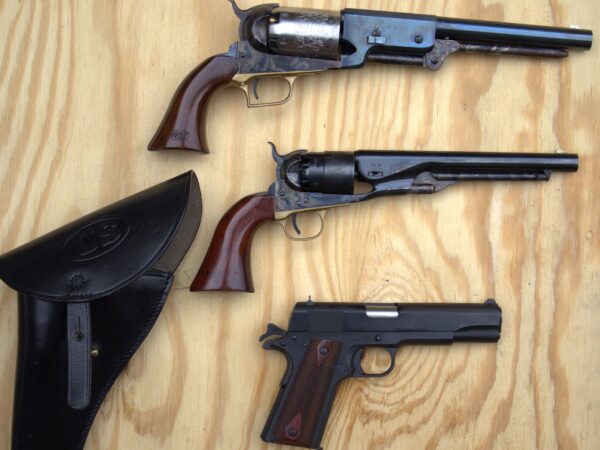
In an age before expandable bullets and high velocity cartridges, bigger was better. When the US Army got its first taste of a revolver with the .44 caliber (nominal .45 caliber bullet) Colt Walker, subsequent revolvers in that caliber were preferred. The Colt Dragoon and 1860 New Army models were both in .44 caliber and preferred for their ability to stop both men and horses. The US Navy gravitated toward the Colt Navy model in .36 caliber. Initially, this was due to its lighter weight over the Dragoon, and the risk at sea from horses was minimal. Back on land, the Army transitioned to cartridges in 1873 with the Colt Single Action Army in .45 Colt. In 1892, the Army adopted a modern double-action revolver in the Colt New Army chambered in .38 Long Colt.
At this time, the role of the horse and of the Army changed.
The Civil War solidified the cavalry’s transition from a main striking force to the eyes and ears of the Army. Horse-drawn transport over long stretches of country were now economized by more efficient water and rail transport. The period from 1865 to 1890 was also a period where the Army’s duties consisted of guard duty along the Mexican border and campaigns against Native Americans in the West. With internal threats extinguished and Europe’s powers dominant on the world stage, the Army had a choice of modernizing or being left behind.
In the 1890s, the lion’s share of European armies fielded .32 caliber revolvers that leaned toward capacity and faster follow up shots over power. The major exception was Britain, whose forces engaged in continuous combat in Africa and Asia. Their .455 revolvers were considered effective and would stay in service for decades to come. Going with a fast firing .38 seemed better than most of the competition and it was a major antidote toward the Army’s lax marksmanship standards and ammunition allowances. During the Indian Wars, the soldier was expected to make do with as few as twenty rounds of practice ammunition per year for his rifle, let alone a handgun that spent most of its life in a holster.
Live Inventory Price Checker
The Colt .38 Succeeds and Fails
The .38 Long Colt was a moderately popular chambering in smaller handguns like the Colt Model 1877 double action before it was paired with the Colt New Army in 1892. It fired a .375 inch 150 grain bullet at a gingerly 650 feet per second. But in its first action in Cuba during the Spanish-American War, the .38 acquitted itself well.
Subduing the Philippines after the peace was another matter.
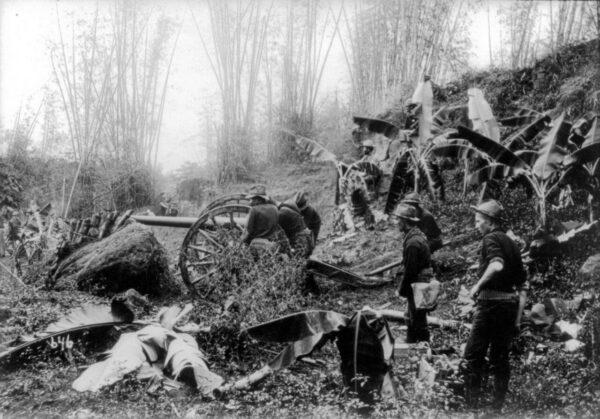
The Philippine-American War is generally when the story of the 1911 starts.
The story goes that Moro rebels in the south of the Philippines were particularly resistant to American coercion. Stories circulated about servicemen emptying their revolvers into rebel combatants to no effect. While the sources are few, there were enough encounters to motivate the Board of Ordnance to pull Colt Single Actions out of mothballs and purchase .45 Colt M1878 Colt double actions for use in the Philippines.
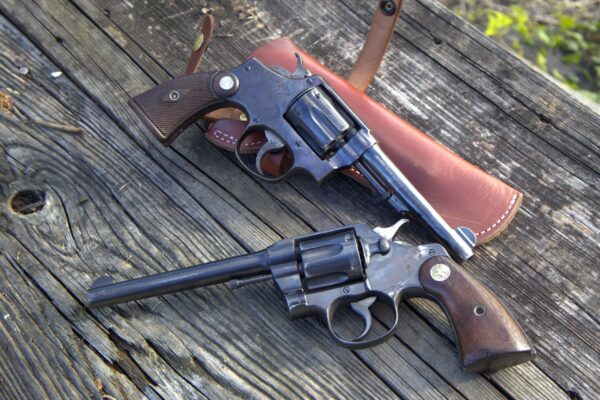
1899 also saw the introduction of the Smith & Wesson Military & Police revolver. It was initiated by a call for arms at the start of the war in Cuba, but Smith & Wesson took the opportunity to develop it along with the more powerful .38 Special cartridge. This was done with an eye to replacing Colt as the Army’s next handgun. But “stopping power” failures were not limited to the .38 revolver. The Army’s .30 caliber Krag rifle was held in low enough regard that the near-retired .45 caliber Trapdoor Springfield was reinstated.
Despite these contradictory developments, the Army’s next pistol was the Colt Model 1901 revolver in .38 Long Colt.
The M1892s had suffered from timing problems and mechanical issues through its service. The adoption of an improved model over a .45-caliber pistol underscores the issue that stopping power was more complicated than lore suggests.
The Quest for a New .45
The Colt .38 was in its fourth iteration with the Model 1901, and it would see a few more before it was officially replaced as standard by the M1911 .45. In that decade, the quest to return to an old caliber was now couched in a new debate: revolver vs. autoloading pistol.
The Luger pistol was adopted by the Swiss in 1900, and the world took notice. This eight-shot auto pistol took full advantage of smokeless powder with its fast 7.63 cartridge. American Ordnance Chief General William Crozier was allotted funds to purchase the Luger for testing. This confirms that the Army was not sold on getting away from smaller calibers. For good measure, Luger expanded the 7.63 case for a 9mm bullet in 1903. Fifty of these 9mm Lugers were also purchased for trials at Fort Riley, KS.
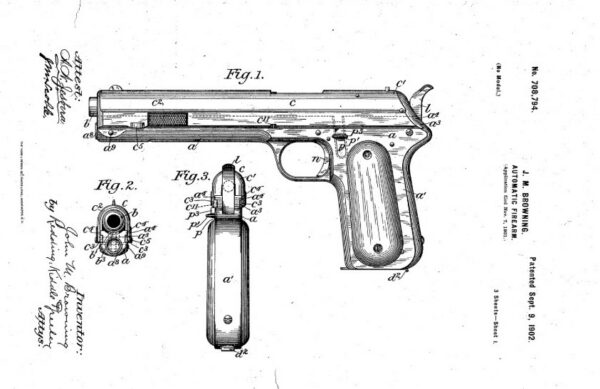
While Georg Luger was hitting pay dirt with his powerful new pistol, John Browning had the slide-action pistol in the FN Model 1900. This .32 ACP blowback dominated European sales and it was a design that could be upscaled and improved. With an eye on Luger in America, Browning collaborated with Colt to produce the Model 1900 in .38 ACP. It competed with the likes of the Luger, Broomhandle Mauser, and Steyr-Mannlicher. As is often the case with military trials, none were adopted after exhaustive testing.
The caliber debate continued, and continue til this day. The Thompson-LaGarde tests did not answer every question, but they strongly reinforced the Army’s preference for a service handgun of not less than .45 caliber. In the aftermath of testing, no caliber was recommended but the .45 Colt and .476 Webley were considered adequate while the 7.63, 9mm, and .38 ACP fell short. After the test, the Army formally declared that their next service pistol had to be .45 caliber.
The .45 ACP Is Born
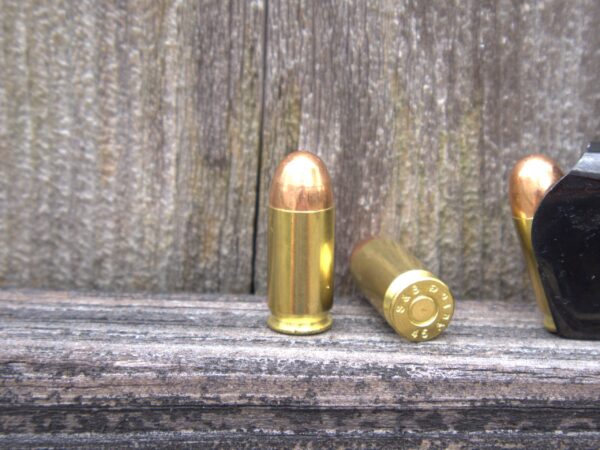
Browning’s improved Model 1905 Military Model was offered in .45 caliber and chambered for the new .45 ACP cartridge. Rather than being a direct copy of the old .45 Colt revolver round, the .45 ACP was a new rimless cartridge designed for a self-loading pistol while delivering the hard-hitting performance the Army wanted. During the trials period, .45 ACP development included a 200-grain bullet at about 900 feet per second. Later, the cartridge settled into the 230-grain loading at roughly 850 feet per second that became standard for U.S. service.
Pistol trials began again in 1907, and this time the Board changed its decision and settled on pistols in .45 ACP caliber. Luger was asked for 200 pistols in the .45. By then, Luger’s home country of Germany was close to adopting the 9mm Luger pistol. Tooling up for a limited run for an unimportant market was not worth it. This left the Colt 1905 and the Savage Model 1907 in the running.
The Adoption of the M1911
After a decade of trials, the 1911 pistol came to be. It would go on to outlive all of its contemporaries.
Browning and Colt’s engineers simplified the M1905 to have an internal extractor and a single barrel link. The link was also held in place with a solid slide release that ran through the frame. The existing grip safety was kept, but the Army requested a manual thumb safety in addition. The pistol was tested against the improved Savage 1910, the Dryse, as well as the existing Colt New Army .38 and Colt New Service .45 Colt revolvers.
The Model 1911 went through 6,000 rounds of testing without malfunctions and was formally adopted on March 29, 1911. The rest, as they say, is history.
Springfield Armory 1911 Mil-Spec, Defend Your Legacy – Review
About Terril Hebert:
Terril Hebert is a firearm writer native to south Louisiana. Under his motto—Guns, Never Politics—he tackles firearm and reloading topics both in print and on his Mark3smle YouTube channel, where he got his start. He has a soft spot for ballistics testing, pocket pistols, and French rifles. When he is not burning ammo, he is indulging his unhealthy wildlife photography obsession or working on his latest novel. Scourge of God was published in 2017.”
Some of the links on this page are affiliate links, meaning at no additional cost to you, Ammoland will earn a commission if you click through and make a purchase.


