

Images by the author
I guess you could say that I’m a fan of RCBS equipment. I have one of each press they make, excluding my 1978-purchased RCBS Jr. press, which has been retired. I also own bullet-casting equipment, case prep tools, tumblers, dies… the list goes on.
Add to my fascination with Big Green (green’s always been my favorite color – maybe that figures) a similar interest in loading the 9mm or the .223/5.56 mm cartridges, and you have an interesting combination. I recently replaced a decades-old Lee turret press with the RCBS Turret Press. It was a suitable upgrade. I moved the old press off the bench and installed the new one. Out with the old, in with the new…
Anyway, this press is strong and can easily provide loads for my Ruger .308 Scout rifle as easily as it does 9mm. It is cast iron, which minimizes wobble in the ram and provides strength. Let’s look at it.

You have six stations, so powder cop-type and swage dies have a place.
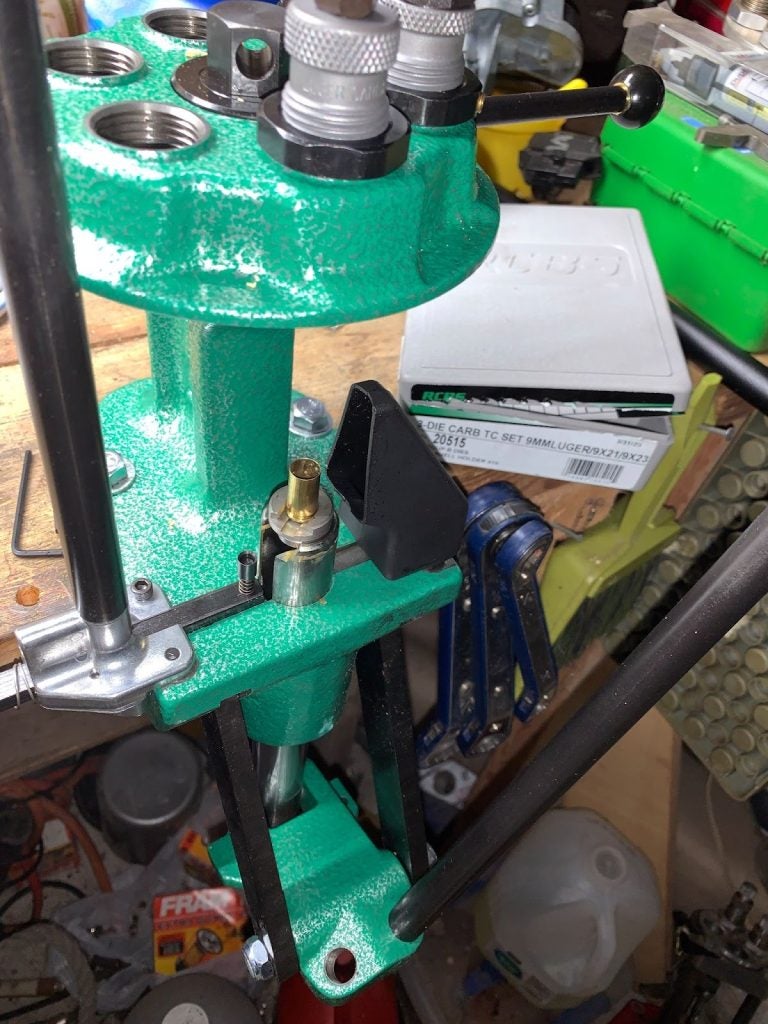
On-press priming is easy with the primer feed tube. Shown are dies and a shellholder from an RCBS 9mm set. You can place the handle on either side. Compound leverage/linkage makes resizing large cases easy. Its cast-iron construction will last for decades, with care.
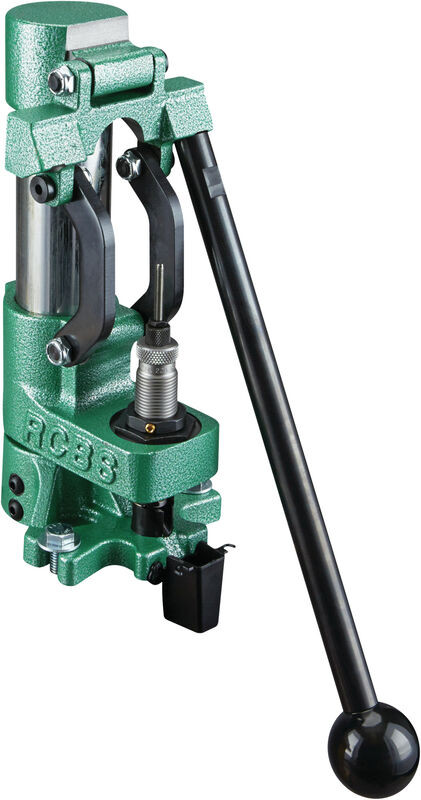
We also employed an RCBS Summit single-stage press for some prep and production work. This small unit can sit back, away from the edge of your bench, because there is no linkage below tabletop level. (The photo below shows the long handle that comes with it, which does need the press mounted at the edge of your bench, but you can get a shorter one that allows you to move the press away from the bench edge. I have both of them.) It came in handy for some quick uses. Check here for more information about this and other RCBS presses.
Why .223?
I was thinking about possibly doing a two-birds-with-one-stone article/review after I got the turret press by combining it with an article on loading for the 5.56 mm (.223), since I recently acquired two ARs in that caliber… a new Ruger Harrier and an HM Defense Stealth suppressed rifle. That got me wondering about creating both standard-pressure and subsonic loads. I am blessed to have ammo for my reviews provided by Black Hills… they have a large selection of 5.56 mm ammo available, which they have been very generous with. After shooting their excellent loads, I had a source of quality cartridge cases. Thanks to Hodgdon, I also have five powders to use in my load experimentation… Winchester Sta-Ball Match, and Hodgdon powders: CFE223, H4895, Varget, and Titegroup for the subsonic loads. I sourced, locally, three different bullet styles and weights. I already had the primers.
To say I was curious about how a subsonic load would perform in the HM rifle is an understatement… regular-velocity 5.56 ammo is not very loud in that gun. You should still wear hearing protection, but you could shoot it bare-earred for a few shots if the situation required it. The sound level drops from about 160 DB to around 118, as far as I can tell. I was very curious how loud subsonic ammo would be, pushing a 55-or-so grain bullet with a 9mm-sized-charge of Titegroup powder. This was going to be fun! I was not too concerned about the HM rifle’s functionality… it seems good across the spectrum. It is truly a well-built, quiet(er) rifle.
In terms of load data, I will state that I used information from the Hornady Load Center for the bullets and powders I had. You can check there for the specific load data we used. I won’t give the charges I used… they came from that data center and manual and are easily found.
Here is a diagram of important measurements of the 5.56 mm, from xxreloading.com. I joined that organization in order to have access to their load data… it was a very good way to spend twenty bucks for a year’s membership. You have access to hundreds of tested loads.

The two most important measurements for a reloader to pay attention to are maximum case length (1.760) and maximum overall cartridge length (2.260). You need to keep your brass trimmed and your overall cartridge length within these limits. Also note that, even though we use .224” bullets here, it’s called the .223. That’s just one of those cartridge-naming anomalies.
.223 vs. 5.56 mm
Right now might be a good time to discuss the differences between .223 and the 5.56 mm cartridges. The outside dimensions are pretty standard for both of them… what differs is the pressure level they are loaded to. The civilian .223 is loaded to 55,000 psi, while the military 5.56 mm checks in at 58,000+ psi. Another difference is in the rifle’s chamber. The leade (free bore before engaging the rifling) is different between the two, with the 5.56 mm having a bit more space than the .223. While I’m good with shooting .223 in a 5.56-chambered rifle, I can’t recommend going the other way due to the higher pressures generated, combined with the shorter chamber freebore in the .223 chamber. You may experience zero issues, but all it takes is one.
One solution to the above is to adopt a rifle chambered in .223 Wylde. This is from Wikipedia: The .223 Wylde is a hybrid rifle chamber designed to safely and accurately shoot both 5.56 NATO and .223 Remington ammunition, offering better precision than a 5.56 chamber while maintaining safe pressures. It features a tighter freebore diameter than 5.56, optimizing accuracy for competitive and precision shooting.
So now you know. On with the reloading!


One departure from the RCBS equipment we used was the Hornady Auto Charge Pro powder dispenser since it was handy at the time. It will have another benchmate soon, the RCBS Matchmaster dispenser, a two-tube, 0.04-grain-accurate scale and dispenser. With both of these precision dispensers, you can’t go wrong, as you can check one against the other.
For this session, we set the Auto Charge Pro up and then grabbed the Hornady Reloading Handbook. I don’t care if you use green, blue, black, or red reloading equipment… this Handbook should be on every bench.
Also shown is the Hornaday Premium Powder Funnel Kit. This, like the RCBS Matchmaster funnel kit, uses an aluminum funnel with different caliber adapters so the funnel fits tightly over the case mouth and allows hands-free charging. The funnel does not wobble on the case, and its aluminum construction doesn’t allow powder granules to cling to it like plastic funnels do. All the powders slid right into the case
The Proof Is In The Pudding… Reloading Results
OK, so that’s an archaic expression. It means that the only way to test or check something is to actually use it. I took it to mean targets… testing our loads. Here’s what we came up with.
First, the subsonic load. Our 9mm-sized charge of Titegroup was enough to push the 55-grain bullets out of the barrel… actually, accuracy wasn’t bad from what we could tell, as we didn’t shoot those from a bench. However, cycling the action was a different story. We had, in essence, a single-shot rifle. I talked with my contact at HM Defense, where this Stealth MS5 rifle came from, and he said that unless we were willing to swap out springs, we would keep that rifle in single-shot mode with loads that provide less than 1100 fps. His thinking was, unless we were willing to do that, it wasn’t worth it. I agree, so we moved on.
Now for the standard-pressure loads we concocted.
We used loads featuring bullets in three weights: 55-, 60-, and 68-grain. I wanted to include 77-grain as well, but none were available.
Here are the bullets, specifically:
Here are the four powders we used (minus the fifth variety, Titegroup, that was used in the subsonic load). They included three Hodgdon offerings…
… and one Winchester sample:
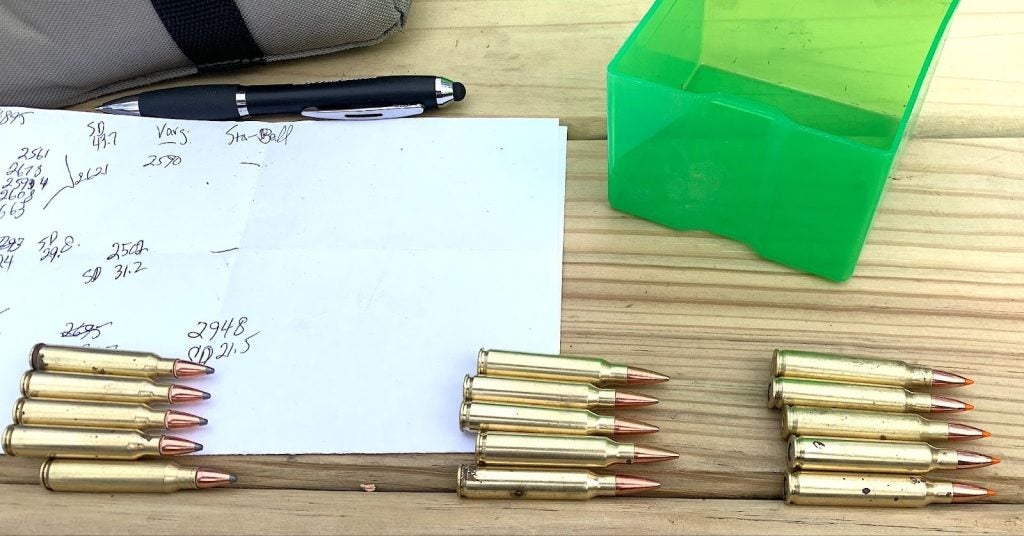
All of these are useful in a number of rifle cartridges. I have used them in my .308 loads, and my son has used at least one of them for his .45-70, .308, and 6.5 Creedmoor rifles. They are standard, versatile powders that can fuel many calibers.
I swapped rifles at this point. I put the short-barreled, suppressed Stealth AR in the safe and grabbed my new Ruger Harrier 16-inch AR (review here.) with a Burris Fullfield 3-12×42 scope in place. I wanted velocity numbers out of a standard-length AR barrel. In terms of primers, we used CCI Small Rifle for all loads, set into mixed cases.
We set targets up as close to 100 yards as I could get, since a huge tree came down in front of my 100-yard target stand. We came close, with a 93-yard distance. I used my Caldwell Lead Sled Solo rifle rest on my new shooting bench. I like 5-shot groups… I think they are more informative than three shots. So, that’s what I shot. I used my home-made diamond targets that help with reticle alignment.
Here are the results in table form…
| Bullet | Powder | Charge, grains | Velocity, 5-shot average, fps | Standard Deviation | Comments |
| 55-grain BTSP | Varget | 25 | 2502 | 31.2 | 2 |
| CFE223 | 27.5 | 2912 | 6.7 | 1 | |
| H4895 | 24 | 2724 | 29.8 | 1 | |
| Sta-Ball Match | 27 | 2915 | 17.8 | 3 | |
| 60-grain Ballistic Tip | Varget | 24 | 2590 | N/A | 2 |
| CFE223 | 26 | 2716 | 27.4 | 2 | |
| H4895 | 23 | 2621 | 43.7 | 1 | |
| Sta-Ball Match | 25 | 2663 | 36.8 | Horizontal stringing | |
| 68-grain BTHP Match | Varget | 23 | 2717 | 30.0 | 3 |
| CFE223 | 24 | 2481 | 30.5 | Vertical stringing | |
| H4895 | 22 | 2461 | 12.3 | 2 | |
| Sta-Ball Match | 24 | 2948 | 21.5 | 1 |
1 Shot into 1 – 1.5 MOA
2 Shot into 1.5 – 2 MOA
3 Not accurate enough to warrant development
The charges we chose were between the minimum and maximum charges listed for each bullet weight and powder.
This was not an exhaustive test, but it served well to let us know which loads were worth pursuing in terms of both accuracy and velocity. Since I couldn’t get to the full 100-yard mark, you may assume these results are close to the MOA standard, but not quite. At least we know what works and what doesn’t, among the components I used. There are dozens of .224 bullets, primers, and suitable powders out there that can reload .223. I used components I could source…. This is but a start.
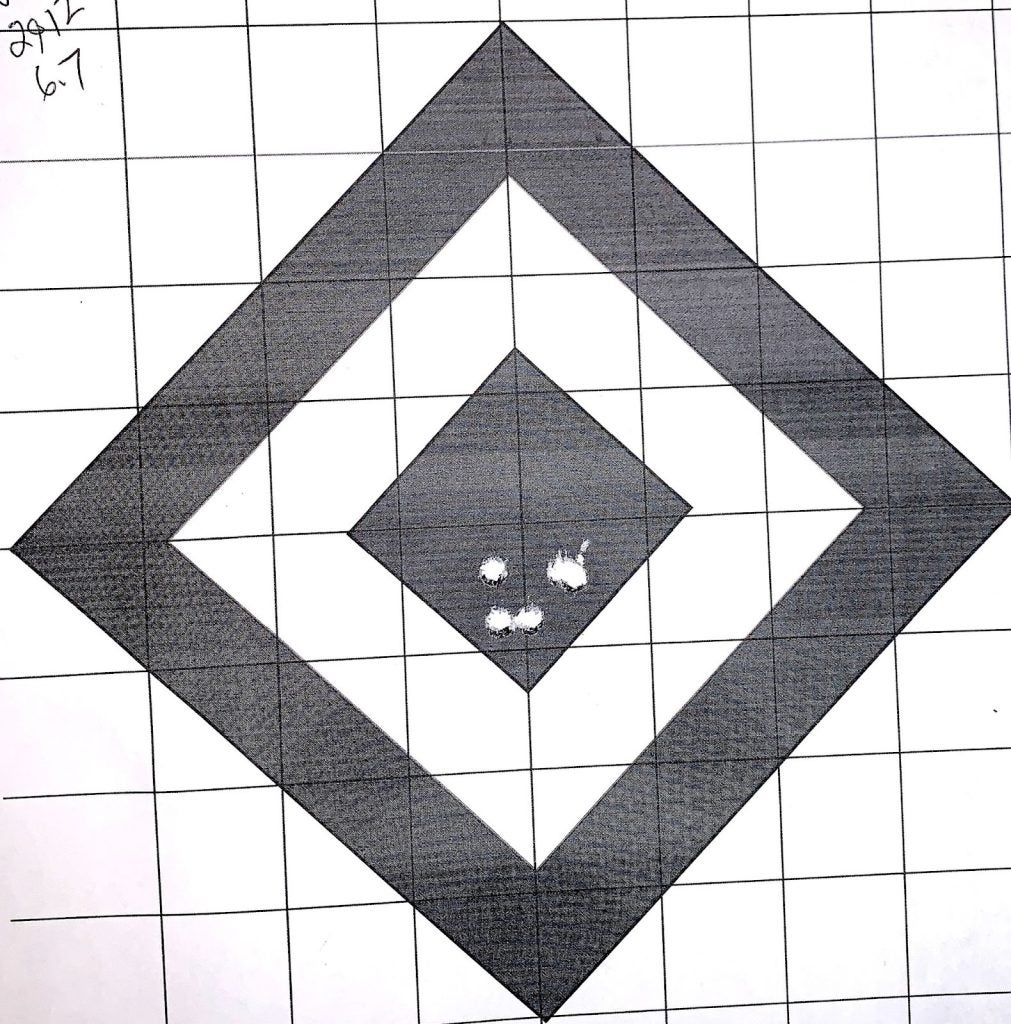
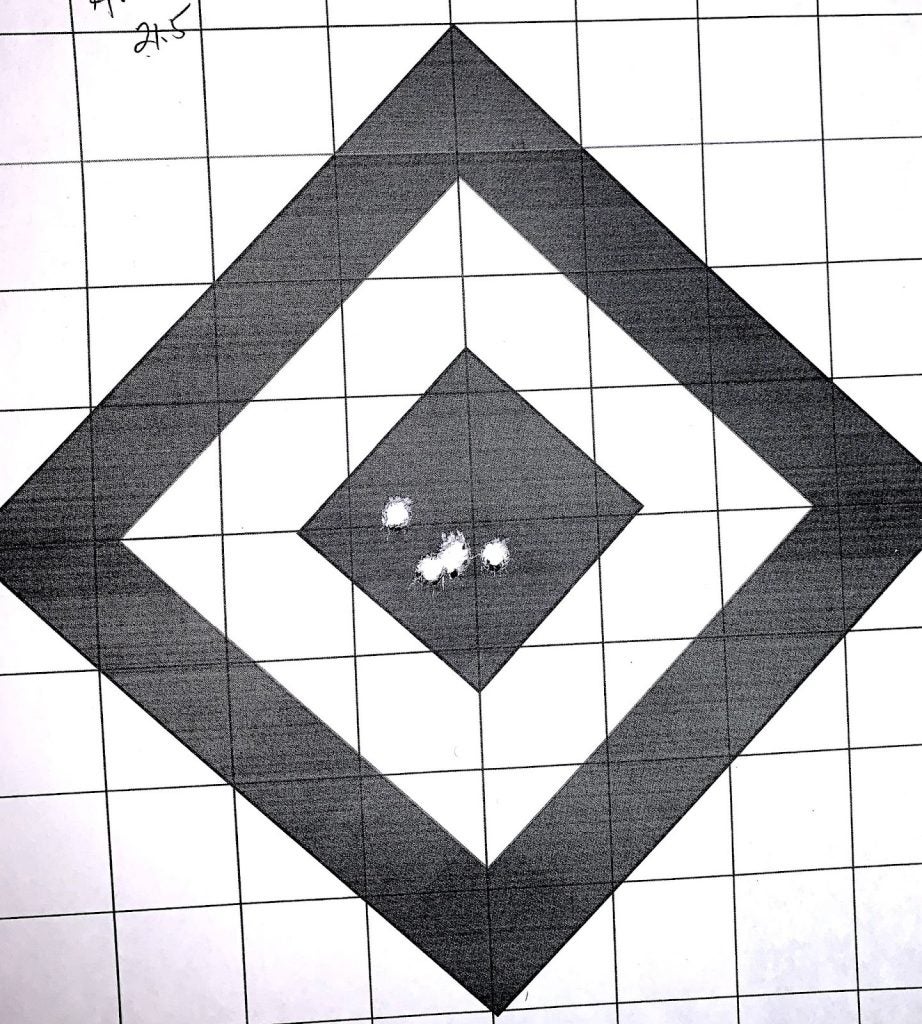
For my little exercise, two powders proved themselves worthy of further experimentation… CFE223 and Winchester’s StaBall Match. I had not done much with either of those before this experiment, but, ja sure, you betcha I’m going to develop both powders with more bullets after these preliminary results… I can’t wait to try!
The Take-Away
As you can see from the targets, some loads were more accurate than others. We found that
Final Thoughts
As I said above, this was a dual-type review… well, maybe a review/article, since the reloading part wasn’t a review. Anyway, the RCBS turret press bridges the gap between single-stage and progressive very well. Having used all three press types for years, I found myself gravitating back to my old turret press more often than not. It was faster than a single-stage, but not as complicated to set up or use as a progressive… the Goldilocks of presses.
If you want to take a step up from your single-stage press but don’t feel the need to go full-tilt progressive, take a look at the RCBS turret press. It can’t do what a true progressive can do, but it will certainly speed up the process. I do recommend getting the RCBS case-activated linkage kit that connects your Uniflow measure to a powder-through expanding die and is activated by the case going up into the die. This is a quicker way to dispense powder. I would also use some type of powder cop die (the RCBS Powder Checker is one such die) that uses a sliding rod that sits on the powder charge. This way, you see at a glance if your powder dispenser did its job for each case. Some such dies use an audible beep to accomplish the same purpose. This is an inexpensive way to ensure that the powder charge is dropped.
Reloading is a great way to expand your enjoyment of shooting. You can do more shooting for the same amount that you would spend on ammo, plus you have the satisfaction of crafting your ammo yourself. RCBS equipment is top-notch… I’ve owned their products since 1978. This turret is a practical, less expensive way to start reloading… why not give it a try?
DISCLAIMER: Neither The Truth About Guns (TTAG) nor Mike Hardesty is responsible for any damage or injury caused by using any information contained in this article. Readers are instructed to proceed at their own risk.

