

Estimated reading time: 15 minutes
The Ruger LCP Max takes the old pocket .380 formula and finally makes it feel modern. For California buyers especially, this little pistol delivers real sights, real capacity, real concealability, and a price tag that makes it awfully hard to dismiss.

Ruger is well known for making solid firearms with value in mind. Their guns do not break the bank, yet they are also known for reliability. They have long had the reputation that while they may not be pretty or fancy, they get the job done. In 2008, Ruger jumped into the concealed carry market in a big way with the LCP series of .380 Auto pistols. Their latest version, the LCP Max, has now become an impressive option for concealed carriers in, of all places, California. It brings a concealable, capable, and much-improved version of the LCP to the market that is absolutely worth a look.
Why the Pocket Gun Still Has a Very Real Job
Before we go much further, we really should address the elephant, or in this case, the mouse, in the room. None of this is terribly new, but it is important for context.
So what exactly is the role of a micro gun, or “mouse gun” as they used to be called? This gun serves a very specific purpose. It is a gun for when I do not expect to need a gun, and when I need the most discreet firearm I can carry. It is a gun that I can fit in a pocket and not look like I am carrying a gun in my pocket.

Additionally, some people’s threat environment, lifestyle, or circumstances may dictate this kind of firearm. You may not be able to carry a larger gun, and the need for discretion outweighs your preference for something bigger or easier to shoot. A smaller gun, especially in .380 ACP, is not a 9mm or .45 ACP when it comes to stopping power. However, not everyone feels they need a full-size 9mm. It is still potentially adequate in many self-defense circumstances, and in a firearm this small it is a very viable option.
🛒 Check Current Price for Ruger LCP Max on GunsAmerica
How the Ruger LCP Became a Serious Pocket Carry Player
In 2003, Kel Tec introduced the affordable P3AT, a tiny .380 Auto that was arguably one of the smallest .380s on the market. It used a plastic frame and a steel upper. In 2008, Ruger launched the first version of their Lightweight Compact Pistol, or LCP, which appeared to be heavily based on the P3AT, using a glass-filled nylon frame and steel slide. This sat in stark contrast to more famous .380 ACP designs such as the Walther PPK/S or the Beretta Cheetah, which were larger and heavier handguns.
These early LCP autos were so small that they easily went into a pocket and disappeared, with a 6-round magazine of .380 on board. At just over 0.8 inches thick, the gun became known for its ease of carry. They later became somewhat famous when a Governor used one to dispatch a coyote that was attacking his dog.
The double-action-only trigger was brutally heavy to address safety concerns, and recoil was snappy due to the small size combined with the narrow grip. However, two of the biggest complaints were the lack of usable sights, which were tiny metal nubs molded into the top of the slide, and the fact that the gun would not lock open on an empty magazine. This was a close-in gun, and not something I would use beyond 7 to 10 yards.
Over the years, the Ruger LCP evolved. Versions with different triggers and improved sights came out. A version called the LCP II was released in late 2016 with a better trigger that used a partially cocked hammer, a somewhat improved grip design, and slightly better sights that were integral to the slide. Currently, all of these versions are still in production.
The Ruger LCP Max Fixes What Used to Hold the LCP Back

In 2021, Ruger decided to jump into the higher-capacity micro gun space and released a new version, the LCP Max. Instead of going after a micro 9mm, although they did that as well, they built out a micro .380 Auto.
This new version improved on the early designs. It gave you a far better trigger pull with a partially cocked hammer like the LCP II, actual sights, a recontoured frame, and better capacity with a standard 10-round magazine or an optional 12-round extended magazine.
The new sights are dovetailed into the slide with a tritium-dot front and a blacked-out rear. The new frame is slightly taller, about a half inch from the early LCP, and marginally thicker, 0.945 inches by my calipers, to accommodate the larger magazines. These pistols come with or without safeties, and in multiple finishes and frame colors.
The gun has an empty weight of 10.6 oz, and mine tipped my scale at 14.6 ounces with 11 rounds of Speer Gold Dot. This compares well even against a lightweight revolver, yet still carries over double the capacity.
Why the California LCP Max Actually Matters
As the reality of the Bruen decision comes to California and its impact on concealed carry permits, Ruger submitted the LCP Max to the Golden State’s roster. I will go out on a limb and say it is the best micro gun for its specific purpose we can buy here. It may not be the best for every application, but for the purpose this gun fulfills, it stands alone here. This little, reliable handgun is a welcome addition to this market. It also just might help the cause somewhat, but I will get into that later.
Our version is almost identical to the one in most other states, with two exceptions. First, there is a loaded chamber indicator, or flag, that is about an inch and a quarter along the top of the slide. The flag allows for visual or tactile verification that there is something in the chamber while staying out of the way of the sight picture. It would, however, prevent the use of the Ruger Ready Dot optic that they put on versions of the LCP Max available in other states. Normally I gripe about loaded chamber indicators because they can get in the way of the sights, or are just plain gawdy and ugly. This one was well executed by Ruger.

Second, there is the required magazine disconnect safety that disables the trigger mechanism when there is no mag in the gun. This has not been much of an issue for me on this little pistol, but it does mean I have to be very careful about dry-fire practice. We can have both models, with or without a thumb safety.
All California-approved versions have a stainless slide and black frame. The price point here is in the $300 to $350 range, with it commonly hanging around the $300 area in most stores, placing it at a very affordable price point.
Ruger LCP Max Specs, Capacity, and California Value
| Model | Ruger LCP Max |
|---|---|
| Caliber | .380 Auto |
| Width | 0.945 inches |
| Empty Weight | 10.6 oz |
| Tested Loaded Weight | 14.6 ounces with 11 rounds of Speer Gold Dot |
| Standard Capacity | 10 rounds |
| Optional Capacity | 12 rounds |
| California Configuration | Stainless slide, black frame |
| California Street Price | $300-$350 |
What Comes in the Box With the California Ruger LCP Max

The gun comes in the usual nondescript Ruger cardboard box. Inside, you will find the pistol, a Ruger-branded pocket holster, a loaded chamber flag, a lock, the usual paperwork, a magazine loader, and a single magazine with two baseplates, one flush fit and one with a finger extension. The magazine loader was surprisingly helpful. I was able to purchase a second magazine easily. No matter what weapon I carry, I always want to have a reload on hand.
Currently, as of this writing, there are two versions of the LCP Max on the California State Roster, one with and one without a thumb safety. I chose the one with the safety. Outside of California, there are many versions of this fine little pistol, including different finishes, thumb safeties, and even an optic version.
Shooting the Ruger LCP Max: Better Than a Tiny .380 Has Any Right to Be

I took the little LCP Max to the range with an assortment of ammunition, and over two shooting outings, I put over 120 rounds through the gun using various carry and practice ammo. Federal White Box practice, CCI Blaser Brass practice, Speer Gold Dot, and Underwood Extreme Defender all made the trip. I even began with the gun right out of the box, no cleaning, no lubricating, just straight onto the firing line.
Every round functioned, and overall that shooting, I did not get a single bobble or hiccup.
I have attached my chronograph reading below for the various ammo.
| Ammunition | Velocity (fps) | Velocity Avg (fps) | Avg. Energy (ft./lbs) |
| Federal 95 Gr. FMJ RN Practice Load | 814.9 810.5 828.7 |
818.0 | 141.1 |
| Blazer 95 Gr. FMJ RN Practice Load |
880.6 881.5 863.8 |
875.3 | 161.6 |
| Gold Dot 90 Gr. JHP Defensive Load | 971.2 969.4 984.2 |
974.9 | 189.9 |
| Underwood 68 Gr. Solid Copper Fluid Dynamic Extreme Defender | 1144.9 1205.2 1182.4 |
1177.5 | 209.4 |
*All Measurements Taken with Garmin Xero

Recoil was very manageable and nothing like previous iterations of the LCP. The slightly increased size of the grip allows recoil to be better managed by having a bit more gun to hold onto, and its slightly wider profile and contour spread the recoil out a little better along your palm. While the defensive ammo definitely had more umph behind it, it was not punishing. I was also pleasantly surprised that all types of bullets, from the FMJ to the Gold Dot, to the Phillips-head screwdriver nose of the Extreme Defender, fired flawlessly.
The sights made shooting the gun for accuracy much more attainable. They can be picked up easily and put where you want them. Even with my older eyes, I was hitting the target out to 15 yards or so without issue. In the more realistic range of 7 yards, accuracy was very good for such a small gun.
All magazines locked open on the last round and ejected flawlessly. The only issues I would mention are that the magazine release could be a little more extended, and one of my magazines was a bit hard to load. However, once the mag release was pushed, the mag dropped freely from the gun, and reloads were not an issue. The slide catch and slide release were stiff, but I tend to slingshot the slide anyway.
For a $300 gun, those are minor issues, and overall, both will likely be alleviated with time and the aftermarket. It is far superior to its predecessors in my opinion. Does it shoot like a bigger 9mm, like a Shield Plus or P365? No. But depending on how you perceive recoil, it might shoot surprisingly close to those.
I also have to add that this gun feels great in the hand. With the pinky extension on the magazine, I could get a full grip on the gun, and it pointed naturally for me.
Carrying the LCP Max in the Real World, Pocket, IWB, and Beyond
I worked on finding a good holster, both for the pocket and IWB. Normally, I would have looked for a Harry’s Holsters model, but I found a small kydex IWB at my local shop that did the job. For a pocket holster, while the Ruger version is adequate, I grabbed a Sticky Holsters SM-2. I had heard good things about them, and this gave me an excuse to give one a try.
The IWB keeps the gun secure, and I do not feel it at all. It conceals so well that it has become my exercise gun, and it can sit on a set of gym shorts without effort. As I sit here writing this, it is on me now, and I do not even feel it. A quality ankle rig like the DeSantis Apache Ankle Rig will also hold it securely without any shifting.
For pocket carry, if the pocket is deep enough and you do not wear skinny jeans, it goes in without effort. The new grip is slightly longer and a smidge thicker, but still conceals well. The Sticky holster is a bit thicker than the Ruger one, so it adds a little bit of girth, but it stayed right in the pocket when I drew the LCP Max.
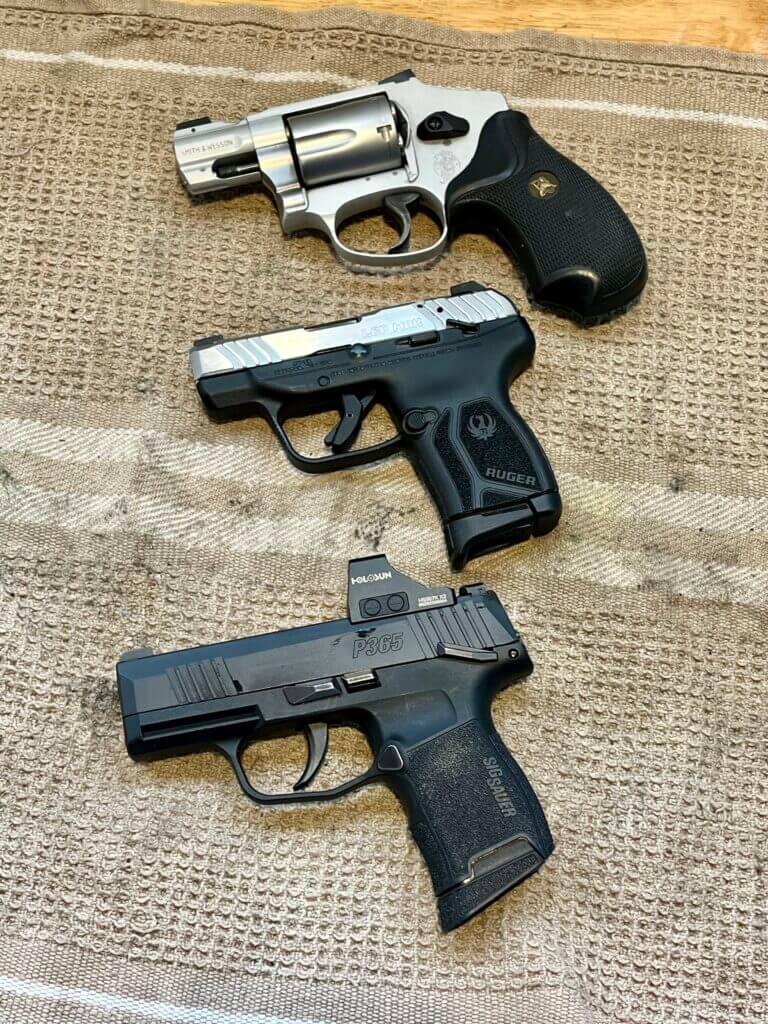
| Firearm | Weight (Loaded) ounces |
| LCP Max (.380 Auto) | 14.53 oz. |
| S&W 642 Ultimate Carry (.38 Sp.) | 19.58 oz. |
| Sig P365 (9mm) | 24.16 oz. |
| S&W Shield Plus (9mm) | 25.71 oz. |
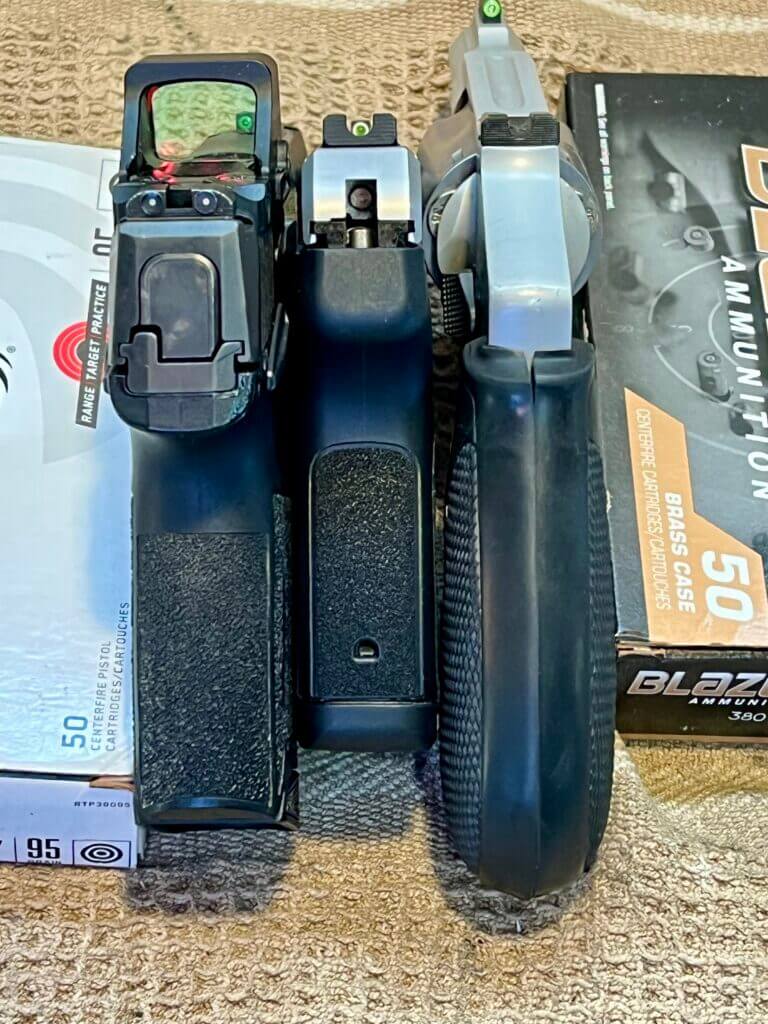
My spare magazine is small and fits in a back pocket easily, so I can be out and about with 21 total rounds of .380 Auto on board. Again, depending on your threat environment, this may be totally adequate, and there are those who carried a .380 for years as a primary concealed carry weapon with far less ammo on board.

Why This Little Gun Matters More Than Its Size Suggests
This gun allows for discreet carry in almost any circumstance or dress. It also gives you a gun you can reliably carry at all times and have adequate firepower on board, again based on your individual needs, to get you out of trouble and protect yourself should you be faced with a deadly force threat. Its performance on the range belies a much more expensive handgun, and the .380 is still a viable defensive round with some of the latest offerings.
What I think is even more important for those of us living in more restrictive states, the gun sends a message: I am discreetly taking responsibility for my own safety.
Final Verdict: The Best California Pocket .380 on the Roster?
I can say this with confidence after owning several of the past versions of the LCP. This version builds on those earlier models and addresses their shortcomings with definitive improvements. Better capacity, much better recoil management, and far superior sights than the earlier versions. It is an absolute improvement over what came before.

I would suggest the LCP Max sits alone on our authorized list of handguns as a micro .380 that is lightweight, reliable, affordable, and shoots far better than its price tag would suggest. There are other .380s, but none of them do it for the size, weight, quality, and value this gun does.
Pros and Cons of the Ruger LCP Max for Everyday Carry
- Pros: Excellent concealability, meaningful 10-round capacity in a true pocket gun, much better sights than earlier LCP models, manageable recoil, reliable performance, affordable California street price, easy backup or deep-concealment role.
- Cons: Magazine release could be more pronounced, slide catch is stiff, one magazine was hard to load, California version loses optic compatibility because of the loaded chamber indicator, and this is still a tiny .380 rather than a larger, easier-shooting 9mm.
Available on GunsAmerica Now
Brian Jensen has been a shooter for over 45 years, and served in law enforcement for over 30 years in Southern California. During that time he served for over 27 years on the Department Range Staff. Brian has written for Guns America and Harris Publications, and currently trains law enforcement trainees in a local police academy as well as civilians for CCW courses.
Away from writing Brian does photography and exploring the southern California backcountry.
Experience:
-45+ years as a shooter
-Prior Law Enforcement for over 30 years
-27+ years instructing firearms for peace officers
-Civilian CCW Instructor

