

Estimated reading time: 11 minutes
A 6.2-lb Savage 110 wearing carbon fiber in all the right places, including a Proof Research barrel, then casually stacking a 0.46-inch best group in 308 Win. If you have ever wished the 110 could go full mountain mode, this is it.

Savage 110 KLYM V2 Review: The 110 Goes Full Mountain Rifle
The Savage 110 rifle has been in continuous production since 1958, making it America’s longest-running sporting rifle. The venerable design is known for many things, including affordability and out-of-the-box accuracy, but the rifle was never top of mind for those seeking an ultralight rifle. Most models weighed more than seven pounds, and some tipped the scales well north of eight pounds.
That changed with the introduction of the model 110 KLYM (as in “climb”), which has now evolved into the KLYM V2. Depending on chambering, this gun weighs just 6 – 6.4 pounds, making it a legit mountain or backcountry rifle. Considering that the gun is built around the beefy 110 action, making the KLYM this light represents quite an engineering accomplishment.

How Savage Got a 110 Down to 6 – 6.4 Pounds
As you might expect, Savage got a lot of the weight out of the 110 by employing carbon fiber. This includes a carbon fiber-wrapped, stainless-steel barrel from Proof Research and a thumbhole-design carbon fiber stock from FBT (Fine Ballistic Tools). This drives the price up considerably from the affordable category Savage has long occupied, but that’s the price of admission these days if you want an ultralight rifle.
Closer examination reveals that Savage shaved weight from the rifle in other areas, as well. The left side of the receiver, for example, has a fair amount of metal removed from four milled-out cuts. The bolt body has diamond-pattern fluting to save a bit more weight, and even the bolt knob is made of carbon fiber.
The result is a trim, light rifle tailored for backcountry or mountain hunting. That’s evidenced in the rifle’s available chamberings. In addition to standards like 6.5 Creedmoor, 308 Win, 300 WSM, and 300 Win Mag, the rifle is offered in newer, highly efficient long-legged cartridges such as 6.5 PRC, 6.8 Western, 7mm PRC, and 7mm Backcountry.

Proof Research Carbon Fiber Barrel: Light, Fast, Consistent
Barrel length on the KLYM V2 varies by chambering, from 24 inches for guns in 6.5 PRC, 6.8 Western, 300 WSM, and 300 Win Mag to 20 inches for the 7mm Backcountry, which achieves higher velocities out of shorter barrels. Barrels for all other chamberings measure 22 inches.
The benefits of carbon fiber-wrapped barrels are by now well-known. They can be more than 60 percent lighter than traditional steel barrels of the same contour and be just as accurate. They can also provide reduced harmonic barrel vibration and improved heat dissipation, which translates into consistent accuracy and little point-of-impact shift during long shot strings.
With the KLYM V2, Savage did not ignore those who wish to hunt with suppressors. Barrel muzzles are threaded 5/8×24, and rifles ship with an Omniport muzzle brake in place that helps mitigate recoil.

FBT Thumbhole Carbon Stock: The One That Changed My Mind
The rifle’s barrel is free-floated inside a unique, lightweight carbon fiber stock from Fine Ballistic Tools (FBT). Even a cursory glance tells you this stock is different from most on factory rifles. For starters, it’s a thumbhole design. I’ve never been a big fan of thumbhole stocks, but this one won me over. The thumbhole in the buttstock provided a near-vertical grip, which I find great for shooting in a variety of field positions, and it positioned my finger perfectly on the trigger.
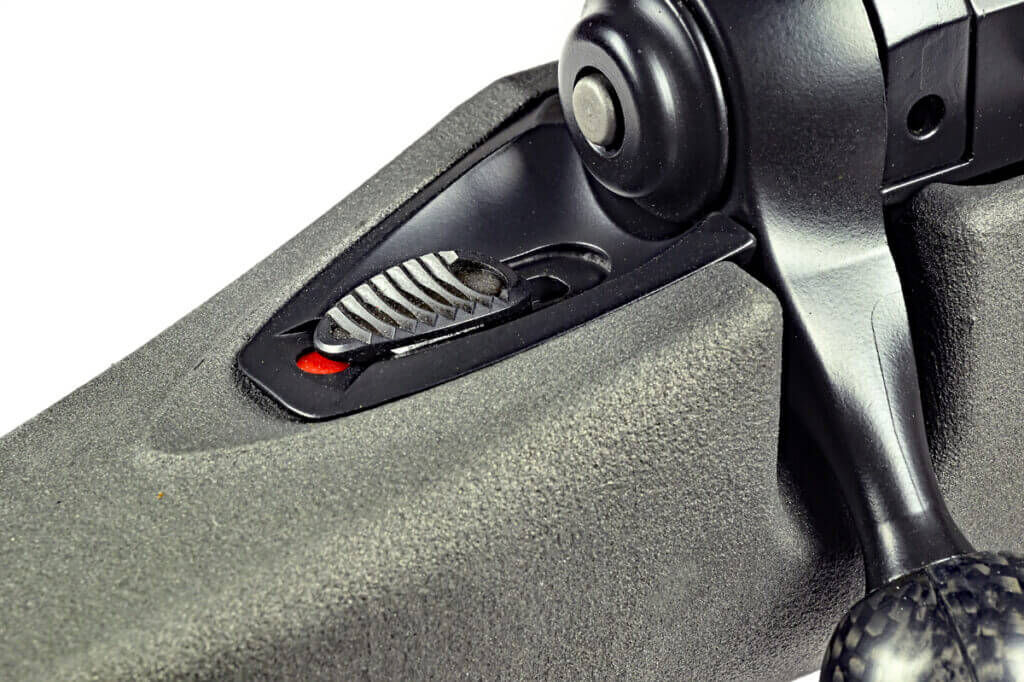
The FBT stock also has a comb that you can adjust quickly with the push of a single button to achieve optimal eye-scope alignment. You will find traditional sling swivel studs fore and aft, as well as a single MagnaSwitch adapter for attaching MagnaSwitch system components like bipods or tripods.
The stock forend flexes slightly more under firm pressure than I would prefer, but that did not, as you will see, seem to have any adverse impact upon accuracy. The stock is equipped with a substantial rubber recoil pad. Interestingly, the recoil pad has a set of latitude/longitude coordinates carved into its surface. These appear to match the alpine location of FBT in Austria.
A Proven Savage 110 Action, Trimmed but Still Tough
While the action has had some weight removed, it’s still a 110 action, which long ago established a reputation for being tough and durable. In this case, with the KLYM V2, the receiver is made of stainless steel and has a protective black Cerakote finish.
Savage does a couple of things differently from other gunmakers with 110 actions. First, Savage takes a zero-tolerance approach to headspacing by hand-fitting barrels to actions and securing them with a barrel locknut. Some purists have mocked the appearance of the barrel nut, but this precise headspacing undoubtedly contributes to the solid reputation Savage rifles have earned over the years for out-of-the-box accuracy. The same applies to the Savage floating bolt head, which employs two substantial locking lugs that self-align to a degree.
My test rifle ran with complete reliability, feeding, extracting, and ejecting without hiccup. That’s partly due to the bolt’s tough extractor and twin plunger ejectors. The bolt has a protective black finish, and diamond fluting helps it cycle with acceptable smoothness. The bolt handle is threaded and topped with a round, oversized carbon fiber bolt knob.
The rifle uses a detachable magazine that’s partly made of metal. Magazine capacity is four rounds for rifles chambered in 6.5 Creedmoor, 308 win and 7mm Backcountry, three rounds for guns chambered in 300 Win Mag, and two rounds for guns chambered in 6.5 PRC, 6.8 Western, 300 WSM, and 7mm PRC. The magazine clicks into place with authority and pops freely into the hand when you operate the recessed, protected magazine-release lever.

Improved AccuTrigger: Lighter Pull, Same Confidence
The rifle is, of course, equipped with the much-copied Savage AccuTrigger, which first made its appearance 23 years ago. This proven design uses a steel blade in the trigger shoe that blocks the path of the sear when the trigger is at rest. The blade functions as an additional safety, and the gun won’t fire unless the blade is fully depressed. Some purists don’t like it, but the AccuTrigger has never given me any issues.
The trigger is adjustable, but you’ll have to pull the action from the stock first, taking care to torque the action screws to specification afterward. AcccuTrigger pull weight is generally adjustable from 2.5 pounds to 6 pounds, but select models get an improved AccuTrigger with a lighter pull weight. With the KLYM V2, the pull-weight range is just 1.5-4 pounds.
For testing, I dialed the pull weight down to 2 lbs., 6 oz., which I find to be just about perfect for a hunting rifle. I then mounted one of my favorite scopes for field or range work, the Zeiss Conquest V4 6-24×50, on the 20-MOA Picatinny rail that comes pre-installed on the rifle.
The rifle’s improved trigger pairs with a three-position, tang-mounted safety that locks the bolt down in the rearmost position. You can still operate the bolt and cycle rounds through the action with the safety in the middle, engaged position. To fire, you simply push the safety all the way forward, and you’ll find that easy to do since the safety is within easy, natural reach of the thumb when the trigger hand is in shooting position.

Range Results: 0.46-In Best Group From a 6.2-Lb Rifle
The first order of business in evaluating the rifle sent to me for testing, which was chambered in 308 Win, was to select and chronograph five different factory loads to see what sort of velocity the gun’s 22-inch barrel delivered. As measured with a Garmin Xero C1 Pro chrono, velocities for most loads were within just a few fps, plus or minus, of factory-advertised numbers for the loads tested. This indicates that the gun has a somewhat “fast” barrel, as the factory numbers are typically achieved with longer barrels.
Accuracy testing consisted of shooting three 3-shot groups per load at 100 yards. I deliberately handicapped the rifle by testing mostly hunting ammunition, with only one match load in the mix. Considering that lightweight rifles are always more challenging to shoot with consistent accuracy, the rifle did quite well and lived up to my expectations. Nosler’s 168-gr. match load produced 0.91-inch average groups and a 0.75-inch best group, but Winchester’s 150-grain Deer Season XP load stole the show with 0.74-in average groups and a 0.46-in best group.
Three other tested hunting loads turned in average groups that were just slightly over one MOA, with some sub-MOA best groups. I’m sure those groups would have tightened up a bit if I had been shooting on a less windy day.
Wind or no wind, I’ll take that sort of accuracy all day long in a rifle that’s light enough to tote into the most rugged and remote high country.

Savage 110 KLYM V2 308 Win: Accuracy and Velocity Data
| Load | Avg. Velocity (feet per second | Avg. Group 100 yards | Best Group 100 yards |
| Federal NonTypical Whitetail 150 gr. | 2,821 | 1.16 | 0.94 |
| Nosler Match grade 168 gr. HPBT | 2,718 | 0.91 | 0.75 |
| Nosler Whitetail Country 165 gr. | 2,753 | 1.33 | 1.28 |
| Winchester Deer Season XP 150-gr. | 2,823 | 0.74 | 0.46 |
| Hornady Superformance 165 gr. SST | 2,837 | 1.07 | 0.85 |
Note: Velocity was an average of 3 shots, measured with a Garmin Xero C1 Pro chronograph. Accuracy is taken from three, three-shot groups at 100 yards in wind varying 8-14 mph.

Savage 110 KLYM V2 Specifications: The Exact Build, As Tested
| Action/Length | Bolt action/short action |
|---|---|
| Chambering | 308 Win, as tested |
| Stock | FBT carbon fiber thumbhole |
| Stock Finish | Matte carbon-fiber weave |
| Barrel | 22-in. Proof Research carbon fiber/stainless |
| Rifling Twist Rate | 1:10 |
| Threaded | 5/8×24 |
| Magazine/Capacity | Detachable, 4-rounds |
| Sights | None, 20-MOA Picatinny rail for optics |
| Trigger | Adjustable, 1.5-4 lbs. |
| Weight | 6.2 lbs. |
| Overall Length | 44.5 inches |
| Length of Pull | 13.75 in. |
| MSRP | $2,969.00 |

Pros & Cons: The Mountain-Rifle Reality Check
- Pros: Very light for a 110-based rifle at 6.2 lbs.; Proof Research carbon fiber barrel; threaded 5/8×24 with Omniport brake; improved AccuTrigger range (1.5-4 lbs.); excellent accuracy potential with hunting ammo.
- Cons: Premium MSRP at $2,969.00; forend flexes slightly more than preferred under firm pressure; thumbhole stock will not be everyone’s flavor.
Related Reads from GunsAmerica Digest
Available on GunsAmerica Now

Mike Dickerson is an award-winning writer who has published thousands of magazine and newspaper articles. He is an avid hunter and recreational shooter with decades of experience, specializing in rifles, shotguns, optics, and ammunition. He is also a proud Vietnam veteran who maintains close ties with the US military.
Experience
Decades of hunting experience spanning North America
Deep relationships with major industry manufacturers
Extensive training in long-range shooting
Stories published in virtually every major American hunting and gun magazine
Highly experience wildlife and landscape photographer

