

Estimated reading time: 10 minutes
Seekins Precision has redesigned their rifle actions and bolts for high pressure. Now, they’re rethinking the barrel itself for a new generation of cartridges that run hotter, hit harder, and punish old-school barrel design in a hurry.

Why Seekins Thinks the Barrel Is the Next Big Rifle Breakthrough
For decades, innovation in precision rifles has largely focused on optics, chassis systems, and ammunition. Barrels, despite being the most critical component influencing accuracy, pressure tolerance, and long-term durability, have changed very little. Most manufacturers continue to rely on traditional steels, conventional rifling geometries, and twist rates that have remained largely unchanged for generations.
That long-stagnant part of the precision rifle world is finally starting to move.
Seekins Precision is introducing a new barrel technology platform designed specifically for the realities of next-gen modern high-pressure cartridges. As military and commercial cartridge development continues to push operating pressures higher, rifle systems must evolve alongside the ammunition they fire. Seekins’ approach is simple: design the entire rifle system, including the barrel, to safely and efficiently harness higher pressure.
Their receivers and bolt systems have already been engineered with this future in mind. Now, Seekins is introducing a new generation of barrels built to fully exploit those capabilities.

The result is a combination of advanced metallurgy, internal bore coatings, proprietary rifling geometry, extreme gain-twist rifling, and cut-rifled manufacturing that together represent a substantial leap forward in barrel performance and longevity.
Watch Seekins Explain the Barrel Technology
Why Seekins Built This Barrel for the High-Pressure Era
Next-gen modern cartridge development is moving steadily toward higher chamber pressures. Military small-arms programs, including next-generation squad weapon initiatives, have already begun pushing pressures far beyond traditional sporting cartridges.
Higher pressure produces meaningful performance gains. Velocity increases. Ballistic efficiency improves. External trajectories flatten. Terminal performance can increase.
But higher pressure also brings serious challenges.
Barrels experience dramatically increased thermal loads, higher friction, greater throat erosion, and accelerated wear. Traditional barrel materials and geometries were never designed to live long under these conditions.
Seekins’ new barrel system addresses these problems at multiple levels simultaneously.

The foundation of the new system is steel.
Seekins is utilizing a hardened barrel steel made of Carpenter GNB200 with a metallurgical profile designed to better tolerate the thermal and mechanical stresses associated with high-pressure cartridges. While most barrel steels prioritize machinability and traditional heat treatment profiles, Seekins’ formulation focuses on maintaining structural integrity and surface hardness under repeated high-pressure firing cycles.
The result is a barrel that resists throat erosion, maintains rifling geometry longer, and retains accuracy deeper into its service life. These barrels are engineered to remain dimensionally stable even when subjected to the pressure and heat loads that are beginning to define modern cartridge design.
Simply put, these barrels are built to survive the pressures that modern cartridges are starting to demand.
Machine-Gun-Proven Coatings That Fight Heat and Erosion

Material strength alone is not enough.
To further combat friction, heat, and erosion, Seekins is incorporating specialized proprietary internal bore coatings similar to those proven in belt-fed machine gun systems. In military applications, these coatings dramatically extend barrel life under extreme firing schedules where conventional barrels quickly degrade.
Applying this concept to precision rifle barrels produces several important advantages. Friction between the bullet and bore is reduced, which lowers operating temperatures and slows the rate of throat erosion. Copper fouling is reduced because the smoother surface creates fewer microscopic points where jacket material can accumulate. The bore surface itself becomes far more durable, allowing it to maintain consistent internal ballistics over thousands of rounds.
For shooters accustomed to traditional stainless barrels losing their edge relatively quickly in high-performance cartridges, the difference can be significant.
Seekins’ Proprietary Rifling Geometry Is Built to Last Longer

Another key component of the system is Seekins’ proprietary rifling design.
Traditional rifling profiles tend to prioritize manufacturing simplicity over long-term durability. Seekins approached the problem from the opposite direction, focusing on rifling geometry that reduces stress on bullet jackets while improving long-term barrel life and ease of maintenance.
Combined with the hardened steel and specialized coatings, this rifling geometry helps ensure that the barrel maintains consistent performance much deeper into its service life than conventional designs.
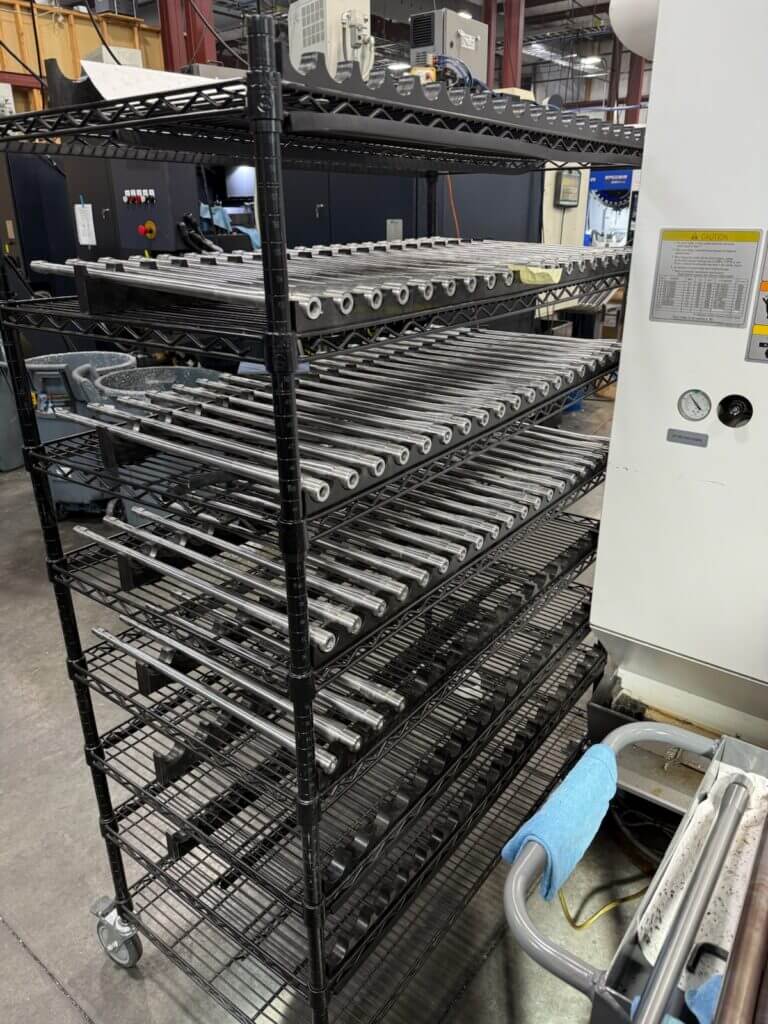
Extreme Gain-Twist Rifling Could Be the Real Story Here
The shape of the lands and grooves reduces aggressive jacket deformation while still providing excellent bullet stabilization. Because the bullet is not being excessively distorted as it travels down the bore, copper fouling tends to accumulate more slowly. The smoother radial transition between land and groove surfaces also makes the barrel noticeably easier to clean, reducing fouling buildup that can degrade accuracy over time.

Perhaps the most technically interesting component of the new barrel system is Seekins’ use of extreme gain-twist rifling.
Traditional barrels use a constant twist rate. If a barrel is listed as a 1:8 twist, that rate is fixed from chamber to muzzle. The bullet is forced into full rotational speed almost immediately upon entering the rifling.
Gain-twist barrels operate very differently. Instead of applying the full twist immediately, the barrel begins with a slower twist rate near the chamber (somewhere between 1:30 and 1:200 depending on caliber) and gradually increases the twist as the bullet travels toward the muzzle. By the time the projectile exits the barrel, it has reached the proper twist rate necessary for full stabilization. The shooter will also notice less torque on the rifle during recoil, especially with the larger 338 bullets.
This gradual spin-up produces several mechanical advantages. The bullet encounters less resistance when it first engraves into the rifling, which reduces the initial pressure spike that normally occurs as the projectile begins moving. Friction is reduced as the bullet accelerates down the bore, which in turn lowers heat generation inside the barrel. The jacket of the projectile experiences less violent deformation, which preserves bullet integrity and reduces fouling.
By spreading the rotational acceleration across the entire length of the barrel rather than forcing it instantly at the chamber, the system reduces stress on both the projectile and the barrel itself. The end result is a system that operates more efficiently while extending barrel life.
While gain-twist rifling has appeared in specialized applications in the past, Seekins’ implementation pushes the concept further by pairing extreme twist progression with modern projectiles and high-pressure cartridges.
Precision Cut Rifling and Chamber Tolerances That Actually Matter

Equally important to the performance of the new barrel platform is how the barrels are manufactured.
Seekins Precision is utilizing precision-cut rifling for these barrels. Cut rifling has long been regarded as one of the most precise methods of forming rifling because it removes material gradually with a single-point cutter rather than displacing steel through button rifling or hammer forging. Each pass of the cutter removes only a microscopic amount of material, allowing the bore geometry to be formed with exceptional dimensional control.
This approach allows Seekins to maintain extremely consistent bore dimensions, groove geometry, and twist progression from barrel to barrel. That level of control becomes especially important when combining hardened steels, specialized internal coatings, proprietary rifling geometry, and aggressive gain-twist profiles. Every one of those elements depends on the bore being machined with extraordinary precision.
Seekins has also developed a proprietary method of chambering these barrels that allows them to hold incredible tolerances in the chamber body and throat, as you would expect from highly experienced gunsmiths. That level of dimensional control at the throat, where the bullet first transitions from cartridge to bore, has historically been nearly impossible to achieve consistently in production rifles.
Maintaining that degree of precision has significant implications for both accuracy and consistency. The relationship between the chamber throat, freebore, and the start of the rifling plays a critical role in how a bullet initially aligns with the bore and how consistently it begins its travel down the barrel. By controlling this transition with tolerances measured in tenths of thousandths of an inch, Seekins is effectively minimizing one of the largest variables that can affect precision.
Seekins Is Trying to Set the New Barrel Standard

Taken individually, none of these technologies is entirely new. Advanced coatings and metallurgy have existed in military applications, gain twist rifling has appeared in limited and often impractical forms, and precision cut rifling has long been associated with high-end custom work. What Seekins Precision has done is bring all of these elements together into a single, cohesive system built specifically for modern high-pressure cartridges and make it available in a factory rifle.
That has not been done before. The result is a barrel that is stronger, more efficient, longer lasting, and more consistent than anything currently offered at scale. As this technology proves itself in the field, it is hard to imagine the rest of the industry standing still. More likely, they will do what they have done before, study it, chase it, and eventually try to copy it. Seekins isn’t waiting around.
🛒 Check Current Price for Seekins on GunsAmerica
Available on GunsAmerica Now

As the Editor-in-Chief of GunsAmerica, Hunt365, Decoding Darkness, and Suppressor Academy, True Pearce brings a rare blend of legal expertise, competitive shooting credentials, and deep hunting knowledge to the forefront of the firearms world. A former professional sponsored 3-Gun and Multigun competitor with multiple championships and titles, True’s shooting career began in long-range and tactical sniper matches—and he still burns powder in precision competitions, now branching into Hunter NRL.
A certified firearms instructor who has trained over 10,000 students face-to-face, True has also served on both sides of the courtroom as an attorney and currently as an elected Prosecuting Attorney. He has prosecuted and defended high-profile self-defense and firearms cases, giving him a unique, real-world perspective on the Second Amendment.
Outside the courtroom and off the range, True is a true western outdoorsman. A lifelong hunter and rancher, he rides and hunts off his own string of horses and pack animals, chasing elk, mule deer, wolves, coyotes, and anything else in season. He’s a longtime reloader, producing both precision rifle ammo and, back in the day, handloading over 40,000 rounds of 9mm and 5.56 annually for competition.
He’s also a thermal and night vision expert, known for his obsession with high-end optics, and is rarely found without a camera or a guitar nearby. Whether he’s glassing a distant ridge, reviewing cutting-edge gear, or deep in legal research, True brings passion, precision, and grit to everything he does.
Experience:
– Professional Shooter – Sponsored 3-Gun & Multigun competitor with multiple titles and a foundation in long-range and sniper/tactical matches.– Firearms Instructor – Certified instructor with over 10,000 students trained face-to-face.– Elected Prosecuting Attorney – Attorney with real-world experience defending and prosecuting self-defense and gun-related cases.– Hunter & Rancher – Horseback hunter with a working ranch, passionate about elk, deer, predator, and backcountry hunting.– Reloading & Ballistics Expert – Precision reloader and former high-volume competition handloader.– Optics Authority – Known for his deep knowledge and unrelenting standards in optics, thermal, and night vision gear.– Outdoor Creative – Avid photographer, guitar player, and outdoorsman with a sharp eye for gear and storytelling.– 2A Advocate – Committed to protecting the Second Amendment and educating Americans about their rights and responsibilities.

