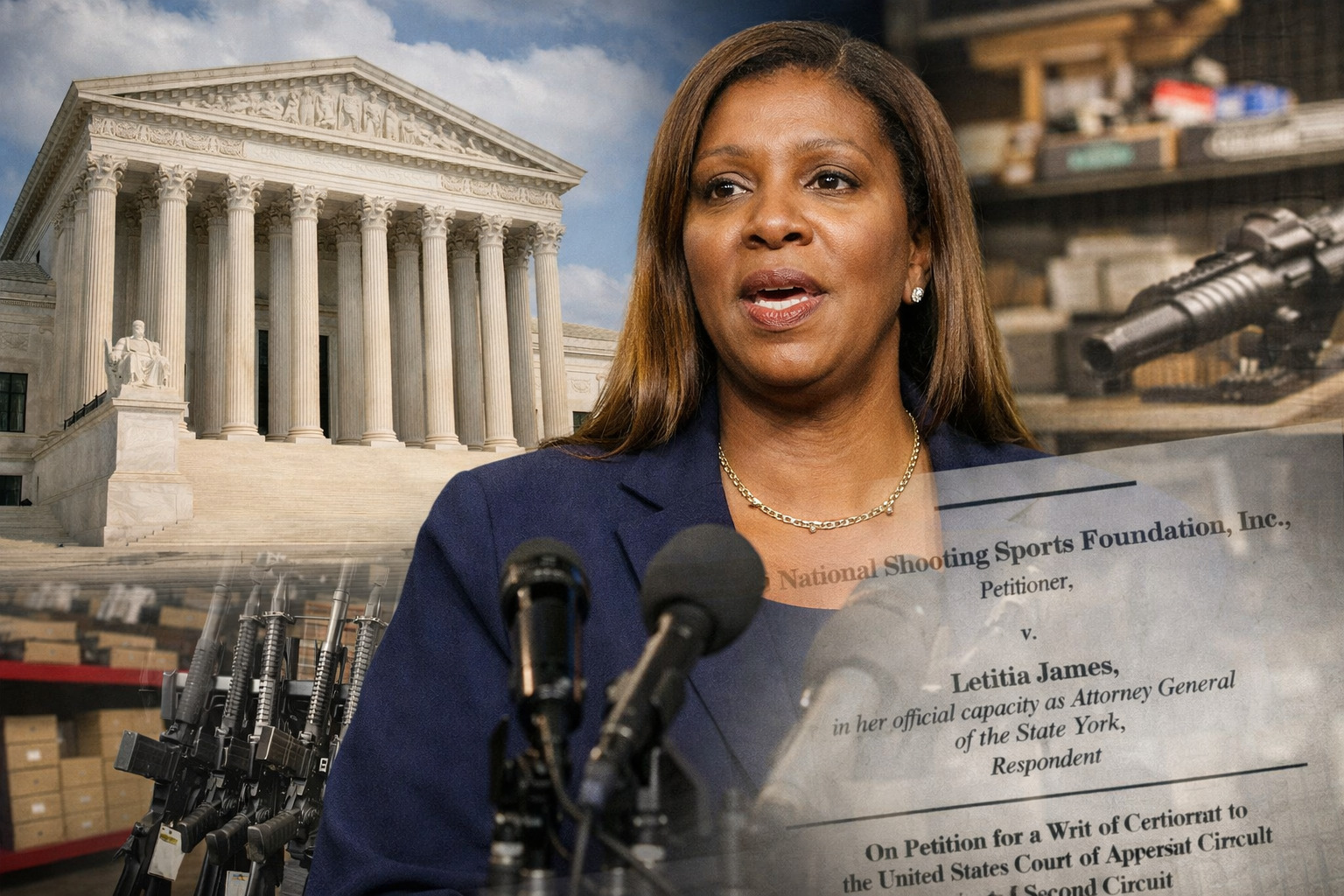


The fight over New York’s gun-industry liability law is getting bigger, and the message now reaching the U.S. Supreme Court is hard to miss: this is not just a trade dispute, and it is not just another blue-state consumer protection case dressed up in legal jargon. According to two major amicus briefs filed in support of certiorari in National Shooting Sports Foundation, Inc. v. Letitia James, New York is trying to do through lawfare what anti-gun politicians have failed to do through the normal legislative process—use the courts to choke off the lawful commerce in arms.
One of those briefs comes from the National Rifle Association, Second Amendment Foundation, American Suppressor Association, and Independence Institute. The other comes from Montana and 23 additional states. Together, they make a serious and layered argument:
New York’s statute is an attempt to sidestep the Protection of Lawful Commerce in Arms Act (PLCAA), revive the same kind of junk litigation Congress barred in 2005, and let one hostile state pressure gun makers and sellers across the country to live under New York’s anti-gun policies.
In the cert petition, petitioners tell the justices the real question is whether PLCAA’s narrow predicate exception can be stretched to let states bring the same tort-style lawsuits Congress enacted the law to stop, simply by codifying general nuisance or negligence principles into a statute aimed at the firearms industry. The petition argues that the Second Circuit green-lit exactly that move, creating a circuit split and opening the door for states to nullify federal law through hostile legislation and coordinated litigation.
Gun rights groups’ brief provides historical context. It argues that suppressing the lawful trade in arms has always been one of the most effective ways to disarm a free people.
As the brief puts it, “Suppressing commerce in arms has long been a means of disarming Americans.”
That theme runs through the filing from beginning to end. The amici trace how British authorities, before the American Revolution, sought to control the colonists not merely by force of arms, but by restricting gunpowder, arms imports, and domestic arms commerce.
In the brief’s telling, the Founding generation understood exactly what those restrictions meant: if government can cut off the supply of arms, it can reduce the people to dependence and submission.
That is why the filing spends so much time on the 1770s. It recounts General Thomas Gage’s restrictions on powder in Massachusetts, the seizure of powder stores, the British embargo on importing arms and ammunition into America, and colonial writings that openly described those measures as efforts to disarm and enslave the people.
One of the brief’s most powerful historical passages cites South Carolina patriots declaring that the British prohibition on arms exports “too clearly appears a design of disarming the people of America, in order the more speedily to dragoon and enslave them.” The brief goes on to argue that Americans did not treat those policies as technical regulatory disputes. They answered them by seizing powder, smuggling arms, ramping up domestic manufacture, and ultimately fighting.
In one blunt line, the brief states, “At the Lexington Green and the Concord Bridge, the British demonstrated that they were willing to kill Americans to take their arms. Coercive disarmament initiated the war.”
The right to keep and bear arms has always depended in part on the ability to make, sell, import, and acquire arms through lawful commerce. The brief even quotes Thomas Jefferson writing in 1793 that American citizens “have always been free to make, vend, and export arms. It is the constant occupation and livelihood of some of them.”
That is the principle the amici say New York threatens now, not with redcoats and royal decrees, but with litigation schemes aimed at strangling the industry from the outside.
The states’ brief adds a different kind of force. Where the NRA-led filing is rich in history and constitutional meaning, the 24-state brief is more direct about the mechanics of the legal end-run.
It says outright that anti-gun activists turned to the courts after they failed to get the results they wanted from Congress and state legislatures. It describes the strategy in plain terms: use novel legal theories, pile up lawsuits, and force firearms companies into bankruptcy or coerced policy concessions even if the claims never truly belonged in court.
According to the states, Congress enacted PLCAA because it recognized that the right to keep and bear arms would be hollow if anti-gun officials could simply destroy the firearms industry through litigation costs and hostile judgments.
Both briefs revisit the coordinated lawsuits of the late 1990s and early 2000s, when cities and activists pursued gun makers under theories like public nuisance and other creative claims designed to impose liability for criminal misuse by third parties. The gun rights groups’ brief notes that some of these theories treated ordinary handguns as “defective” simply because criminals also used them, or tried to liken lawful firearms manufacturing to “ultrahazardous activity.” The states’ brief is even more explicit about the strategy, pointing to public statements from anti-gun officials who openly admitted they were trying to create law through litigation after losing in the legislature.
Congress saw all of that and responded with PLCAA. That is the center of this case. The amici argue that PLCAA was specifically enacted to stop lawsuits against lawful manufacturers, distributors, dealers, and trade associations for harm caused by the criminal or unlawful misuse of firearms by third parties.
The law contains narrow exceptions, but both briefs argue those exceptions were never meant to become loopholes big enough for hostile states to drive the entire old litigation model through. The Supreme Court itself said last year in Smith & Wesson Brands, Inc. v. Estados Unidos Mexicanos that PLCAA’s exceptions cannot be read so broadly that they “swallow most of the rule.” Both amicus briefs hammer that point.
That brings the case back to New York. According to the states’ brief, New York’s law was openly designed to get around PLCAA by recasting the same nuisance-style theories Congress barred. The brief points to New York Governor Cuomo’s own words, noting that the law was intended to “reinstate the public nuisance liability for gun manufacturers” and to correct what state officials viewed as the federal “mistake” of PLCAA.
In other words, the amici are telling the Court this was never subtle. New York did not stumble into a novel theory by accident. It built a statute to restore the very cause of action Congress wiped out.
Twenty-four states are telling the Supreme Court that the Second Circuit’s decision lets a single state gut federal law by slapping firearms-specific language onto what is still, at bottom, a broad nuisance theory aimed at lawful commerce. The brief argues that approach conflicts with decisions from the Ninth Circuit and the D.C. Court of Appeals, both of which rejected similar attempts to turn general laws into PLCAA “predicate” statutes. It also leans on Judge Jacobs’ concurrence in the Second Circuit, where he said the exception should not be stretched to cover general-purpose nuisance statutes with firearms references grafted onto them.
That split matters. It gives the justices a real reason to take the case now instead of waiting around while more anti-gun states copy New York’s approach. And that is not a hypothetical concern. The gun rights groups’ brief warns that ten other states have already enacted similar laws, and the states’ brief points to lawsuits already filed under New York’s statute. Once that model spreads, the damage does not stay local. It becomes national, because the target is the national firearms market.
The states’ brief presses that point with another argument the gun rights groups’ filing touched less directly: the Dormant Commerce Clause. That section of the filing argues New York is not just regulating conduct inside New York.
New York is trying to force manufacturers and sellers everywhere to adopt “reasonable controls and procedures” aimed at preventing misuse in New York, on pain of liability. In practical terms, that means out-of-state companies are forced to tailor nationwide conduct to satisfy one hostile state’s standards, or else risk crushing lawsuits. That is a serious claim because it frames New York’s law not just as a PLCAA problem, but as an attempt to project New York policy far beyond New York’s borders.
If hostile states can sidestep PLCAA and use lawfare to bleed the firearms industry dry, they do not need outright confiscation to weaken the Second Amendment. They can attack the supply chain, drive up costs, shrink access, and erode the right piece by piece. A hostile government does not need to confiscate every rifle or pistol if it can make it legally and financially impossible to manufacture, distribute, insure, or sell them on workable terms.
The end result is the same: fewer choices, higher prices, fewer dealers, a weaker industry, and a right that still exists on paper while becoming harder to exercise in the real world.
That concern is not limited to civilian ownership either. Both briefs emphasize that Congress viewed the firearms industry as important not only to law-abiding citizens, but also to law enforcement and national defense.
The gun rights groups’ brief notes that Congress found national security implications in efforts to bankrupt the industry. The states’ brief echoes that concern, saying the amici states are seeking to protect not just their citizens’ Second Amendment rights but also “the industrial base” that equips police and military forces. That is a reminder that the anti-industry strategy has consequences well beyond the courtroom or a single policy fight.
Taken together, these two amicus briefs give the Supreme Court a full picture. One explains why arms commerce has always been bound with liberty itself. The other explains why Congress passed PLCAA, how New York is trying to slip around it, and why the Court should step in before that workaround spreads further. The gun-rights side is not asking the justices to create something new here. It is asking them to enforce the law Congress already passed and stop states from nullifying it through creative relabeling.
If the Court grants review, NSSF v. James could become one of the most important gun-law cases on the docket, not because it directly asks whether a particular weapon or carry rule is constitutional, but because it goes to a more basic question: can anti-gun states use lawfare to accomplish the slow destruction of the firearms industry after Congress explicitly told them they could not?
These filings leave no doubt how the amici answer that question. They see New York’s statute as a direct threat to PLCAA, to the lawful firearms market, and to the practical ability of Americans to exercise a constitutional right that means very little if government can cripple the commerce that sustains it.