
In the final frantic days of the 2026 West Virginia legislative session, a bill unlike any other in modern American history appeared to clear its first major hurdle. On March 2, the Senate Judiciary Committee advanced Senate Bill 1071, the Public Defense and Provisioning Act, by voice vote, sending the measure to the Finance Committee with barely 24 hours to spare before the crossover deadline.
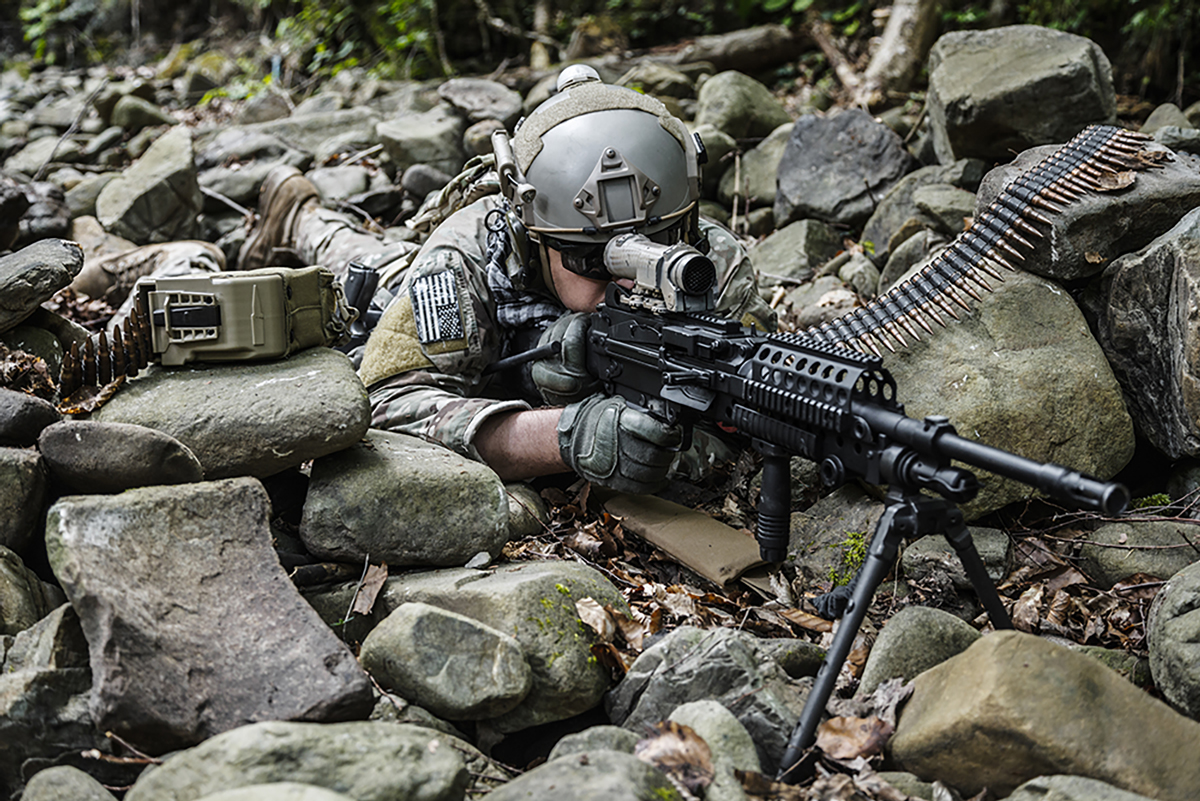
Sponsored by Senators Chris Rose (R-Monongalia) and Zack Maynard (R-Lincoln) and drafted with assistance from Gun Owners of America (GOA), SB 1071 would create a state-run Office of Public Defense inside the West Virginia State Police. That office would purchase modern, fully automatic machine guns, AR-15/M16-platform rifles, M249 squad automatic weapons, MP5 submachine guns, and any other arms “in common use by the military or law enforcement,” and sell them directly to qualified West Virginia residents at every State Police troop headquarters across the state.
The bill is not a modest tweak to existing firearms law. It is a deliberate, carefully constructed attempt to circumvent the 1986 Hughes Amendment, which effectively froze civilian ownership of newly manufactured machine guns after May 19 of that year.
By positioning the State of West Virginia itself as the transferor, SB 1071 invokes the explicit federal exemption in 18 U.S.C. § 922(o)(2)(A) that allows transfers “to or by, or possession by or under the authority of… a State.” The bill’s legislative findings run for pages, quoting District of Columbia v. Heller, Tench Coxe, Henry Campbell Black, and Article III, Section 22 of the West Virginia Constitution to argue that the right to bear “arms of modern warfare” is both a constitutional imperative and a practical necessity for state defense and resistance to tyranny.
If enacted, the practical mechanics are straightforward yet unprecedented. The Office, headed ex officio by the State Police Superintendent, would acquire weapons, prioritizing West Virginia manufacturers where possible, store them in existing barracks and troop headquarters, conduct NICS-style background checks, and complete the transfer. Buyers pay the dealer price plus a mandatory $250 surcharge (plus up to $50 in administrative fees) that flows into a new “Public Defense Fund.” The state issues a sealed certificate proving the transfer was made “by” West Virginia, which the bill declares satisfies federal law. Critically, the legislation shields the state, its officers, and employees from any civil or criminal liability arising from subsequent misuse of the firearms. Records are exempt from the state’s Freedom of Information Act.
The immediate legislative impact is already measurable in the political theater it has generated. Even in one of the nation’s most gun-friendly states, where constitutional carry for those 21 and older has been law since 2021, SB 1071 has exposed fissures.
Sen. Ryan Weld (R-Brooke) voiced open skepticism during the Judiciary hearing, questioning whether the state can unilaterally declare itself immune from decades of federal court precedent interpreting the Hughes Amendment as a near-total ban on new machine guns for private citizens. The president of the West Virginia Troopers Association, Lonnie Faircloth, testified that rank-and-file troopers are personally uneasy about becoming the intermediaries in transfers that he claims could expose both sellers and buyers to federal felony charges. Committee counsel acknowledged that no court has ever blessed a state-to-citizen machine-gun sale of this nature and warned that the Supremacy Clause would likely control any conflict.
Yet supporters, led by GOA’s volunteer state director Alex Shay, insist the bill is not a loophole but a plain-text reading of federal statute. “This actually is federal law,” Shay told the committee. “West Virginia is not flying in the face of federal law.” Chairman Tom Willis (R-Berkeley) called the proposal a “novel legal concept” that finally delivers full Second Amendment parity in the Mountain State.
Though Willis has talked like he has always supported the bill, it took an outpouring of calls from gun owners who live in the Mountain State to force his hand to bring the bill for a vote. Last Friday, the bill was due to be heard, but Willis pulled it at the last minute. Only after an outpouring of outrage was the bill finally given a hearing yesterday, where it passed by a voice vote.
🚨WV BREAKING NEWS🚨
SB 1071 passed out of committee via a voice vote.
We’re at the 11th hour, and need to get the machine gun sales bill to the Senate floor.
WV Gun Owners, please continue to keep the pressure on your Senators by calling (304) 357-7800! pic.twitter.com/QQcdXhPqCd
— Gun Owners of America (@GunOwners) March 2, 2026
This stage is where the bill should have been reported out of committee, but Willis failed to do his duty and report it as of early Tuesday Morning. Of all the bills voted out of committee, only SB 1071 was not reported. A West Virginia lawmaker told AmmoLand News that he believed that Willis did not want the bill and only brought it to the committee to quell unrest.
Although most believe that pro-gun organizations would support the bill, one organization whose endorsement was conspicuously absent was the West Virginia Citizens Defense League (WVCDL). A West Virginia lobbyist working for WVCDL threatened to kill the bill over the weekend in a verbal exchange in front of multiple lawmakers. The lobbyist threatened to kill the bill in other states as well, including Kentucky.
AmmoLand News also discovered in closed-door meetings that at the Capitol, the same lobbyist openly worried to lawmakers that if the bill passed, it could lead to police getting arrested for transferring machine guns. Since the transferee would have to go through the National Firearms Act (NFA) process, the police would be in the clear. The ATF could approve or deny the transfer. If the ATF approved, the police officer would transfer the gun with the federal government’s blessing. If they denied the transfer, the firearm would not be transferred, triggering legal battles. The lobbyist also said he was worried about West Virginians “getting hurt.”
AmmoLand News reached out to WVCDL President Kevin Patrick. He confirmed that the lobbyist was working for WVCDL, but WVCDL doesn’t have an official position on the bill. In the organization bill tracker, SB1071 is not listed, and in an email sent out Monday by WVCDL about current gun legislation, the bill was conspicuously absent. On Saturday, Patrick claims he just hadn’t had the time to update the tracker.
AmmoLand News asked Mr. Patrick whether the lobbyist was acting in good faith for WVCDL or acting on his own, using the WVCDL name. Mr. Patrick refused to answer the question and ended the conversation. It is unclear the motivation for trying to kill the bill, or why WVCDL has not even acknowledged its existence.
All bills must clear their respective chambers by Wednesday in what is known as “Crossover Day.” The bill’s non-reporting could kill it for a year, even though West Virginia Governor Patrick Morrisey has indicated he would sign it into law. The West Virginia Senate could change the rules and forgo some of the mandatory readings, but that would require a two-thirds vote, and it’s unclear whether there is enough support for such an action.
SB 1071 tests the outer limits of state authority versus federal gun control. Success would represent the first time since 1986 that civilians in any state could legally acquire brand-new, select-fire weapons without the artificial scarcity premium that has driven pre-1986 transferable machine guns to $20,000–$50,000 apiece. Should the ATF approve even a handful of Form 4 transfers under this framework, the precedent could ripple outward. Wyoming lawmakers have already signaled interest in similar legislation.
The passage would cement West Virginia’s reputation as the most aggressive pro-Second Amendment state in the Union. For Republican lawmakers facing primary challenges from the right, a vote for SB 1071 becomes a litmus test. Mr. Willis is facing a tough primary, and gun owners might see his actions as a betrayal if the bill isn’t reported.
As of March 3, 2026, the bill’s future remains uncertain. Yet the mere fact that such a bill has advanced this far in 2026 speaks volumes about the evolution of Second Amendment jurisprudence post-Bruen (2022) and the growing assertiveness of state legislatures against perceived federal overreach. Whether SB 1071 ultimately arms thousands of West Virginians with modern machine guns or becomes a symbolic footnote in the culture wars, its legislative journey has already reframed the national conversation.
In a nation where gun policy remains bitterly divided, West Virginia is once again proving willing to push the envelope toward what its lawmakers see as constitutional parity between citizen and soldier.
About John Crump
Mr. Crump is an NRA instructor and a constitutional activist. John has written about firearms, interviewed people from all walks of life, and on the Constitution. John lives in Northern Virginia with his wife and sons, follow him on X at @crumpyss, or at www.crumpy.com.