

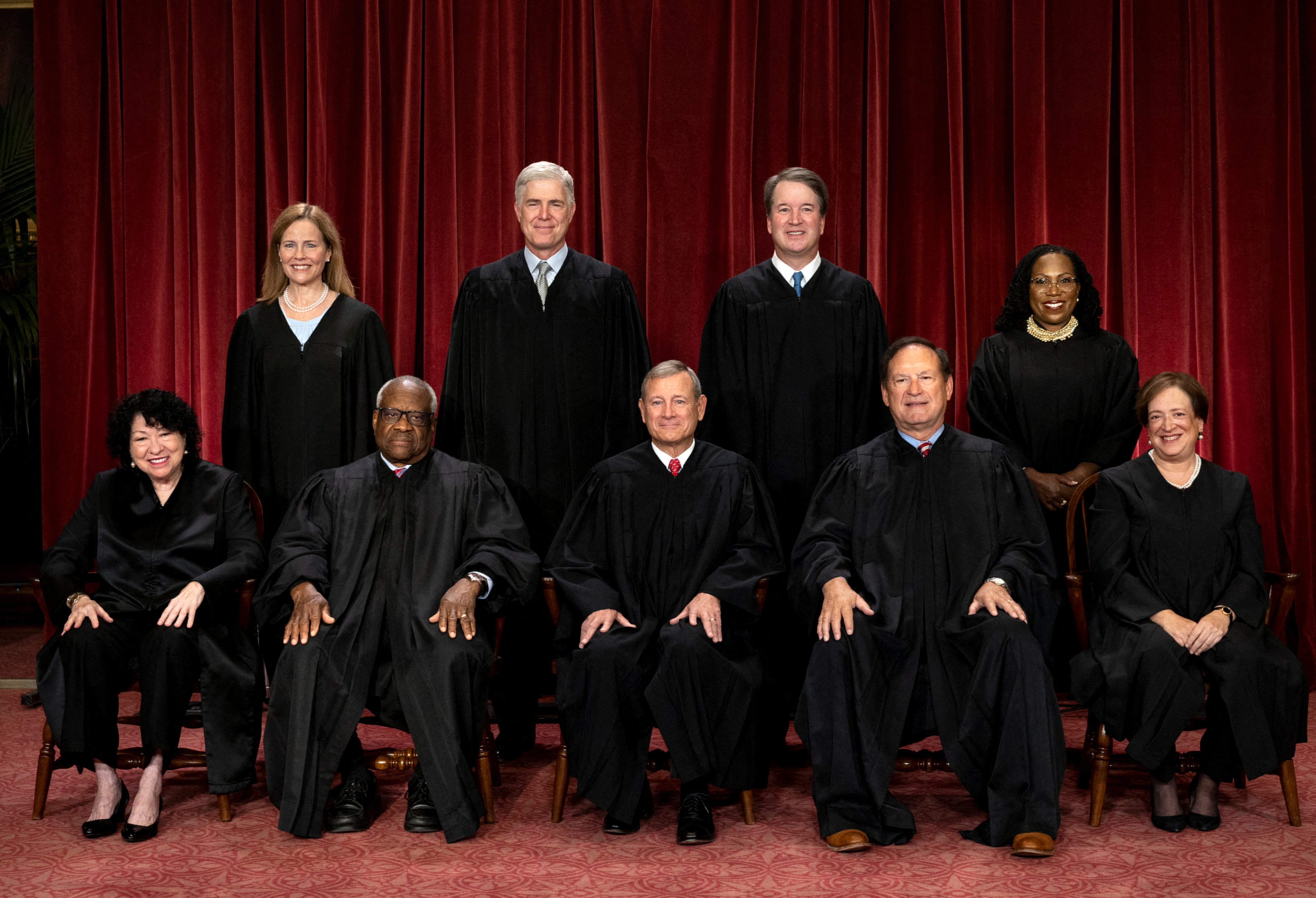
As I listened—and re-listened—to oral argument in United States v. Hemani, I was struck most of all by the seeming confusion over what the Court should do with a case like this. Some of that confusion is no doubt attributable to Bruen, and its requirement to tie any current gun law to something analogous in the distant past. But even under traditional means-end scrutiny, disarming marijuana users presents hard questions, as indicated in the colloquy on this precise point between Justice Jackson and Erin Murphy, the lawyer for Hemani. Despite that confusion, it seems to me there might be a path where a majority of the justices (1) endorse legislative power to create categories of individuals dangerous enough to be disarmed, and (2) consider those legislatives determinations worthy of some amount of judicial respect, even if there is disagreement over application of those standards to the case of marijuana users.
Hayley’s argument preview touched on several key themes that arose during argument. To situate the justices’ questions, let me briefly recap the statute and the parties’ respective positions. The statute at issue is 18 U.S.C. § 922(g)(3), which prohibits gun possession by a person who is either (1) “an unlawful user of” or (2) “addicted to” a controlled substance as defined in the Controlled Substances Act (“CSA”). The government prosecuted Hemani under the “unlawful user” prong, not the “addicted to” prong of the statute. The government argues that the meaning of unlawful user is restricted to habitual or frequent users, not just casual or occasional users. And it finds historical support for disarming those habitual users in the historical tradition of punishing “habitual drunkards.” Hemani counters that the government’s definition of unlawful user isn’t supported by the text and that the historical tradition doesn’t apply to mere frequent users, like habitual drinkers, but only encompasses those for whom habitual substance use so impaired their daily functioning that they could not take care of themselves at all.
As in most major cases, the justices were trying to test where the advocates’ logic would lead. It’s possible they end up choosing to punt on answering some of those implications, but the slippery slopes down either side of the mountain seemed top of mind. For the government’s position, the bottom of the slippery slope would mean someone who had a marijuana gummy every other night to sleep, even pursuant to a valid (state) medical prescription, would be subject to criminal prosecution and a felony conviction that carries a term of up to 15 years imprisonment. For Hemani’s position, the bottom of the slope would mean every criminal prosecution for gun possession would involve a trial court, or possibly jury, determination about the scientific evidence base for drug scheduling, competing expert opinions about the pharmacological properties and propensities of a given drug, and a host of similar complex judgments that could vary among all 94 federal judicial districts across the country.
In this post, I’ll first break down what seemed to me to be the primary concerns of each of the justices and then next try to extract some potential collections of rationales that might possibly command a majority.
- Chief Justice Roberts asked precisely zero questions of the government, but was—to my ears—very skeptical of Hemani’s arguments, especially the notion of allowing as-applied challenges for each defendant, which would require determinations about her individual dangerousness, the drug she used, her dependence on the drug, the concentration of the given drug, whether use inhibits her daily function so as to rise to the level of the habitual drunkard statutes, and so on. He emphasized the congressional and executive judgment expressed in the scheduling of drugs through the CSA and suggested the Court lacked the institutional competency to be making these sorts of judgments in Congress’s place. He forced the concession that the logic of Hemani’s argument would apply not just to marijuana, but to every scheduled drug, including PCP, meth, etc. He noted that plenty of gun laws don’t permit individualized carveouts; for example, he said, you can’t bring your gun into the courthouse even if you are a particularly safe gun handler with no history of misuse. He repeatedly expressed concern about the possibility of individualized determinations about each drug or each offender across the country and the notion of reweighing the scientific determinations that Congress and the Executive branch already made in scheduling drugs under the CSA.
- Justice Thomas questioned the breadth of some of the government’s analogues (like vagrancy laws, which applied to, for example, palm readers), noting they appear to have been motivated by more policy interests than just public safety. He queried the government on whether there must be some implicit danger in the drug itself, and how much was riding on the illegality of use. For Hemani, he merely asked whether this was a facial challenge or not. (Hemani’s lawyer said this case is just about Hemani, but said some of the arguments might also call into question other parts of the law.)
- Justice Alito to me sounded the most firmly in the government’s corner. In his exchange with the government, he confirmed that the most frequently abused illegal drugs today did not exist at the Founding or concurrently with the ratification of the Fourteenth Amendment, and so we don’t know what the ratifiers would have thought about illegal drug use. He asked the government to detail all the problems with as-applied challenges to every drug on the CSA schedules and to individualized determinations not just under 922(g)(3), but to all the other 922(g) categories as well. To Hemani’s lawyer, he was hostile. He said he could not make sense of her argument; that he could not fathom how the individualized determination about drugs could take place in the context of a criminal prosecutions; that the requirement for individualized determinations here would necessarily open the door for as-applied challenges to the rest of the statute, which (he had said in an earlier case) in his view was the most powerful weapon the government had to combat gun violence. He thought Congress had made a determination that CSA drugs were a basis to disarm someone by enacting § 922(g)(3) and cross-referencing the CSA.
- Justice Sotomayor pressed the government on the applicability of the tradition it invoked. She suggested the habitual drunkard laws were not about frequent use but rather focused on how substance use impaired the person’s ability to function within society more broadly. She invoked the hypo of an “illegal Ambien user” as covered by the unlawful-user prong of the statute and asked whether the historical tradition wasn’t more in line with the addicted-to prong. She seemed concerned with the breadth of the unlawful-user prong, extending (as the government conceded) to someone who uses marijuana regularly at parties where their gun is never present and is instead safely stored at home. For Hemani, she noted that while she had signed on to the project of saying Congress can make reasonable determinations about who is dangerous, her view was Congress didn’t make any such determination here merely by scheduling drugs. “If no one has actually done the analysis whatsoever” about whether these drugs are linked to violence, she pointed out, then there is nothing for the Court to even defer to. She added that there was a vagueness concern in the unlawful-user prong because it didn’t have a definition in the statute or from history and tradition like the addicted-to prong does. She is the only justice who directly engaged with the void-for-vagueness challenge, although some of Justice Gorsuch’s questions seemed concerned with the text’s scope and coverage as well.
- Justice Kagan queried the government on how the drugs are scheduled under the CSA, suggesting that the things considered in the scheduling decision aren’t primarily tied to whether a person is dangerous when on that substance. For Hemani’s counsel, she asked what would happen if Congress decided to come up with a separate list of drugs it had determined would be the basis for disarmament, where it was focused on questions about dangers of misuse. She offered a hypothetical involving ayahuasca, stipulating that it is a powerful hallucinogen that causes “reality [to] dissolve[]” and whose mind-altering effects last for a while, but is not addictive. She thought it problematic that under Hemani’s proposed rule, Congress could not make habitual ayahuasca use a basis for disarmament. Hemani’s counsel tried to suggest that that example might be the kind where its frequent use would be enough, but it wasn’t clear Justice Kagan was buying that.
- Justice Gorsuch homed in on the statutory definition of unlawful user, pointing out that on this record the only allegations are that Hemani used marijuana a few times a week, but without an indication of how much, what times of day, etc. He asked the government what we do with a situation like marijuana that is legal in so many places, and which the government itself might reschedule into Schedule 3. The government said its backup position was perhaps that only Schedule 1 and 2 drugs would support disarmament, recognizing that “the cutoff with regard to dangerousness does diminish” as you go down the schedules and stating that the Court could “bracket potentially as-applied challenges” to things like the Ambien hypotheticals. For Hemani’s lawyer, he asked why the Court needs to get into a whole series of hypotheticals about the addicted-to prong of the statute, which this prosecution did not proceed under, or what else Congress could do. “Why isn’t it just enough to say, whatever else may be true,” the allegations here against Hemani do not count as “an habitual drunkard.”
- Justice Kavanaugh seemed to think the historical tradition was focused more on addicts than users, asking the government questions that appear to hinge on a worry about the overbreadth of a mere unlawful-user prohibition. “Could the government prohibit an unlawful drug user from possessing a car?” If they are dangerous, he continued, why not? For Hemani’s counsel, he sought to draw out points of agreement. He got concessions that addicts can validly be disarmed under the Second Amendment. He seemed to want to minimize the concerns that the Chief Justice and Justice Alito raised about individualized determinations. He confirmed with Hemani’s lawyer that the determination with respect to addicts “must be individualized as to whether they fall into that category, but not then individualized as to whether they pose a danger.” For unlawful users, the individualized determination would be whether their habitual use led to widespread impairment in daily life most of the time.
- Justice Barrett reiterated her view that legislatures can make categorical judgments. To the government, she said, “I agree with you, and I think this is what Rahimi says, that legislatures can regulate to keep guns out of the hands of dangerous people.” But—echoing a point Justice Kagan also made—she thought the CSA did not reflect legislative judgments about whether each listed drug would make someone dangerous with guns. She said, “I just don’t see anything in the [CSA’s] scheme that actually reflects Congress’s judgment that this makes someone more dangerous.” Returning to the Ambien hypo, she noted that one can use it lawfully with a prescription, but use without a prescription would subject a person to § 922(g)(3), meaning that it’s not the substance itself that’s driving the dangerous determination, the unlawful behavior is. The CSA, she reiterated, ultimately wasn’t about dangerousness. She asked, “what is the government’s evidence that marijuana use makes someone dangerous?” She queried whether “proclivity for violence” is one of the things considered in scheduling. She agreed with the government that “you don’t need to have just alcohol because that’s all they had at the founding and that would be trapped in amber.” Instead, the goal is to find the principle. “Let’s say then I think the principle is if you have reason to know that someone would pose a risk of violence, is dangerous, the legislature can disarm.” But, she said, the CSA governs things like Robitussin, Ambien, and Adderall, where it’s not obvious their ingestion would make someone pose a risk of violence. She repeated that even if Congress could make categorical judgments, “I just don’t see that Congress did that” here. She too seemed to want to blunt some of the concern about as-applied determinations: what about as-applied challenges to the category of drug, she asked, instead of to each particular offender. Couldn’t the challenger say “government, I would like to put you to your proof, about whether marijuana has an established link to violence.” For Hemani’s lawyer, she continued on this theme. What if, like in Justice Kagan’s hypothetical but instead of ayahuasca, the government comes back and does factfinding on marijuana and says we want this to be a basis to disarm. Hemani’s counsel said in that case the Court would “have to look at that evidence yourself and decide does it suffice to show that someone fits this pattern.” Justice Barrett got the concession that Congress could make that required showing on a categorical basis for at least some substances.
- Justice Jackson questioned how the government’s argument squared with Bruen–that is, how can we consider Congress’s modern judgments about particular drugs? Aren’t all these questions the justices have been asking the ones we would normally address under means-end scrutiny? To Hemani’s lawyer, she confirmed the arguments sounded in overbreadth/over-inclusivity frames, where the law’s means were not adequately furthering congressional objectives. Hemani’s counsel suggested it was overly broad for the historical principle but agreed the old means-end scrutiny test should arrive at the same conclusion.
To the extent that oral argument can give us a view into the justices’ actual perspectives, it seems to me that Chief Justice Roberts and Justice Alito were more skeptical of Hemani’s position than the government’s. It seems likely to me they would vote to uphold the law here. Each was concerned about the pandora’s box that would be opened by second-guessing scientific determinations made in the CSA. But I have trouble readily locating—at least from the arguments—another vote in the government’s camp. Justice Thomas was too laconic for me to guess where he might land, but he has the distinction of being the only justice on the Court who has never voted to uphold a law in a Second Amendment challenge.
Both Justices Kagan and Barrett seemed to think that Congress (a) can permissibly make categorical judgments about whom to disarm as dangerous, and (b) is entitled to some form of deference as to those determinations, but also (c) had not made such findings here through the CSA because the legislative purpose and factfinding focused on things other than risk of violence. If that’s right, they could be two votes to say the law is invalid as-applied here because there hasn’t been a congressional determination about the category of marijuana users posing a special risk of harm when armed. Justice Sotomayor I think is probably in the same camp as Justice Kagan and Barrett on that point, as she suggested that despite her belief courts should defer to reasonable legislative judgments “no one has done the analysis” about whether these drugs are linked to violence in this case, so there was nothing to which the Court could defer.
Justice Sotomayor and Justice Kavanaugh also seemed to think that historical tradition might support disarming only those addicted to controlled substances, not mere habitual users. They too, then, could be votes to say the law cannot apply on these facts.
Justice Gorsuch’s views could be read either as focused on statutory or constitutional grounds. On the one hand, some questions suggested he thought Hemani’s conduct just would not qualify as habitual use under the statute’s text, which would mean dismissal of the charges against Hemani because his conduct was not encompassed within § 922(g)(3), but not a ruling on the constitutional question. On the other hand, his questions could suggest that to Justice Gorsuch, the Second Amendment only allows disarming those who are like habitual drunkards, such as addicts, and so Hemani could not be convicted under the statute even if his conduct fell within the statutory definition of unlawful user.
I am not sure what to think about Justice Jackson’s perspective on the case. She clearly has problems with Bruen’s test (and rightly so), but I think that makes it hard to see how she might either apply it or write separately to say she is no longer going to apply it. In Rahimi, she applied the test, even though she wrote separately to say she would not have joined Bruen had she been on the Court. Here, one could see her suggesting that the law is overly broad as to the relevant historical principle under Bruen (as articulated by Hemani) and also fails traditional means-end scrutiny as applied to marijuana users.
So, although it is always a hazard to try to predict these things—and especially so after the very dim light that oral arguments might shed on the justices’ positions—I’m going to venture out and say I think it likely Hemani wins this case. My wildly speculative guess is that he gets somewhere between 6-7 votes. The hard part, however, is that I am not sure from the oral arguments what rationale a majority of those justices would agree on.
I could see some plurality rationales if the Court sides with Hemani.
For instance, I can imagine 4 votes for the view that Congress can make categorical judgments about dangerousness, but that it just had not done so here (Sotomayor, Kagan, Barrett, Jackson). But I cannot see Justices Thomas or Gorsuch joining an opinion siding with Hemani on that rationale, and it might be a stretch to see Justice Kavanaugh doing so.
Alternatively, I could imagine 3 possible votes for Hemani on the rationale that the relevant historical tradition supports disarming only those who are addicted to the substances or whose frequent use renders them incapable of performing most daily activities (Sotomayor, Kavanaugh, Thomas). I am not sure where Justice Jackson would land on that rationale, and at least as I heard them, Justices Kagan and Barrett appeared to be more open to dangerousness findings at a higher level of abstraction. Justice Gorsuch seemed to suggest the Court should not reach the question of whether the government could proceed under the addicted-to prong because it had not sought to prosecute Hemani on those grounds.
The problem with getting broader buy-in for Gorsuch’s narrow proposal—that would only resolve this case by saying the occasional use alleged here isn’t sufficient—is that it would leave the state of the law in considerable uncertainty, something the Court presumably took the case to resolve (or at least shed some light on). If the government wanted to re-indict Hemani, what would it have to show? Marijuana use every other day apparently would not be enough, but what would suffice?
Despite that, could there still be a majority rationale here?
One way might actually map onto the argument several Second Amendment scholars and I (Joseph, Darrell, and Eric Ruben) made in an amicus brief we filed in Hemani. That argument had two key propositions about our historical tradition: (1) it supports legislatures’ power to make categorical determinations about danger and disarmament, and (2) those legislative determinations deserve judicial respect. On the second point, we emphasized that legislatures get respect for the judgments they make, but they do not have free rein; courts, we said, can “test whether a legislature’s judgment about the danger posed by particular groups is founded on evidence.” It seems to me there was a lot of focus in the oral arguments on these questions about categorical determinations, respect for legislative judgments, and the evidence lawmakers relied on. In fact, I think there was even agreement that spanned across the sets of justices whom I speculate would side with Hemani here and those who might side with the government.
There’s a way in which one could imagine Hemani producing a splintered set of decisions sort of akin to the fractured split in the tariff’s case, Learning Resources v. Trump. For example, consider Hemani as asking three questions:
(1) Can Congress make categorical determinations about who can be disarmed instead of regulating only on the basis of case-by-case, individualized dangerousness determinations?
(2) If so, is its judgment entitled to some level of judicial respect?
(3) If so, does that respect mean the categorical disarmament at issue here be should upheld?
Our brief argued for affirmative answers to all three questions.
Judging by comments at oral argument, I think it’s possible to count 6 votes for affirmative answers on questions (1) and (2): Roberts, Alito, Sotomayor, Kagan, Barrett, and Jackson.
On question (3), however, that majority might fracture: Roberts and Alito seem to think the executive-congressional judgment in the CSA supports disarmament under § 922(g)(3). Sotomayor, Kagan, Barrett, and Jackson seem to think it does not, at least as applied to marijuana users. Perhaps Kavanaugh or Gorsuch or Thomas joins with these four on this latter point (which, might, however, be odd if they reject the permissibility of categorical determinations or judicial respect assumed in the first two questions).
To be clear, a result like that would mean the opposite disposition on the specific facts here than the one we argued for in our brief, but in my view, having a majority of the justices endorse affirmative answers to questions (1) and (2) would be far more significant than any disagreement on question (3) or the fate of this particular law, or of Hemani’s prosecution itself. That agreement would vindicate the primary points about historical tradition that we sought to draw out in our amicus brief—against many advocates and some lower court judges who have read Rahimi to suggest that the Second Amendment demands individualized considerations. It would also properly vindicate the historical tradition showing that judges must afford some level of respect to legislative judgments. From the standpoint of the future of Second Amendment doctrine, then, the final conclusion about any particular application of that standard (including to the class of marijuana users) would be far less important than the Court firmly committing itself to such a standard.

