

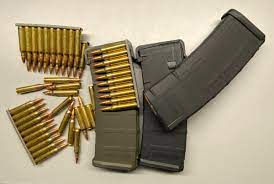
In March 2026, a panel of the D.C. Court of Appeals (the District’s sole appellate court and court of last resort) held that the District’s ban on large capacity magazines (LCMs), which the District defined as capable of holding more than 10 rounds, is unconstitutional under the Second Amendment. Judge Deahl, writing for the majority, explained that:
Magazines capable of holding more than 10 rounds of ammunition are ubiquitous in our country, numbering in the hundreds of millions, accounting for about half of the magazines in the hands of our citizenry, and they come standard with the most popular firearms sold in America today. Because these magazines are arms in common and ubiquitous use by law-abiding citizens across this country, we agree with Benson and the United States that the District’s outright ban on them violates the Second Amendment.
The court broke the inquiry down into three questions: “1) are 11+ magazines bearable arms? (2) are 11+ magazines in ‘common use’ for lawful purposes? and (3) is there a historical tradition of banning arms in such common use?”
As to the first question, the court explained that magazines are “bearable arms covered by the Second Amendment’s plain text” because, according to Heller, they are things that one may take up in self-defense to cast or strike another. In so holding, the Court also quoted the following reasoning from the Third Circuit’s 2018 opinion in Ass’n of N.J. Rifle & Pistol Clubs, Inc. v. Att’y Gen. N.J., 910 F.3d 106, 116 (3d Cir. 2018): because “magazines feed ammunition into certain guns, and ammunition is necessary for such a gun to function as intended, magazines are ‘arms’ within the meaning of the Second Amendment.”
The Court rejected the District’s argument that, because magazines are “practically harmless and of no use without ammunition and a receiver,” they cannot be “arms” under the Second Amendment. This is because “a gun is also practically harmless and of no use without ammunition, but it is still obviously an arm.” The question, the court explained, is “not whether 11+ magazines are strictly necessary for armed self-defense, but whether they facilitate it, as magazines of any capacity do.”
The court then explained that magazines holding 11+ rounds are “ubiquitous” for self-defense. Interestingly, the Court appears to presuppose that there is no history of regulation because they are in common use today:
So if 11+ magazines are arms in common and ubiquitous use, the Second Amendment inquiry is over: not only does the Second Amendment apply as a threshold matter, but the District’s outright ban on 11+ magazines violates the Second Amendment.
Setting aside that this puts the cart before the horse, it is also profoundly non-originalist logic. But that is also true of the “in common use” principle that Heller espoused, which was itself a doctrinal innovation. Furthermore, as the District argued,
prohibitions on firearms in common use is “hopelessly circular,” because that would mean that once a firearm became sufficiently popular, there is no clawing it back. Put another way, the District posits that under the common use test, “gun manufacturers and retailers would only need to race to make their products commonly possessed before any limitations could be enacted to forever prohibit such limitations under the Second Amendment.”
The Court of Appeals was unpersuaded.
D.C.’s last attempt at undermining the “in common use” argument likewise failed. The District asserted that LCMs are not “in common use” because “it is extremely rare for an individual to fire more than ten rounds in self-defense.” But again looking to Heller, Judge Deahl explained that the Second Amendment is “not concerned with how often arms [a]re actually fired in self-defense”; rather, Heller requires that we ask only whether the arms at issue were “typically possessed by law-abiding citizens for lawful purposes.”
To me, that’s conflating two different principles. Either we ask whether the weapon is in common “use” for self-defense—which is to say, the data shows us that people actually use the arm at issue to defend themselves—or we ask whether the weapon is commonly owned or possessed with the intention of using it for self-defense (which is what Judge Deahl apparently suggests). He explains, “Most firearms held in self-defense will never be fired in self-defense at all—that cannot justify a ban on ammunition simply because it is rare for law-abiding citizens to actually shoot some attacker, or because blanks might suffice to scare most attackers off without live ammunition.” Furthermore, according to Judge Deahl, “law-abiding citizens . . . regularly fire more than 10 rounds for lawful purposes like target practice and marksmanship,” and because hunting is a protected activity under the Second Amendment, LCMs are protected arms for more than self-defense purposes.
The court, apparently persuaded that Heller’s pronouncement that “in common use” today necessarily forecloses the existence of a history of similar regulation, goes on to hold (in a sort of belt-and-suspenders approach) that even if the court were required to undertake a separate historical analysis, the District failed to “carr[y] its burden of identifying any historical analogue banning bearable arms that approach the ubiquity of 11+ magazines, much less a historical tradition of similar bans,” noting that its analogy to gun powder storage laws were inapt because they “did not ban anything.”
This opinion, like so many others applying Heller, Bruen, and their progeny, lays bare the logical inconsistencies of the prevailing Second Amendment doctrine. First, we have the recurring and troublesome level-of-generality question: can weapons deemed by legislatures to be “dangerous and unusual” be banned? Or do we have to find historical analogues for, say, restrictions on the number of rounds persons were allowed to carry? Nor does the majority contend with the fact that, at the Founding, even trained soldiers could fire only “three or four shots in a minute, or every 15 or 20 seconds.” That’s a far cry from 11+ shots in a matter of seconds, which modern semiautomatic weapons with LCMs permit. It’s also worth noting, as the dissent (penned by Chief Judge Blackburne-Rigsby) does, that even if 11-, 15- or 17-round magazines are in common use and therefore protected by the Second Amendment, the defendant in this case was convicted for having 30-round magazines. The majority, for its part, did not even attempt to show that 30-round magazines are in common use for self-defense.
At bottom, the technology in use today differs in degree and kind to the arms technology with which our forebears were equipped. If originalists care about anything, it should be understanding the practical realities of the world in which the Founders lived and legislated.
The second overarching issue is the profound intellectual dishonesty of the “common use” doctrine. Defining the bounds of a constitutional right by metrics of what is in common use today is necessarily an unoriginalist—and indeed living constitutionalist—principle. Allowing consumers and gun manufacturers define the scope of the Second Amendment before legislatures can act is no way to do constitutional law. Indeed, in no other constitutional context would we even countenance such a thought. And as a recent paper by Andrew Nell explains, even setting aside the merits of the common use test, it has proved unadministrable at best, and “hopelessly subjective” at worst.

