

Key Takeaways
- The Indiana Supreme Court dismissed the City of Gary’s lawsuit against gun manufacturers, ending a 25-year legal battle.
- This decision followed the passage of House Enrolled Act 1235, which restricts such lawsuits to the State of Indiana.
- The law retroactively applied to Gary’s case, preventing it from continuing after two decades of appeals.
- The Indiana attorney general, Todd Rokita, will not file similar lawsuits on behalf of cities, solidifying the ruling’s impact.
- Gun-control advocates expressed concern over access to courts, while the firearms industry celebrated the decision as a victory.
Estimated reading time: 4 minutes
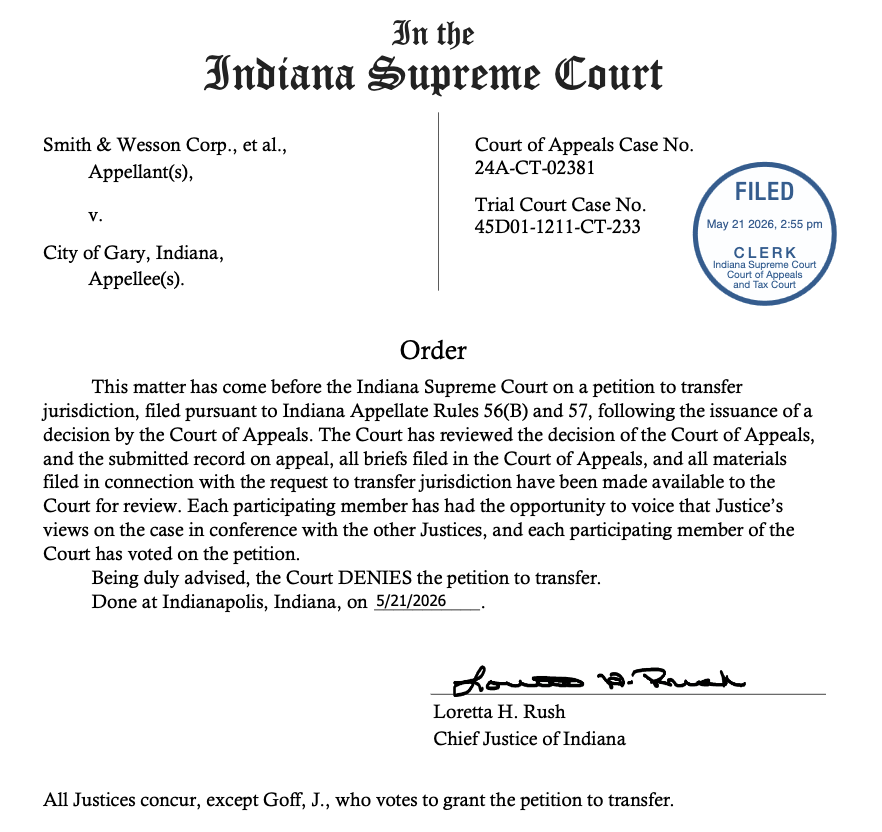
INDIANAPOLIS, IN — The last surviving lawsuit from the gun-control movement’s first wave of city cases against the firearms industry is over. On May 21, the Indiana Supreme Court denied the City of Gary’s petition to transfer its case against Smith & Wesson and other gunmakers, letting stand a December Court of Appeals ruling that ordered the suit dismissed. The vote was 4-1, with Justice Christopher Goff the only member who would have taken the case. Chief Justice Loretta Rush signed the order.
That ends a fight Gary started in August 1999. The city sued a long list of manufacturers, distributors, and dealers, including Smith & Wesson, Glock, and Beretta, claiming their sales and marketing practices created a public nuisance and fed straw purchases that drove local crime. Gary sought money damages and a court order forcing changes to how the industry does business. The suit survived three trips through the appellate courts over more than two decades.
What finally stopped it was not a jury or a ruling on the merits. It was the legislature. In 2024, lawmakers passed House Enrolled Act 1235, now codified as the Reservation Statute, which provides that only the State of Indiana may bring or maintain this kind of action on behalf of a city or county. Representative Chris Jeter introduced the bill in the House. Then-Governor Eric Holcomb signed it on March 15, 2024, and lawmakers made it retroactive to August 27, 1999, three days before Gary filed.
The trial judge, John Sedia of Lake Superior Court, upheld the law but refused to apply it backward to a case that had already run for a quarter century, calling that a manifest injustice. The Court of Appeals reversed him on every point. It held the statute is a general law that applies to every political subdivision in the state, not special legislation aimed at one city. It found no violation of separation of powers or the Open Courts Clause. And it held that Gary, as an agent of the state, had no vested right in a lawsuit that never reached a final judgment.
The panel was blunt about what it was doing. “Unfair as it may appear, the legislature can legally do exactly what it did,” the December opinion reads. The court sent the case back with instructions to dismiss it.
The practical effect is the part worth understanding. Under the new law, the only official who can sue gunmakers on a city’s behalf is the Indiana attorney general. That is Todd Rokita, who pushed for the dismissal and has made clear he has no interest in filing a suit like Gary’s. He called the decision the end of the city’s “relentless campaign to harass the firearms industry.”
More from USA Carry:
The industry treated it as a landmark. The National Shooting Sports Foundation, the firearm trade group, described Gary’s effort as a “losing lawfare strategy to abuse the courts,” arguing the city was trying to win through litigation what it could not win in the statehouse. I have watched these municipal suits fall one by one since the Protection of Lawful Commerce in Arms Act passed in 2005, and Gary’s was the last one standing from that original group.
Brady, the gun-control group that represented Gary for two decades, conceded the loss. President Kris Brown said the result should alarm anyone who wants access to the courts and asked, “What are the gun industry defendants so afraid of?” The group says lawmakers passed a series of state and federal laws over 25 years to shut suits like this down.
There is not much road left. The case returns to Lake Superior Court for dismissal. Any further appeal would have to go to the U.S. Supreme Court, and the questions Gary lost on are matters of Indiana constitutional law, which makes that a steep climb. For now the answer in Indiana is settled. A city cannot sue the firearms industry on its own, and the one official who can has said he will not.

