

This guest post does not necessarily reflect the views of the Duke Center for Firearms Law.
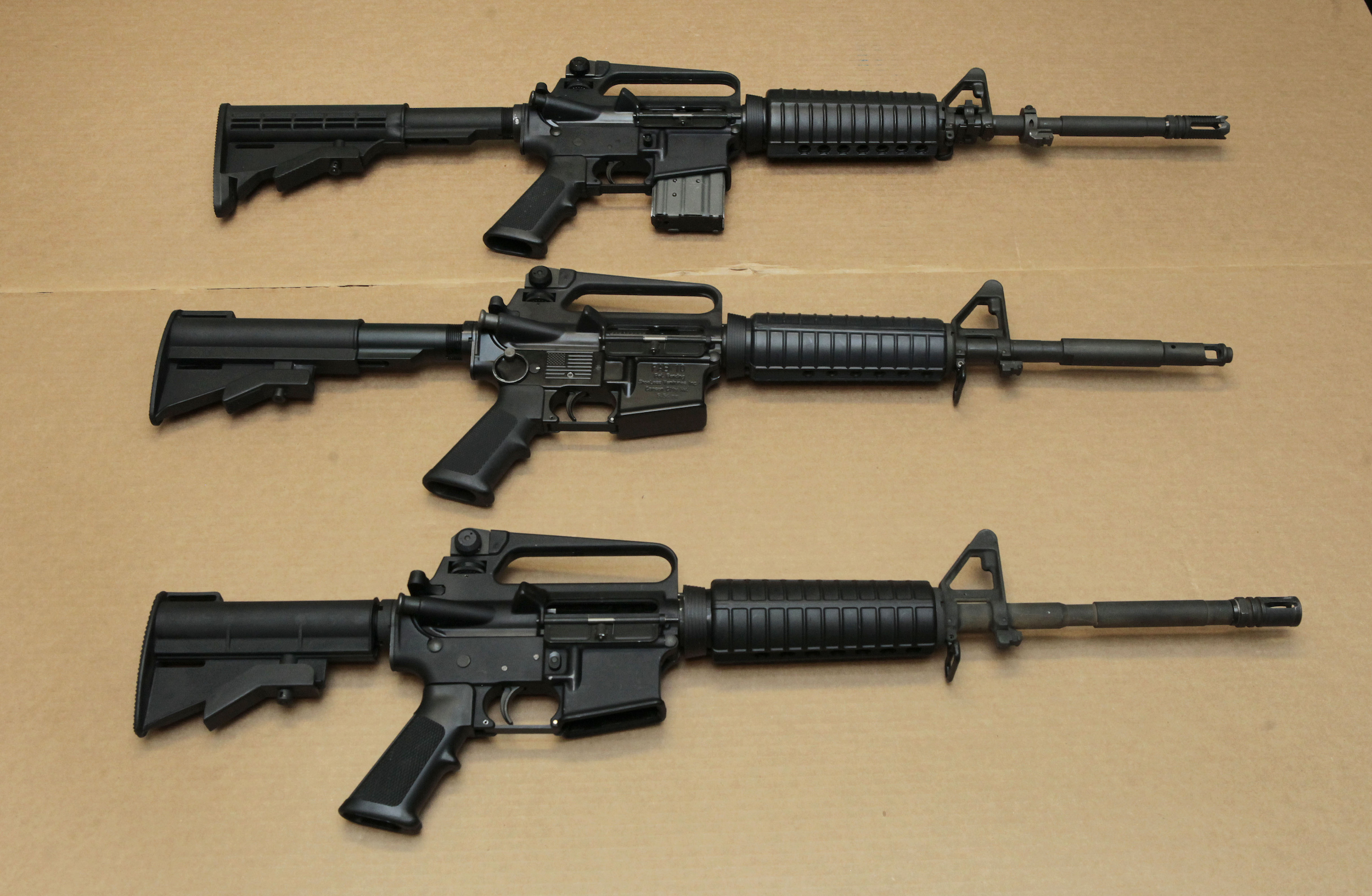
For over 35 years, states have regulated assault weapons. Such firearms generally include Uzi and TEC-9 pistols, as well as AK-47 and AR-15 rifles. Until this year, these bans—which are in effect in 12 states plus the District of Columbia—have been upheld by federal appellate courts as constitutional. But on December 2, the Supreme Court will hear arguments over whether restrictions on the possession of AR-15 rifles and similar models violate the Second Amendment.
In its landmark 2008 decision Heller v. District of Columbia, the Supreme Court held that the Second Amendment establishes an individual right to keep and bear arms. As part of its opinion, the Court noted that firearms “in common use” might be protected by the Constitution, although, if certain weapons are “dangerous and unusual,” a government could defend its restrictions by showing that its laws are consistent with the history and tradition of weapons regulation in the United States. The Court, however, never elaborated on what it meant by “common use.” Nor did it identify which party had the burden of proving that an arm is (or is not) in common use.
By agreeing to hear a constitutional challenge to restrictions on AR-15 rifles, the Supreme Court appears poised to offer some guidance on how to define and measure “common use.”
In their opening brief submitted to the Supreme Court, the petitioners in the consolidated cases of Khaya v. Cook County and Grant v. Higgins have urged the justices to treat the term “use” as synonymous with availability. In their view, “use” should be measured by how many AR-15 rifles are in circulation nationwide, with either of two metrics being acceptable: production numbers or ownership estimates. In other words, according to the petitioners, whether AR-15s are in common use boils down to a simple counting exercise, and regardless of which metric is used, they insist that there are millions of AR-15s in circulation.
As an expert in several cases challenging assault weapons bans, I was asked to assess the claim that there are millions of AR-15s in circulation. What I concluded is that the sources that are often cited to support this assertion are severely flawed and, therefore, unreliable.
The Evidence That the Petitioners Rely Upon to Establish “Common Use” Is Unreliable
In terms of production figures, for years now, the National Shooting Sports Foundation (NSSF)—the trade association for the firearms industry—has published estimates of how many so-called “modern sporting rifles” (MSRs) have been manufactured for the domestic marketplace. According to the NSSF, between 1990 and 2023, 32.1 million MSRs entered into the national stock of firearms. Citing NSSF figures, the Khaya petitioners have argued that “AR-15s and similar rifles accounted for approximately 20% of all domestic firearms produced for the American market from 2012 to 2023.” Even if the 32.1 million estimate was accurate—and, as I’ll explain below, it is not—according to the ATF, between 1990 and 2023, 307.6 million firearms were produced for the domestic marketplace (not including the U.S. military). That means that the NSSF’s 32.1 million MSR estimate would account only for 10% of the 1990-2023 domestic stock, not 20%. Even using the abridged timeframe of 2012-2023, which the petitioners use in their Supreme Court brief, the share would be 14%, not 20%.
But the Court should not rely on these percentages because the underlying NSSF MSR data are flawed and nonrepresentative.
There are at least five problems with the NSSF MSR production estimate. First, it is unclear exactly what an MSR is. In deposition testimony, the NSSF’s director of research offered an ambiguous definition that “could be expanded or narrowed.” As he noted, although AR-15s are MSRs, they are not the only rifles that fall under this category, which cautions against using MSRs as a proxy for AR-15s. Second, as the NSSF admitted in sworn testimony, while its MSR estimate is supposed to be limited to rifles, its tally actually also includes pistols, frames, and receivers—none of which are rifles. Indeed, the NSSF’s director of research could not rule out that the NSSF had included certain shotguns in its MSR estimate. Third, when the NSSF’s director of research was asked to explain how some of the individual estimates were collected and then verified, his answers often acknowledged information gaps, making reproduction of the overall estimate impossible. As verification and reproduction are two hallmarks of scientific evidence, the NSSF’s inability to back up its estimate supports a conclusion that it is without a sound foundation. Fourth, production figures do not reflect how many firearms are in the hands of private individuals. No doubt, a portion of firearms produced for the American marketplace make their way to private citizens as personal firearms. But others stay in wholesale and retail inventories, become part of the stock of shooting ranges and gun clubs, or serve as the armaments of security companies and law enforcement agencies. Fifth, the NSSF estimate also fails to account for firearm attrition (i.e., loss, trafficking, decommission, deterioration, or destruction of firearms). Quite simply, just as guns can easily enter circulation, they can exit circulation. Production figures fail to account for this change.
Evidently then, the NSSF’s estimate of 32.1 million AR-15s in circulation misses the mark.
The other metric that the petitioners rely upon is firearm ownership. Unlike the production metric, which draws on a single source, petitioners cite three types of surveys in support of their ownership claims: NSSF surveys of gun owners, two surveys of gun owners conducted by Georgetown University professor William English, and a Washington Post/Ipsos survey of AR-platform firearm owners. As with NSSF production figures, all of these sources, from which ownership estimates are extrapolated, are plagued with problems that call their findings into question.
Although the NSSF has never publicly released any data that directly probes how many gun owners own MSRs, over the years, it has queried MSR owners as to how many MSRs they own. It has reported that, back in 2010, the gun owners who possessed MSRs owned, on average, 2.6 such rifles. By 2022, the last time the NSSF appears to have asked this question, the mean average of MSRs owned had risen to 3.8 such rifles. However, these survey results contained a disclaimer from the organization conducting the poll: “Sports Marketing Surveys cannot guarantee the accuracy of the information contained and does not accept any liability for any loss or damage caused as a result of using information or recommendations contained within this document.” When the organization conducting the poll warns you that the accuracy of its results cannot be assured, it’s a good reason to treat the results as unreliable.
In 2021 and again in 2026, Georgetown University professor William English conducted surveys of gun owners that purported to show how many AR-15s are owned by Americans. These surveys were never peer-reviewed, and English’s analyses of these results have been released in a series of unpublished papers (posted online). In analyzing the earlier survey, English concluded that “30.2% of gun owners, about 24.6 million people, have owned an AR-15 or similarly styled rifle, and up to 44 million such rifles have been owned.” Based on his more recent survey, English now claims, “In total, 30.0% of gun owners, approximately 26.4 million adults, currently own at least one rifle of the type commonly classified as an ‘assault weapon,’ and approximately 60 million such rifles are currently owned (40 million AR-15 type rifles and 20 million similarly styled rifles).”
In conducting these firearm surveys, English has been criticized for seemingly violating ethical and methodological canons, with one scholar accusing him of engaging in “deception” and “dishonesty.” Indeed, there is a whole scholarly article and a Supreme Court amicus brief devoted to identifying the problems with English’s work. The numerous issues that have been raised, which are far too many to review here, render English’s surveys unreliable. As such, this poll data should not serve as the basis for any “common use” analysis.
Last is the September-October 2022 Washington Post survey. It claimed that 20% of all gun owners, which they estimated to be 16 million Americans, own AR-15-platform firearms. A closer examination of the underlying data indicates that the Post rounded up its findings, when it should have rounded down to 19% of all gun owners, or 15 million Americans. This might have been a simple mistake. Or perhaps it reflected an editorial decision to promote a narrative that AR-15 rifles are widely circulating in American society. Regardless, this is a relatively minor issue.
The bigger problem with this survey is that leaves three crucial methodological questions unanswered: How was the larger pool of gun-owning respondents identified? What was the exact percentage of the larger survey pool that the gun owners accounted for? How is it that the gun owners who were polled constituted a representative sample of American gun owners? These shortcomings cast doubt on its extrapolations. In fact, the only way for the Post to calculate its ownership estimate was by drawing on one survey for its numerator (the September-October 2022 Post survey) and a different survey for its denominator (a November-December 2022 Ipsos survey). Generally, this methodological practice, which risks population mismatch, is frowned upon. If nothing else, it calls into question the reliability of the survey.
Finally, despite having numerous opportunities to replicate the survey’s findings, neither the Washington Post nor any other national polling organization has ever conducted a similar poll. Leaving a matter of great national importance to a one-off, small survey of just 399 respondents is, at best, an unsettling proposition.
For all of the above reasons, the petitioners fail to point to reliable survey evidence that establishes how many AR-15 rifles are privately owned as personal firearms in the United States.
(The petitioners also reference NSSF surveys of firearm retailers as evidence that AR-15 rifles are in common use. However, these surveys do not translate into actual numbers in circulation because percentages of which types of rifles are sold do not generate absolute numbers on how many rifles are owned. As such, the data points in these surveys do not shed much light on the matter. That said, one interesting sales trend reported in the two most recent NSSF firearm retailer surveys is that, of all the different calibers of MSRs on the market, AR-15 rifles, which typically fire 5.56mm and .223 caliber cartridges, do not account for more than a third of all MSRs sold. This, again, reminds us that AR-15 rifles and MSRs are not synonymous, making the latter a poor proxy for the former.)
“Common Use” Defined in a Plain Text Manner
There is, of course, an alternative way to think about the term “use,” one that focuses on the actual employment of firearms, especially in defensive situations. This offers a more faithful, plain text interpretation of “common use.” And it’s a commonsense approach that the Supreme Court has adopted in the past.
Consistent with the Court’s opinion in Bailey v. United States (1995), “use” could be defined as the active employment of a firearm: “brandishing, displaying, bartering, striking with, and most obviously, firing or attempting to fire, a firearm.” Although Bailey was interpreting a federal statute—18 U.S.C. § 924(c)(1)—its value in helping to interpret the Second Amendment should not be overlooked. Indeed, the Court has done so in the past: Heller drew on Muscarello v. United States (1998), which interpreted the same federal statute as Bailey, for purposes of construing the meaning and intent of the Second Amendment. If nothing else, Heller serves as a reminder that statutory interpretation can offer helpful guidance in constitutional interpretation. This is especially true now, in the Bruen “history and tradition” era, in which the scope of the Second Amendment is defined by historical legislative action.
Yet petitioners offer no data about instances of actual use. Ignoring the plain text interpretation feels, at best, intellectually dishonest. But there’s probably a good reason for the omission: the data wouldn’t support petitioners’ position. Short of relying on anecdotal evidence alone, there is no evidence that AR-15s are commonly used to protect life or property from violent criminals.
Two sources—both apparently compiled to assist gun rights organizations promote their agendas—suggest that typically, AR-15s are not used in self-defense. For instance, English’s 2021 survey of gun owners found that self-described AR-15-style rifle owners used handguns—not rifles, let alone AR-15 rifles—in the majority (63%) of their defensive gun uses. Similarly, the Armed Citizen searchable database maintained by the National Rifle Association’s Institute for Legislative Action (NRA-ILA) contains only six news items in which someone reported using an AR-15 rifle to defend against a perceived criminal threat, out of a total of 4,961 defensive-gun-use news items from 1980 through 2023.
Taken together, there is virtually no evidence that AR-15 rifles are commonly used in self-defense.
Conclusion
To put it bluntly: no one knows how many AR-15s there are in the United States. Furthermore, AR-15s are not typically used in self-defense scenarios. Accordingly, there is little reason to conclude, under either metric, that AR-15s are “in common use” and therefore guaranteed the protections of the Second Amendment.
So, what does all this mean for the upcoming Supreme Court’s review of the constitutionality of restrictions on AR-15 rifles? I guess we will have to wait until the end of the Court’s current term to find out.

