

The Florida Fish and Wildlife Conservation Commission (FWC) has planned a 2026 bear hunt. An executive order allows for a total of only 215 permits for the entire state, far less than needed to stabilize the bear population. 22 of those permits are reserved for the Private Lands Bar Harvest Program. The Tampa Bay Times has written about 10 percent of the permits will be reserved for private landowners who own more than 5,000 acres of land. 9,091 applicants have submitted 156,383 applications. That is an average of over 17 applications per applicant so far. Some hunters and non-hunters who do not want any bears to be hunted have submitted multiple applications in order to improve their odds. The Sierra Club, Florida Chapter is offering financial assistance to those who win a permit, with the intent to prevent a bear from being harvested. The bear hunting season will be from Saturday December 5th to Sunday, December 27.
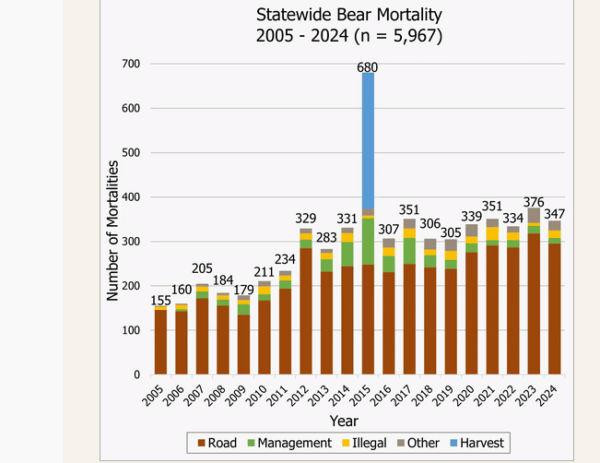
The FWC publishes a chart of bear mortality. Curiously, the chart does not appear to include bears harvested during scheduled bear hunts.

Chart from myfwc.com Florida Fish and Wildlife Conservation Commission. Where are the 52 bears harvested in the 2025 bear season? There does not appear to be any place for them on the chart. The 304 bears harvested in the 2015 hunt also appear to be missing. In a previous chart, the 2015 bear harvest was included in blue.
The FWC has not published an update of estimated bear numbers in Florida since 2017. The population data was gathered in 2014-2015. The total bear population then was estimated at 4,350 bears. In the 2019 Florida Black Bear Management Plan, the population of bears in Florida was estimated to grow to 11,088 in the four largest sub-populations of bears existing in Florida. From the FWC:

The three minor sub-populations of bears in Florida add another couple of hundred of bears to the total. The estimates published in the 2019 study are the best numbers we have for bear populations which exist in Florida.
Florida has abundant food supplies for black bears, with most calories existing because of human efforts to produce food from the land and the waters. With abundant food and sufficient habitat, black bears tend to increase in population at about 15% per year. In Michigan, about 1,700 bear are harvested from a population of about 12,000. The Michigan bear population continues to increase. If the estimates from the Florida bear plan of 2019 are correct, Florida should be harvesting about 1500 – 1800 bears per year to reach a stable population. The less than 400 bears which are recorded as dying each year in Florida in the mortality chart do not appear to be sufficient to keep a stable population.
The Florida FWC has not published a number of bears which they consider to be an optimum population for Florida. The Florida pre-Columbian bear population has been estimated at about 12,000. According to the FWC 2019 plan, the Florida black bear population is approaching that number.
In 2024, the Florida government restored the right of humans in Florida to defend themselves, their pets and their property against aggressive black bears. In 2025 Florida suffered the first recorded fatal bear attack against a human in Florida.
The Florida Fish and Wildlife Conservation Commission faces enormous pressure from the deep green bear preservationists. Those groups argue against any bear hunting in Florida. Having regular bear seasons to regulate bear numbers in Florida is a step forward. The FWC should publish a number, to be debated in public, as to what is considered the optimum bear population to maintain in Florida. Is it more or less than the 12,000 estimated to be in pre-Columbian Florida? The FWC should publish figures for their estimate of the current bear population. No such estimate has been published since 2017, nearly a decade ago. Bear populations must be controlled. The FWC has stated bear populations are best controlled by managed hunting. The current permit levels are too low to create a stable bear population in Florida.
About Dean Weingarten:
Dean Weingarten has been a peace officer, a military officer, was on the University of Wisconsin Pistol Team for four years, and was first certified to teach firearms safety in 1973. He taught the Arizona concealed carry course for fifteen years until the goal of Constitutional Carry was attained. He has degrees in meteorology and mining engineering, and retired from the Department of Defense after a 30 year career in Army Research, Development, Testing, and Evaluation.