


The United States Marine Corps has a varied mission set in the modern world. Because of their amphibious nature, Marines deploy worldwide as part of a Marine Expeditionary Unit. To prepare for this often dynamic mission, Marines complete a wide variety of training and qualifications. We can’t replicate most of it on the range, but we can complete the USMC’s MEU(SOC) M4A1 Rifle qualification course.
Not every Marine on a MEU will shoot this course, as many Marines fill support duty roles. Typically, trigger pullers are required to run this short-range course of fire a run or two during their predeployment workup. The MEU(SOC) M4A1 qual is part of a close-range shooting package.
Traditional Marine marksmanship focuses on engagements at longer ranges, anywhere from 200 to 500 yards. The Marine Corps recognized a need for close-range fighting prowess for forces that might be conducting visit-board-search-seizure operations. This close-range nature makes the course of fire easy to replicate at most ranges, but it may require tweaks.
Live Inventory Price Checker
The MEU(SOC) Qual – The Basics
The MEU(SOC) qual is designed around the M4A1 and what I assume is the M27 and its variations these days. You can shoot this qual with just about any semi-auto rifle that can reach out to 50 yards. Shoot it with a PCC if you want. The adaptability to a ton of different rifles makes this one of the more accessible quals.

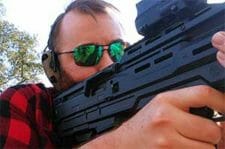
I shot it with my PSA M4A1 clone. The first time I shot it, I used iron sights, and boy, do I need to work a little more with irons. The second time I shot it, I went with an LPVO and improved significantly.
The course of fire starts at 50 yards and slowly closes to 3 yards. We’ll need two magazines and a total of 50 rounds. Load the first magazine with 24 rounds and the second with 26 rounds. You’ll need some way to carry that spare magazine. You’ll also need two targets.

The USMC has its own targets with specified scoring zones. They are easy to find and order online, but I used a USPSA target. Scoring is simple. The board has a total of 100 points, with a passing score of 80.
You get two points for shots inside the vitals, which to me are the A-zones on the USPSA target. You get one point for hits on target and, to no one’s surprise, zero points for misses. Each drill has a par time, and shots outside the par time are misses.
The course of fire is divided into two phases.
Phase 1 – Single Target
We’ll start with one target at 50 yards. Load and make ready with your 24-round magazine.
Stage 1 – 50 Yards
This is one of my favorite rifle drills; it’s simple, but a lot of fun. At the signal, fire two rounds standing, then take a kneeling position and fire two rounds, and end the drill in the prone with a final pair of rounds fired.

You have ten seconds for the entire drill.
Stage 2 – 25 to 50 Yards
I hope you warmed up, because you’ll need to sprint to the 50-yard line. If sprinting isn’t an option, I’d move the target to 25 yards and cut the par time in half.
After sprinting, you’ll fair a pair in the standing and a pair in the kneeling. With the sprint, you have 11 seconds.
Stage 3 – 25 Yards
At 25 yards, you’ll have the simplest drill of the entire MEU(SOC) Qual.

On the signal, aim and fire one brain shot. You have two seconds.
Stage 4 – 25 to 15 Yards
We are going to shoot on the move. Starting at the 25-yard line, you need to move forward and fire two shots on the body in five seconds. Time stops after the second round is fired.

Stage 5 – 15 Yards
At the 15-yard line, we need to drill the target with a pair to the body in 1.5 seconds.
Stage 6 – 15-10 Yards
The MEU(SOC) Qual keeps you moving. This time you’ll be moving while firing a failure drill. That’s two to the body and one to the head. Shooters have 4 seconds to complete the drill.

Stage 7 – 10-5 Yards
Alright, get ready to move again. We are going to shoot another failure drill on the move from 10 to 5 yards in 3.5 seconds.
Stage 8 – 7-3 Yards
Once again, I am asking you to move and shoot another failure drill. Move from 7 to 3 yards while firing a failure drill in 3 seconds.

Phase 2
At the end of Phase 1, go ahead and score your target. You should have 20 hits to the body and four hits to the head. Tape the target up.
Phase 2 uses two targets. You should have one round in the magazine and one in the chamber from your 24-round magazine. Maintain that.
Stage 1 – 50 Yards
At 50 yards, we’ll start in the standing position and fire two rounds to the body, rendering your weapon empty. Assume a kneeling position, reload, and fire two rounds to the body. Conduct this MEU(SOC) drill in 11 seconds.

Stage 2 – 25-15 Yards
No sprint this time, just move up to the 25-yard line. We’re moving again, this time from 25 to 15 yards while shooting a pair to the body of both targets. You have 6 seconds.
Stage 3 – 15 Yards
At 15 yards, you’ll aim and fire two body shots on both targets in 3.5 seconds.
Stage 4 – 15-10 Yards
We don’t stay still for long in our MEU(SOC) qual. We’ll be moving from 15 to yards while firing two shots at each target in 4 seconds.

Stage 5 – 10 Yards
Take a breath, and fire two rounds at both targets in 3 seconds.
Stage 6 – 10-3 Yards
Let’s finish strong with a moving box drill. A box drill is two rounds to the torso of each body, then finish with a headshot to each target.
Ending the MEU(SOC) Qual
We are done; score your targets, calculate your score, and see how you did. I like the MEU(SOC) qual. It’s not logistically heavy and can be shot rather quickly. We get a ton of movement, which most of us rarely train.

It’s also something we can shoot dry, and it provides a fairly varied amount of drills. As you get better, you can always reduce the par times or make the targets smaller to increase difficulty. So how did you do? Can you shoot like a Marine?
About Travis Pike
Travis Pike is a former Marine Machine Gunner, a lifelong firearms enthusiast, and now a regular guy who likes to shoot, write, and find ways to combine the two. He holds an NRA certification as a Basic Pistol Instructor and is the world’s Okayest firearm’s instructor.
Some of the links on this page are affiliate links, meaning at no additional cost to you, Ammoland will earn a commission if you click through and make a purchase.

