


According to the American Suppressor Association (ASA), the number of silencers/suppressors registered in the United States of America was 5,776,685 as of the time the Bureau of Alcohol, Tobacco, Firearms, and Explosives (ATF) responded at the SHOT Show in January of 2026.
This correspondent obtained information from the ATF on January 22, 2026. At that time, it was stated that the information had already been released and that over 150K National Firearms Act (NFA) applications had been approved through January 2026.
The graph of registered silence numbers was created using cumulative January counts from 2011 to 2026. When numbers were unavailable for January, linear interpolation was used to estimate the January number. Each year had at least one reference number. 2017 had three reference numbers, none of them for January.
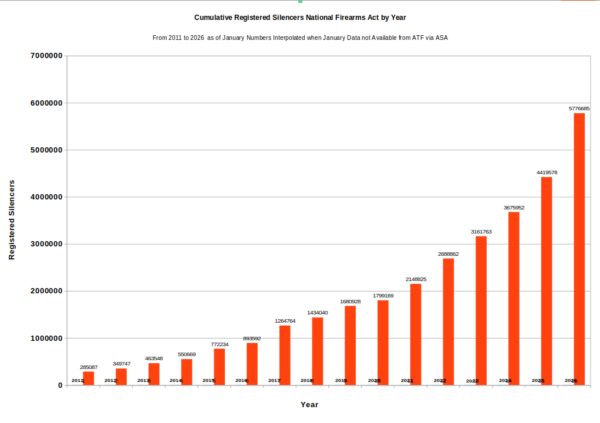
The number of registered silencers has been growing at about 22.6% per year. That rate is roughly equivalent to doubling every 3.2 years. If such a rate continues, there will be about 50 million registered silencers ten years from now.
It is unlikely there will be 50 million registered silencers ten years from now. This correspondent believes the registration requirement will be removed well before 10 years. It could be removed within two years, given the lawsuits now in play. 50 million silencers in the hands of American gun owners, ten years from now, is plausible.
Silencers are very popular firearm safety accessories when they are not restricted by oppressive governmental policies. Silencers can be made inexpensively with economies of scale. Even the best, most technologically advanced silencers/suppressors will come down in price as economies of scale come into play. In New Zealand, silencers had, until 2019, been an over-the-counter commodity, similar to purchasing a rifle scope in the United States. Silencers were relatively cheap. From a Gun Watch article in 2015:
Silencers are often referred to as suppressors. The best descriptive term is gun muffler. In New Zealand, which has a strong tradition of gun ownership, gun mufflers are unregulated and cheap. They are for sale over the counter or in the mail. The above ads or similar ones can be seen on the online buying and selling site for New Zealand, trademeco.nz. From trademe.co.nz . . .
This Silencer will fit any centrefire rifle with 17CM of exposed barrel with a diameter smaller than 19mm.
Takes away the loud crack (down to about a 22 magnum noise) and helps protect your ears from permanent hearing loss.
Super strong tooling grade alloy construction designed to withstand bursts of Full Auto fire, making it virtually indestructible on a hunting rifle and keeping the weight down to just 370 grams.
There is no licence required to purchase these in New Zealand.
Rimfire gun mufflers are commonly available for under $20. Consider that a New Zealand dollar is current valued a .65 U.S. dollars.
Silencer prices in New Zealand have increased, but they are still available through the mail. The exchange rate is now about .59 USD to 1 New Zealand Dollar. At the current exchange rate, quality .22 rimfire suppressors can be had for about $36 USD, and quality high power rifle suppressors can be purchased for prices ranging upward from $120. The highest price showing was about $450 USD. The New Zealand market is tiny compared to the United States. About 400,000 people in New Zealand are firearms owners, with about 1.77 million firearms.
Current prices for a silencer in the United States run about $350 to $2000. Those prices will drop with deregulation and economies of scale.
There are over a hundred million gun owners in the United States, with over 540 million firearms. A market for 50 million silencers in the United States, once the regulatory burden is removed, is entirely possible.
About Dean Weingarten:
Dean Weingarten has been a peace officer, a military officer, was on the University of Wisconsin Pistol Team for four years, and was first certified to teach firearms safety in 1973. He taught the Arizona concealed carry course for fifteen years until the goal of Constitutional Carry was attained. He has degrees in meteorology and mining engineering, and retired from the Department of Defense after a 30 year career in Army Research, Development, Testing, and Evaluation.