

Key Takeaways
- The ATF released a significant regulatory reform package that rolls back previous overreach, featuring 34 proposed and finalized rules.
- Key changes include rescinding the controversial Stabilizing Brace Rule and the Engaged-in-the-Business Rule, addressing compliance with court decisions.
- The package aims to modernize compliance procedures, reduce burdens on NFA owners, and clarify long-standing ambiguities in regulations.
- ATF actions align with statutory text and recent judicial decisions, ensuring better adherence to the law for gun owners and dealers.
- Public comments will be essential for finalizing the proposed rules, allowing stakeholders to influence the regulations moving forward.
Estimated reading time: 6 minutes
WASHINGTON, DC — The Bureau of Alcohol, Tobacco, Firearms and Explosives has released the full breakdown of its landmark regulatory reform package, and the details represent the most significant rollback of ATF regulatory overreach in recent memory.
I reported earlier that Acting Attorney General Todd Blanche and ATF Director Robert Cekada had announced 34 Notices of Proposed Rulemaking and Final Rules following a comprehensive review conducted in compliance with Executive Order 14206, Protecting Second Amendment Rights. The full package has now been published, and it is even more substantive than the initial announcement suggested.
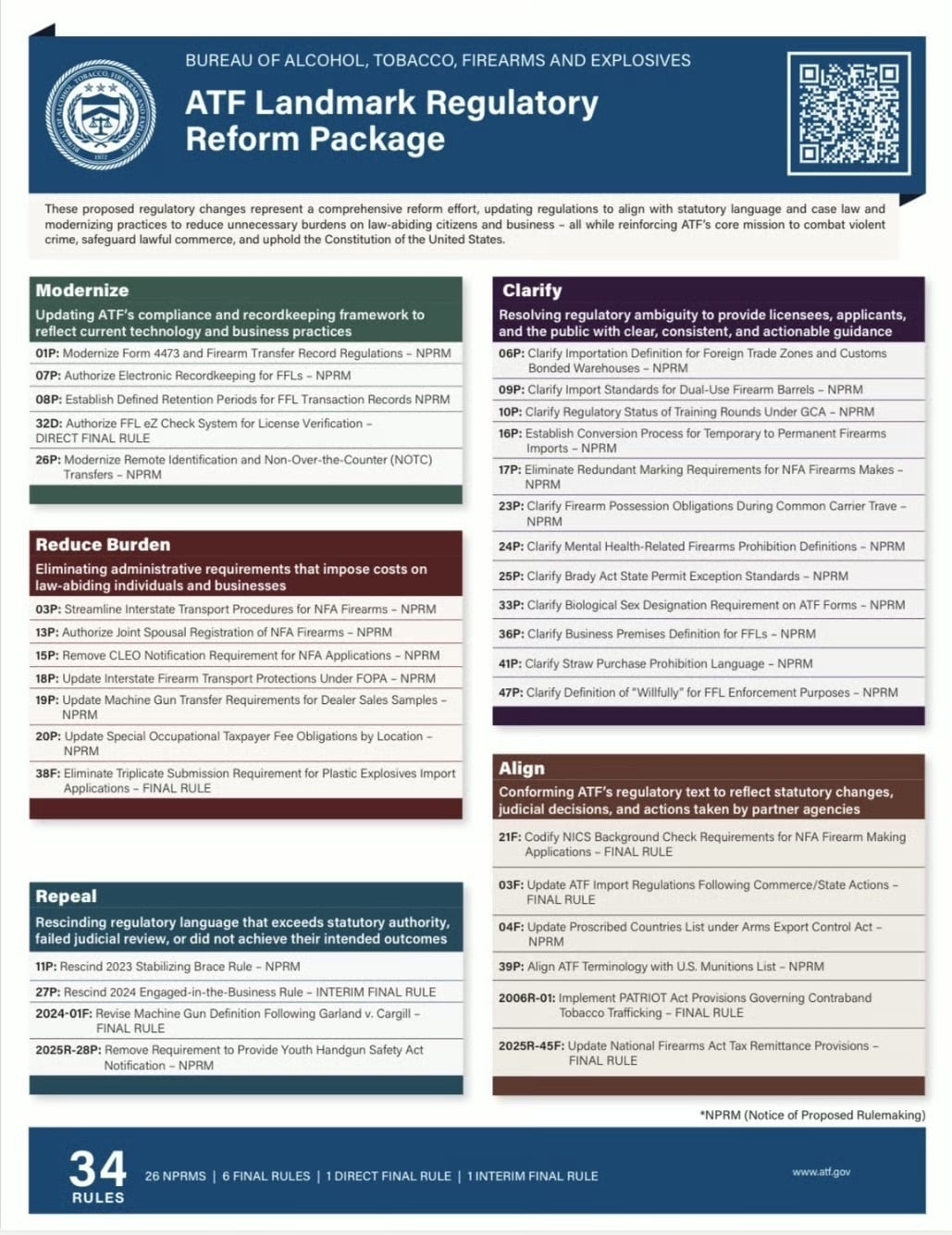
The 34 actions break down as 26 Notices of Proposed Rulemaking, 6 Final Rules, 1 Direct Final Rule, and 1 Interim Final Rule. The agency has organized the package into five categories: Modernize, Reduce Burden, Clarify, Repeal, and Align.
The Headlines: Stabilizing Brace Rule and Cargill Compliance
The most significant items in the package are in the Repeal category. The ATF is rescinding the 2023 Stabilizing Brace Rule through a Notice of Proposed Rulemaking. That rule, finalized under the previous administration, reclassified millions of pistol-braced firearms as short-barreled rifles subject to the National Firearms Act and triggered a wave of litigation and confusion among lawful owners.
The ATF is also issuing an Interim Final Rule to rescind the 2024 Engaged-in-the-Business Rule, which dramatically expanded the definition of who qualifies as a firearms dealer and required Federal Firearms License registration. That rule had been challenged in court for sweeping in private sellers who did not meet the historical understanding of the term.
A separate Final Rule revises the machine gun definition to align with the Supreme Court’s decision in Garland v. Cargill. The agency is also issuing a Notice of Proposed Rulemaking to remove the Youth Handgun Safety Act notification requirement.
Modernizing the Compliance Framework
Several actions address how Federal Firearms Licensees actually operate in 2026. The ATF is proposing to modernize Form 4473 and firearm transfer record regulations, authorize electronic recordkeeping for FFLs, establish defined retention periods for FFL transaction records, and authorize the FFL eZ Check System for license verification through a Direct Final Rule.
The agency is also proposing to modernize remote identification and non-over-the-counter transfer procedures. For licensed dealers who have been carrying paper bound books and dealing with verification calls for decades, this represents a substantial step toward bringing federal firearms recordkeeping into the digital era.
Reducing Burden on NFA Items and Lawful Transport
The Reduce Burden category contains several items NFA owners and travelers will want to read carefully. The ATF is proposing to streamline interstate transport procedures for NFA firearms, authorize joint spousal registration of NFA firearms, and remove the Chief Law Enforcement Officer notification requirement for NFA applications.
The CLEO notification removal is particularly notable. That requirement has long been a point of friction for NFA applicants in jurisdictions where local law enforcement is uncooperative or hostile to lawful suppressor and short-barreled firearm ownership.
The agency is also proposing to update interstate firearm transport protections under the Firearm Owners Protection Act, modify machine gun transfer requirements for dealer sales samples, and update Special Occupational Taxpayer fee obligations by location. A Final Rule eliminates the triplicate submission requirement for plastic explosives import applications.
Clarifying Long-Standing Ambiguities
The Clarify category addresses 12 separate areas where the existing regulatory framework has produced confusion or inconsistent enforcement. The proposed changes include clarifying the importation definition for Foreign Trade Zones and Customs Bonded Warehouses, import standards for dual-use firearm barrels, the regulatory status of training rounds under the Gun Control Act, and the establishment of a conversion process for temporary to permanent firearms imports.
Other clarifications cover firearm possession obligations during common carrier travel, mental health-related firearms prohibition definitions, Brady Act state permit exception standards, the business premises definition for FFLs, straw purchase prohibition language, and the definition of “willfully” for FFL enforcement purposes.
The clarification of “willfully” matters significantly. That single word governs whether a paperwork mistake by a licensed dealer becomes a license-ending federal violation. Tightening that definition can directly reduce the number of FFLs lost to administrative errors that were never intended to subvert the law.
The package also includes a proposed clarification of biological sex designation requirements on ATF forms and one to eliminate redundant marking requirements for NFA firearms makers.
More from USA Carry:
Aligning With Statutes and Court Decisions
The Align category brings ATF regulations into agreement with statutory text, judicial decisions, and partner agency actions. A Final Rule codifies NICS background check requirements for NFA firearm making applications. Another Final Rule updates ATF import regulations following Commerce and State Department actions.
A proposed rule updates the Proscribed Countries List under the Arms Export Control Act, and another aligns ATF terminology with the U.S. Munitions List. A Final Rule implements Patriot Act provisions governing contraband tobacco trafficking, and another updates National Firearms Act tax remittance provisions.
Why This Matters for Gun Owners
The Second Amendment is a fundamental civil right, and federal firearms regulation has been the source of significant friction for law-abiding gun owners and licensed firearms dealers for decades. A coordinated package of 34 separate regulatory actions, structured around modernization, burden reduction, clarification, repeal, and alignment, signals a top-down rebuild of how the agency interacts with the regulated community.
Three things stand out about this package. First, the agency is rescinding two of the most controversial rulemakings of the previous administration directly. Second, the agency is moving meaningful items toward Final Rule status rather than only proposing them, which means real changes are already taking effect. Third, the burden reduction items addressing NFA transfers, spousal registration, CLEO notification, and interstate transport directly address pain points that gun owners and FFLs have raised for years.
The ATF describes this as “the first in a series” of regulatory updates. More are expected to follow.
What Comes Next
Notices of Proposed Rulemaking go through a public comment period before they can be finalized. That gives gun owners, Federal Firearms Licensees, manufacturers, and other stakeholders an opportunity to weigh in on the specifics of each rule. Public comments matter, and the comment record is part of the legal foundation that defends a final rule against future court challenges.
I will continue tracking individual rules in this package as they move through the formal process. Gun owners and FFLs who want to engage on specific rules should monitor publication in the Federal Register and submit comments during the open windows.
The full package is available on the ATF website at www.atf.gov.

