

The .30-30 Winchester has been putting venison on dinner tables for generations. It’s a cartridge with a long hunting history, and for many shooters, that means a lever-action rifle carried through the woods, into a deer stand, or across the back forty. While iron sights remain a perfectly reasonable choice, the right optic can make target identification and precise aiming easier. Finding the best .30-30 scope isn’t necessarily about getting the most magnification or spending the most money. It’s about matching the optic to your rifle, your shooting distances, and the conditions in which you actually hunt.
A traditional 3-9× hunting scope may be a great choice for a rifle with a conventional receiver mount. A low-power variable optic might be better suited to close cover, while a scout scope can accommodate certain forward-mount configurations. A compact red dot offers another option for shooters who value an uncomplicated, unmagnified sight picture. We’ve narrowed the choices to six optics with different strengths, from affordable hunting scopes to premium glass and compact red dots.

Best .30-30 Scopes at a Glance
How We Selected These .30-30 Optics
A scope that works well on one rifle isn’t automatically the right choice for another. We evaluated these recommendations using manufacturer specifications, magnification ranges, eye relief, mounting requirements, weight, reticle design, and intended use.
We also considered the realities of hunting with a .30-30. Many shooters use the cartridge at relatively modest distances, often in wooded terrain where a wide field of view and an easy-to-find aiming point matter more than high magnification.
These are researched recommendations, not the results of a side-by-side range test of all six optics. That distinction matters, particularly when comparing subjective characteristics such as glass quality, eye box, and low-light performance.
Best 30-30 Scopes
SPEC COMPARISON OF BEST 30-30 SCOPES
1. Leupold VX-Freedom 3-9×40 Hunt-Plex — Best Overall Traditional Scope

Leupold VX-Freedom 3-9×40 Hunt-Plex Specs
- Magnification 3-9x
- Objective Lens 40 mm
- Tube Diameter 1 inch
- Eye Relief 4.2–3.7 in.
- Weight 12.2 oz
There’s a reason conventional 3-9× hunting scopes have remained popular for so long. They provide useful magnification without requiring shooters to navigate complicated controls or specialized reticles. The Leupold VX-Freedom 3-9×40 Hunt-Plex follows that formula. Its second-focal-plane Hunt-Plex reticle uses bold outer elements that narrow toward the center, offering a straightforward aiming reference without crowding the sight picture.
At 3×, the scope provides a practical starting point for many hunting situations. Turning up the magnification can help with more deliberate shots when the distance and conditions justify it. The 40 mm objective and one-inch maintube are conventional dimensions, although you’ll still need to confirm ring height and clearance on your particular rifle.
Leupold lists the scope at 12.2 ounces, with eye relief ranging from 4.2 inches at low magnification to 3.7 inches at high magnification. It also uses quarter-MOA adjustments and has no illuminated reticle. For someone who wants a traditional hunting setup without unnecessary features, the VX-Freedom is an appealing starting point. Just remember that its 3× minimum magnification and conventional eye relief won’t make it suitable for every lever-action mounting arrangement.
- Straightforward Hunt-Plex reticle
- Familiar 3-9× magnification range
- Relatively light at 12.2 ounces
- Less flexible at very close distances than a 1× or 2× starting magnification
2. Vortex Crossfire II 1-4×24 V-Brite — Best Low-Power Scope

Vortex Crossfire II 1-4×24 V-Brite Specs
- Magnification 1–4×
- Objective Lens 24 mm
- Tube Diameter 30 mm
- Eye Relief 4.0 in
- Weight 15.6 oz
Not every .30-30 needs a traditional 3-9× scope. For hunters working in thick cover or shooting at shorter distances, lower magnification can be a better fit.The Vortex Crossfire II 1-4×24 V-Brite starts at 1× and offers up to 4× magnification. That range makes it particularly interesting for shooters who want a wide field of view at the low end without giving up magnification altogether.
Its V-Brite reticle uses an illuminated center dot within a conventional crosshair pattern. Illumination can help make the aiming point easier to distinguish against certain backgrounds, although it doesn’t turn the scope into a true red dot. You still need proper eye position and eye relief.
Vortex specifies a 30 mm maintube, four inches of eye relief, and a weight of 15.6 ounces. The scope uses capped turrets with half-MOA adjustment increments. The tradeoff is weight and bulk. It’s heavier than either Leupold in this roundup, and its 30 mm tube requires matching rings. Still, for someone who spends most of their hunting time at relatively short distances, the 1-4× configuration deserves serious consideration.
- 1-4× magnification
- Illuminated center-dot reticle
- Wide field of view at low magnification
- More restrictive eye position than an unmagnified red dot
3. Burris Scout 2-7×32 Ballistic Plex — Best Scout Scope
BURRIS SCOUT 2-7×32 SPECS
- Magnification 2-7x
- Objective Lens 32 mm
- Tube Diameter 1″
- Eye Relief 9.2-12″
- Weight 13 oz
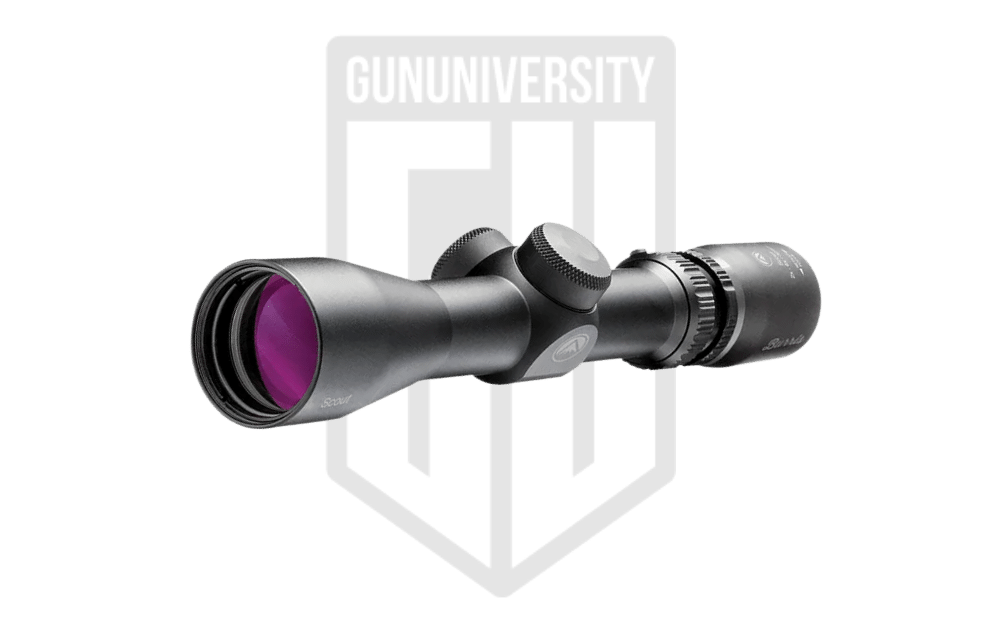
Some .30-30 rifles call for a different approach to mounting an optic. A forward-mounted scout scope can be useful when the rifle is equipped with the appropriate rail and conventional receiver mounting isn’t the preferred arrangement. The Burris Scout 2-7×32 is built for that application. Unlike a standard riflescope, it provides extended eye relief—9.2 to 12 inches according to Burris—so the optic can sit well forward of the shooter’s eye.
That distinction is critical. A conventional scope cannot simply be moved forward and expected to work, and a scout scope isn’t intended to sit in the same position as a standard receiver-mounted optic.The Burris offers 2-7× magnification, a 32 mm objective, a one-inch maintube, and a Ballistic Plex reticle. Its listed weight is 13 ounces.
The reticle includes additional aiming references, but shooters shouldn’t assume those marks correspond exactly to their .30-30 ammunition. Bullet weight, velocity, zero distance, and environmental conditions all affect trajectory. Any holdover references need to be confirmed with the actual rifle and load. The Burris fills a specialized role in this roundup. It’s not the least expensive optic here, and it isn’t the right choice for every rifle, but its extended eye relief makes it worth considering when a proper forward-mount setup is available.
- Designed for forward mounting
- Extended eye relief
- Rugged and durable
4. SIG Sauer Buckmasters 3-9×40 BDC — Best Budget Hunting Scope

SIG Sauer Buckmasters 3-9×40 BDC Specs
- Magnification 3–9×
- Objective Lens 40 mm
- Tube Diameter 1 in.
- Eye Relief 3.9–4.2 in
- Weight 14.7 oz
A .30-30 hunting rifle doesn’t necessarily need an expensive scope to be useful in the field. For someone looking for a basic magnified optic without a substantial investment, the SIG Sauer Buckmasters 3-9×40 is worth examining. This model uses a familiar 3-9× magnification range, a 40 mm objective, a one-inch maintube, and a second-focal-plane Buckmasters BDC reticle. The nonilluminated version uses quarter-MOA adjustments.
Those specifications give it the essential features many hunters want: adjustable magnification, a conventional mounting format, and a reticle with additional aiming references. The main caution concerns that BDC reticle. Holdover marks aren’t universal. They may not correspond to the trajectory of a particular .30-30 load, especially when comparing traditional flat- or round-nose ammunition with newer flexible-tip designs. Shooters need to verify where their chosen ammunition actually impacts.
The Buckmasters makes sense as a value-oriented recommendation for a rifle that accepts conventional scope mounting. It doesn’t need to outperform premium glass to justify its place here; its appeal is a practical feature set at a comparatively accessible price.
- Budget-oriented hunting scope
- Familiar 3-9× magnification
- Conventional one-inch maintube
- No illuminated reticle on this version
5. Holosun HS403B — Best Compact Red Dot

Holosun HS403B Specs
- Magnification 1x
- Objective Lens 20 mm window
- Tube Diameter N/A
- Eye Relief Unlimited
- Weight 20.8 oz
There are plenty of situations where magnification isn’t the priority. For a .30-30 used primarily at shorter distances, a compact red dot can offer a simple aiming reference without the eye-relief restrictions of a conventional riflescope. The Holosun HS403B is a 1× enclosed-emitter red dot with a 20 mm window and a 2 MOA aiming dot. Holosun lists its weight at 2.82 ounces and includes both a lower-third co-witness mount and a 0.75-inch low mount.
That included low mount is particularly relevant for this article. Traditional lever-action stocks often have lower comb heights than modern AR-pattern rifles, and a tall optic mount can make a consistent cheek weld difficult. The HS403B also includes Holosun’s Shake Awake feature and a manufacturer-rated battery life of up to 50,000 hours at the specified setting. Actual battery life depends on brightness and usage.
A red dot doesn’t magnify the target, so it won’t offer the same visual detail as a conventional scope. Shooters also need to confirm that their rifle has a suitable rail or mounting arrangement. For a lightweight, unmagnified option, however, the HS403B brings several useful features without adding much weight to the rifle.
- Lightweight and compact
- Includes a low mounting option
- Simple 2 MOA dot and motion-activated power management
6. EOTECH Vudu 1-8×24 SFP— Best Premium Hunting Scope

EOTECH Vudu 1-8×24 SFP Specs
- Magnification 1–8×
- Objective Lens 24 mm
- Tube Diameter 30 mm
- Eye Relief 3.46–4.09 in. (1×)
- Weight 20.8 oz
For hunters willing to spend more on a conventional riflescope, the Leupold VX-3HD 2.5-8×36 offers a different combination of features than the VX-Freedom. Its 2.5× minimum magnification is slightly lower than the VX-Freedom’s 3×, and the scope tops out at 8× rather than 9×. That’s a practical range for many hunting situations, especially when the goal is a compact optic rather than maximum magnification.
The VX-3HD weighs 11.9 ounces and uses a one-inch maintube with a 36 mm objective. Leupold specifies eye relief of 4.4 inches at low magnification and 3.6 inches at high magnification. Its most notable functional difference is the CDS-ZL elevation dial. The Custom Dial System allows shooters to use a dial configured for their ballistic information, while the ZeroLock feature helps prevent unintended elevation changes.
That doesn’t eliminate the need to confirm zero and trajectory. A custom dial is only useful when its inputs accurately represent the ammunition, rifle, and conditions in which it’s being used. The VX-3HD also features a traditional Duplex reticle and no illumination. For someone who values a lightweight hunting scope and wants the option of a customized elevation dial, it offers advantages beyond simply paying more for a familiar name.
- Compact 2.5-8× magnification range
- Lightweight at 11.9 ounces
- CDS-ZL elevation system
How to Choose the Best Scope for a .30-30

Start With Your Rifle, Not the Scope
Before comparing magnification or reticles, determine how your rifle can accept an optic. That may sound obvious, but it’s particularly important with .30-30 rifles because the cartridge has been chambered in numerous models over many decades.
A modern lever action drilled and tapped for a receiver-mounted scope presents different options than an older top-eject rifle. Some rifles may accommodate a conventional scope, while others need a specialized mount or forward rail. Stock design and cheek height matter, too.
Confirm the rifle’s exact model, production configuration, and compatible mounting hardware before ordering an optic. An otherwise excellent scope isn’t a good recommendation if it can’t be mounted correctly.
How Much Magnification Does a .30-30 Need?
There’s no universal answer, but most .30-30 owners don’t need extreme magnification for typical hunting applications. A 1-4× scope can be useful in close cover. A 2-7× offers a broader range while keeping the low end relatively modest. A conventional 3-9× provides flexibility for shooters who hunt from stands or have more open shooting lanes.
Higher magnification isn’t automatically better. It generally narrows the field of view and can make it harder to locate a target quickly. The appropriate setting depends on distance, lighting, terrain, and the shooter’s needs.
Understand Realistic .30-30 Hunting Distances
The .30-30 Winchester is often associated with relatively short- to moderate-range hunting, but the cartridge’s practical limitations can’t be reduced to one fixed distance. Ammunition design, bullet weight, muzzle velocity, trajectory, retained energy, rifle accuracy, and shooter ability all matter. The conditions and target matter just as much.
Traditional .30-30 ammunition commonly uses flat- or round-nose bullets because many lever-action rifles have tubular magazines. Certain modern loads, such as Hornady’s LEVERevolution ammunition, use specially designed flexible-tip bullets compatible with those magazines. Different loads can produce meaningfully different trajectories. That makes it important to zero with the ammunition you’ll actually use and verify its performance at realistic distances.
Eye Relief and Mounting Height Matter
Eye relief is the distance between your eye and the ocular lens that allows you to see the intended sight picture. Conventional riflescopes typically require your eye to be several inches behind the optic. Scout scopes are designed for much greater distances, while red dots generally provide far more flexibility in eye placement.
Mounting height deserves equal attention. An optic mounted too high can make a consistent cheek weld difficult, particularly on rifles with traditional stock dimensions. Neither extended eye relief nor a low mount guarantees compatibility. Both need to be evaluated in the context of the actual rifle.
Choose a Reticle You Can Use
A straightforward duplex-style reticle remains a sensible option for many hunting rifles. It provides a defined aiming point without requiring the shooter to interpret numerous markings.
Illuminated reticles can help distinguish the aiming point against some backgrounds, but they don’t replace proper target identification or good lighting. BDC and other holdover reticles can be useful, provided the shooter verifies their markings with the actual ammunition and zero. Never assume that a reticle calibrated around one ballistic profile will automatically match a .30-30 load.
Don’t Overlook Weight and Durability
A scope changes how a rifle carries and balances. That’s worth considering on a lever action that may spend hours being carried through the woods. A lighter optic can help preserve the rifle’s handling, although total weight isn’t the only factor. Mounting position, overall length, and stock fit also influence how the finished rifle feels.
Weather resistance and manufacturer warranty coverage are worth evaluating, but marketing descriptions aren’t substitutes for independent durability testing. Consider the manufacturer’s published specifications and the conditions in which you expect to use the optic.
Final Thoughts: Choosing the Right .30-30 Scope
The best .30-30 scope isn’t necessarily the most expensive optic or the one with the highest magnification. A good choice starts with the rifle itself and the distances and conditions in which you expect to use it.
The Leupold VX-Freedom offers a conventional hunting setup, while the Vortex Crossfire II emphasizes low magnification and an illuminated aiming point. The Burris Scout serves a different mounting arrangement, and the Holosun HS403B provides an unmagnified alternative. SIG’s Buckmasters offers a budget-conscious option, while the Leupold VX-3HD adds a more specialized elevation system.
Each has a legitimate place in the discussion, but none is universally compatible with every .30-30 rifle. Confirm the mount, choose a practical magnification range, and verify your zero and ammunition performance before heading into the field.
Frequently Asked Questions
What magnification is best for a .30-30?
For many hunting applications, a 1-4×, 2-7×, or 3-9× scope offers a useful range. The best choice depends on expected distances, terrain, and how the rifle will be used. Higher magnification isn’t necessarily an advantage in thick cover or at shorter distances.
Can you put a red dot on a .30-30 rifle?
Yes, provided the rifle has compatible mounting hardware. A compact red dot can be a practical choice for shorter-distance shooting, but it doesn’t magnify the target. Mounting height and cheek weld are particularly important on traditionally stocked lever actions.
Can you mount a scope on a Winchester Model 94?
Many Winchester Model 94 rifles can accept optics, but mounting options depend on the specific version and its ejection arrangement. Older top-eject models and later angle-eject configurations may require different mounting solutions. Verify compatibility for the exact rifle rather than purchasing a generic mount.
Is a scout scope better than a regular scope for a .30-30?
Not necessarily. A scout scope is useful when a rifle has an appropriate forward-mount configuration and the shooter wants extended eye relief. A conventional receiver-mounted scope may be simpler or more suitable on a rifle designed to accept one. The correct choice depends on the firearm and its intended use.
Does a .30-30 need an illuminated reticle?
No. Many hunters use conventional nonilluminated reticles successfully. Illumination can make an aiming point easier to distinguish in certain lighting conditions, but it doesn’t compensate for inadequate visibility or remove the need to identify a target clearly.
Henry .30-30 Review: A Lever Gun Built for the Woods
.45-70 vs .30-30: Which Lever-Action Cartridge is Best?
Henry 30 30: A Review of the All-American Lever-Action Rifle

