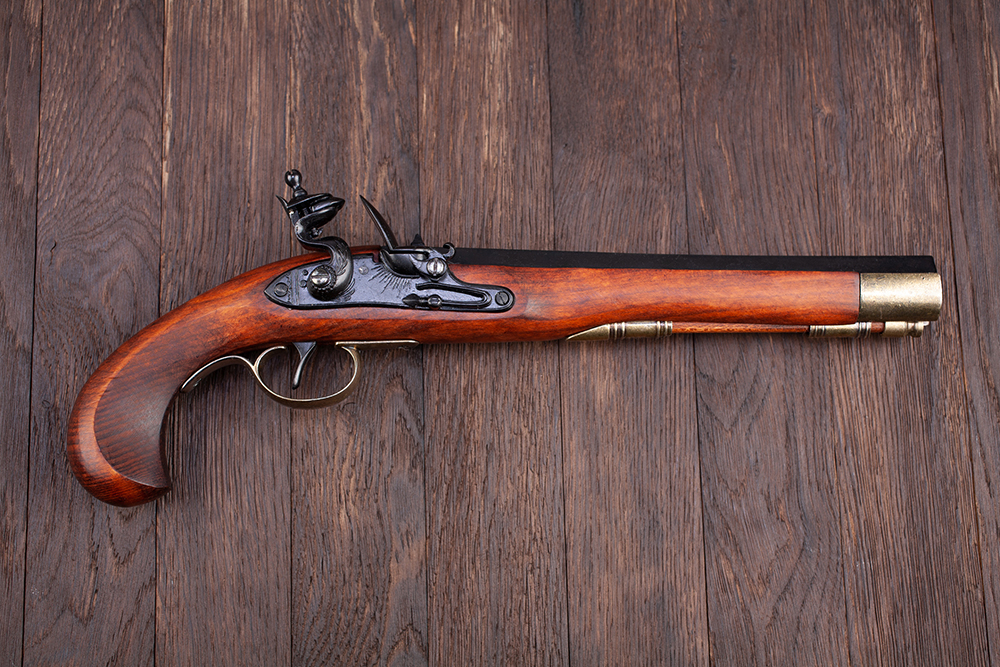

During and after the American Revolution, there was no registration of firearms in the colonies that were to become the United States. There is good evidence that handguns were commonly owned during this period.
One of the primary sources comes from records of the occupation of Boston by General Gage, both before and after the battles of Lexington and Concord. The history of these engagements was meticulously recorded by Richard Frothingham in the History of the Siege of Boston, published in 1873. Frothingham used original sources, particularly the Boston Town Meeting Minutes of 22-28 April, 1775, for the numbers of weapons.
After the disastrous battles at Lexington and Concord, which are considered the start of the American Revolution, General Gage was besieged in Boston. There were about 5,000 inhabitants in the city. Food was running short in Boston. Many people wished to leave.
General Gage made a deal with the Selectmen. People could leave the city *if* the inhabitants surrendered their weapons to the town council.
They were to identify themselves so the weapons could be returned later. People leaving the city were thoroughly searched. Even small amounts of food, such as a loaf of bread, were confiscated. It would have been difficult to smuggle out even handguns.

Page 94 from image 118 Frothingham image
The agreement was for “the inhabitants in general”, so it was to encompass all the inhabitants who were not under the control of General Gage. We have the number of arms that were turned in.

From Frothingham image 119, page 95.
The total number of firearms was 1,778 “fire-arms,” 634 pistols and 38 blunder-busses or 2,450 total, about one for every two inhabitants. Pistols were almost 26% of the total. This is obviously common, about one for every eight people.
All firearms were more expensive in relative terms than they are in the United States in the twenty-first century. The cost of a pistol in 1776 is difficult to find, with the suggestion that common flintlock pistols were about 1.7 British lbs, or roughly two weeks of skilled labor. When the American dollar came into being, there were 20 dollars per ounce of gold and 4.25 British lbs per ounce of gold, or about 8 silver dollars per flintlock pistol. The term “buck” came from the fact that one deer skin was worth about 1 dollar.
There are about 540 million privately owned firearms for about 340 million people in the USA, or about 1.6 firearms for every person. It is likely that firearms were more common in rural areas and on the frontier. An analysis of Plymouth Colony probate inventories during the 1670s showed 13% of the firearms were pistols.
It is the experience of this correspondent that firearms, especially handguns, are often taken from an estate before probate, by members of the family. They are frequently given to heirs before death. The numbers from probate records are very likely considerably lower than numbers owned by the population.
The records from the siege of Boston and the probate records show concealable firearms were commonly owned during the immediate period leading up to the ratification of the Constitution. Handguns were not considered “dangerous and unusual weapons”.
As noted previously, concealed weapons, of which handguns are only one type, were common in the colonies and the early Republic.
Massie Tells Senate the Second Amendment Exists to Thwart Tyranny
About Dean Weingarten:
Dean Weingarten has been a peace officer, a military officer, was on the University of Wisconsin Pistol Team for four years, and was first certified to teach firearms safety in 1973. He taught the Arizona concealed carry course for fifteen years until the goal of Constitutional Carry was attained. He has degrees in meteorology and mining engineering, and retired from the Department of Defense after a 30 year career in Army Research, Development, Testing, and Evaluation.