

For decades, federal law has treated buying a handgun across state lines very differently from buying a rifle or shotgun.
The Fifth Circuit Court of Appeals just ruled that distinction violates the Second Amendment.
In Elite Precision Customs v. ATF, a divided three-judge panel held on September 18, 2026 while our team was in OKC at The Guardian Conference, that federal laws prohibiting direct interstate handgun purchases are unconstitutional. The court reversed a lower court ruling that had upheld the restrictions and rendered judgment for the plaintiffs.
That’s a significant Second Amendment decision. But before anyone starts planning an out-of-state handgun shopping trip, there are some important details about what the court actually decided and what happens next.

Federal Law has restricted Americans to receiving handguns in their home states
How Interstate Handgun Purchases Work Now
If you’ve ever bought a handgun from an out-of-state dealer, you probably already know the drill.
You can buy the gun, but the dealer generally can’t hand it to you. Instead, the handgun must be shipped to a federally licensed firearms dealer in your home state. That dealer receives the firearm, completes the required transfer, and usually charges you a transfer fee.
Federal law treats long guns differently. Under certain circumstances, an FFL can directly transfer a rifle or shotgun to a resident of another state as long as the transaction complies with the applicable laws of both states.
Handguns don’t get that exception.
The restrictions come from several provisions of 18 U.S.C. § 922, primarily §§ 922(a)(3), 922(a)(5), and 922(b)(3). Taken together, the Fifth Circuit referred to them as the “Nonresident Handgun Purchase Ban.”

The Lawsuit Challenging the Ban
The plaintiffs included Elite Precision Customs, a federally licensed firearms manufacturer and dealer in Texas, two prospective handgun buyers from Arizona and New Mexico, and the Firearms Policy Coalition.
Their argument was pretty straightforward. Elite Precision wanted to sell handguns directly to customers from other states, and those customers wanted to buy them. Federal law prohibited the transactions solely because the buyers lived in different states.
A friend of ConcealedCarry.com and a plaintiff on the case, Tim Herron, explained that he had previously purchased handguns from out-of-state dealers using the legally required intermediary FFL. According to the court, those transfers typically cost him an additional $30 to $40 and delayed when he could take possession of the firearm. In my experience a $30 transfer fee would be a bargain. I tend to find $50 to be the going rate in my area.
The plaintiffs challenged the federal restrictions under the Second Amendment.
In September 2025, U.S. District Judge Mark Pittman rejected that challenge and upheld the laws. The plaintiffs appealed to the Fifth Circuit.
The Fifth Circuit Says Buying a Gun Is Protected Conduct
This is where the decision gets interesting.
One of the government’s arguments was essentially that the Second Amendment protects keeping and bearing arms, not necessarily every method by which someone acquires one.
The Fifth Circuit wasn’t persuaded because… they aren’t dumb.
The majority concluded that acquiring a firearm is necessarily connected to the ability to keep one. You can’t exercise a right to possess a firearm if the government can completely remove the ability to acquire it without implicating the Second Amendment.
That doesn’t mean every regulation governing a firearm transaction is automatically unconstitutional. It means those regulations have to survive the constitutional analysis required by the Supreme Court’s decisions in New York State Rifle & Pistol Association v. Bruen and subsequent cases.
Once the court determined that the challenged laws burdened conduct protected by the Second Amendment, the burden shifted to the government to demonstrate that the restrictions were consistent with the nation’s historical tradition of firearm regulation.
The majority concluded the government failed to do that.
The Historical Argument Didn’t Work
The government pointed to various historical laws regulating firearm commerce, including restrictions involving Native Americans, intoxicated people, gunpowder storage, and the commercial sale of firearms.
The Fifth Circuit found those analogues insufficient.
The problem wasn’t whether governments historically regulated the firearms trade. They clearly did. The question under Bruen was whether there was a historical tradition sufficiently analogous to a categorical prohibition on direct handgun purchases between residents of different states.
The majority said there wasn’t.
The court ultimately concluded that the federal ban “is inconsistent with the nation’s tradition of firearms regulation” and therefore violates the Second Amendment.
Judge Jerry Smith wrote the majority opinion, joined by Judge Kurt Engelhardt. Judge Catharina Haynes dissented, saying she would have affirmed the district court’s decision upholding the restrictions.
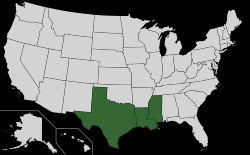
5th Circuit Map
What About the FFL Workaround?
This may be the most practically important part of the opinion.
The government pointed out that federal law doesn’t actually prevent someone from buying a handgun located in another state. It just requires the firearm to pass through an FFL in the purchaser’s home state before the buyer takes possession.
In other words, there is already a workaround. The Fifth Circuit didn’t consider that sufficient and they were right to think so.
The court noted that the second FFL isn’t required to participate, usually charges a fee, and introduces additional delay into the transaction. More importantly, the majority rejected the idea that an otherwise unconstitutional restriction becomes constitutional simply because the government leaves another, more burdensome way to exercise the right.
That reasoning could end up being one of the more important aspects of this case beyond interstate handgun sales themselves.
No, This Doesn’t Mean You Can Ignore Federal Law Tomorrow
This is where we need to pump the brakes a little.
The Fifth Circuit held the federal restrictions unconstitutional and rendered judgment for the plaintiffs. That is not the same thing as every gun owner nationwide suddenly being free to disregard the existing federal interstate transfer requirements.
There are procedural questions still to be resolved, including issuance of the Fifth Circuit’s mandate and the scope of the judgment. Further litigation is also possible.
For FFLs in particular, this isn’t the time to get creative.
Until the legal effect of the decision is settled, dealers should continue paying close attention to ATF guidance, the status of the case, and the laws applicable to their particular transactions.
There’s Also a Circuit Split
The decision becomes even more interesting because the Fifth Circuit isn’t writing on a completely blank slate.
Other federal appellate courts have considered restrictions on interstate handgun transactions, and the Fifth Circuit’s analysis conflicts with the approach taken elsewhere, including by the Second Circuit.
That matters.
A disagreement among federal appellate courts over the constitutionality of a federal law is exactly the kind of issue that can eventually attract Supreme Court attention. It doesn’t guarantee the Supreme Court will take this case, and there are still procedural steps that could change how things develop from here.
But this is no longer just a district court disagreement over how to apply Bruen.
The Bigger Issue
For me, the interesting part of Elite Precision isn’t really the inconvenience of paying another FFL $30 or $40.
It’s the court’s treatment of firearm acquisition itself.
The Fifth Circuit rejected the idea that the government can sidestep Second Amendment scrutiny simply because a regulation governs how someone obtains a firearm rather than whether they can possess one after the transaction is complete.
That’s a distinction worth watching.
For now, though, the practical advice is boring, and boring is usually preferable to becoming the test case yourself. The Fifth Circuit has ruled that the federal Nonresident Handgun Purchase Ban violates the Second Amendment. That is a major legal development.
It is not yet permission to pretend the federal interstate handgun transfer rules don’t exist.
We’ll continue following Elite Precision Customs v. ATF as the mandate issues and the government decides what it does next.

