

In the category of image over substance, Seattle’s KIRO 7 appears to have turned a felon-in-possession arrest into yet another misleading anti-gun scare story.
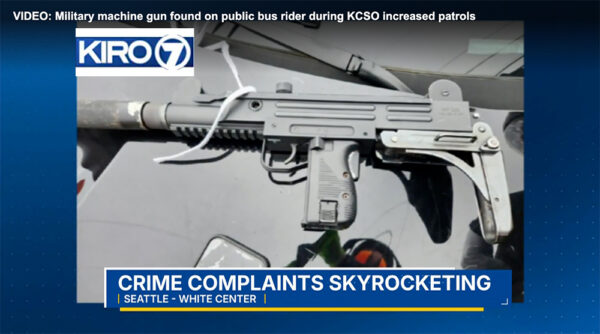
On March 20, KIRO 7 ran the headline: “Military machine gun found on public bus rider during KCSO increased patrols.” In the story, the station reported that King County Sheriff’s Office deputies encountered a man smoking marijuana on a bus, removed him from the bus, and during a pat-down found “a gun — an Uzi with a silencer” concealed under his shirt and tucked down his pants. KIRO then told readers, “An Uzi is a military-grade machine gun that is generally illegal to own in the United States.”
That is a dramatic claim. It is also one that appears not to match the gun KIRO showed its audience.
By the very next day, KIRO’s own follow-up reporting described the seized firearm differently. Instead of repeating the “military machine gun” line, the station referred to it as “a reproduction .22 caliber Uzi-style machine gun with a fake suppressor.” That wording is still sloppy, because a semi-automatic .22 replica is not a machine gun. But it strongly suggests the original story exaggerated what deputies had actually recovered.
That distinction is not a technicality. If the firearm shown was in fact a .22-caliber UZI-style replica, labeling it a “military machine gun” was not just imprecise wording. It gave viewers a false impression about what the suspect actually possessed.
Product listings make the likely explanation even more obvious. Walther has marketed a semi-automatic UZI .22 LR tactical rimfire replica, describing it as a UZI rimfire replica and explicitly identifying it as a semi-auto .22 LR rifle, not a select-fire submachine gun.
That appears consistent with what KIRO eventually reported: a “reproduction .22 caliber Uzi-style” firearm with a “fake suppressor.”
KIRO correctly reported that the man was a convicted felon, which would make his possession of any firearm unlawful regardless of whether the gun was a real machine gun or a semi-auto .22 clone. That was already a valid story. The real offense was serious enough on its own. There was no need to inflate it into a “military machine gun” narrative if the object shown was actually a rimfire replica.
Unfortunately, this kind of framing has a long history. In its well-known paper on “assault weapons,” Violence Policy Center openly argued that public confusion between machine guns and semi-automatic firearms could be politically useful, writing that “anything that looks like a machine gun is assumed to be a machine gun.” That line has aged better than the media outlets that keep proving him right.
If King County deputies recovered a firearm from a prohibited person, report that. If the gun was a .22-caliber UZI-style replica with a fake suppressor, report that too. But telling the public a “military machine gun” was found on a bus rider, then quietly shifting to “reproduction .22 caliber Uzi-style” language later, is bad reporting and exactly why people have shifted away from mainstream media sources.
About Dean Weingarten:
Dean Weingarten has been a peace officer, a military officer, was on the University of Wisconsin Pistol Team for four years, and was first certified to teach firearms safety in 1973. He taught the Arizona concealed carry course for fifteen years until the goal of Constitutional Carry was attained. He has degrees in meteorology and mining engineering, and retired from the Department of Defense after a 30 year career in Army Research, Development, Testing, and Evaluation.