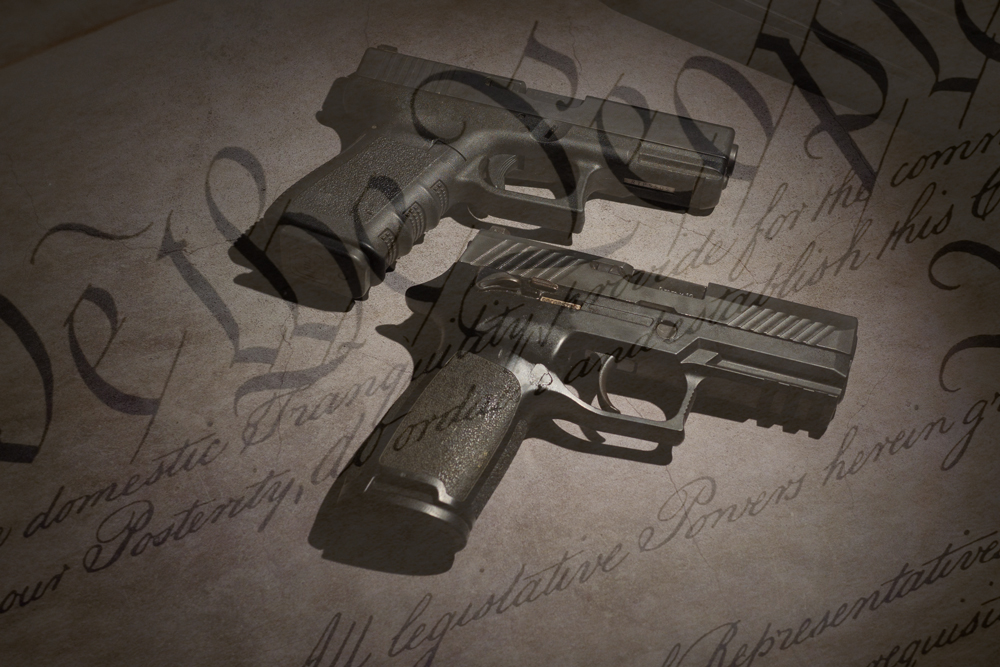

Testifying before the United States Senate, Representative Thomas Massie did not hedge, soften, or apologize for the plain meaning of the right to keep and bear arms. He said, “The simple and direct language of our Constitution is clear. The right of the people to keep and bear arms shall not be infringed. There are no qualifiers on who may keep arms, what types of arms they may keep, or for what purposes.”
He also cut through one of the oldest anti-gun talking points in the book, saying, “It certainly doesn’t say that the right to bear arms is about trivial matters like deer hunting or skeet shooting.” Exactly right.
What made Massie’s testimony important was not just that he defended the Second Amendment, but that he defended it in the way the Founders understood it. As Massie told senators, “The Second Amendment exists for one clear reason: defense. For the defense of one’s home, one’s family, and one’s community, for the defense of liberty and safety, not only from a lone assailant, but from the whole of tyrannical government.”
That is not extreme rhetoric. That is the core American understanding of why an armed citizenry matters.
The generation that wrote the Constitution had lived through a government attempt to seize arms and powder from the people. Before Lexington and Concord became part of our national memory, British authorities were already moving against colonial military stores. The men who framed the Second Amendment knew very well that disarmament was not some neutral administrative act. They understood it as a tool of domination.
Massie captured that point when he warned, “Our founders understood the greatest risks to liberty are not always found outside a nation’s borders… but oftentimes from within, when a corrupt and dangerous few grow too ambitious and attempt to subjugate the masses.”
That is the part advocates of gun control never want to discuss. They do not want to talk about what happens when the government itself becomes the danger.
Massie underscored that by invoking George Mason’s famous warning that disarming the people is the surest path to enslavement. Whether the threat comes from a criminal predator, a violent mob, or a tyrannical government, the underlying principle is the same: a population stripped of the means of defense is easier to control.
Rep. Massie did not stop at principles. He used the hearing to connect the constitutional argument to specific federal policy fights that matter right now. That is what makes his testimony more than a good speech. He put actual legislative priorities on the table.
One of the biggest was the National Constitutional Carry Act.
Massie pointed out that the old concealed-carry reciprocity model was developed in a very different political environment, when most states still required permits to carry a firearm. That has changed. Today, a majority of states recognize some form of permitless carry. As Massie put it, “29 states now recognize that the right to keep and bear arms should not require permission from your government to bear those arms.”
Constitutional carry is no longer a fringe idea. It is the logical expression of a constitutional right. If the right exists, government permission should not be the precondition for exercising it. Massie’s proposal would extend that principle nationwide, applying the same basic understanding of the Second Amendment across all 50 states and the territories.
That was easily one of the most important policy points in his testimony, because it moves the debate beyond abstract praise for the Second Amendment and into the real question: does Washington actually believe this is a right, or just a slogan Republicans recite during election season?
Massie also called for repeal of the Gun-Free School Zones Act, and that matters for both practical and political reasons. He argued that so-called gun-free zones too often function as advertisements for vulnerability rather than real deterrents against evil. His point was that disarmament policies often leave law-abiding people defenseless while doing nothing to stop those already willing to ignore murder laws, gun laws, and every other law on the books.
He also raised the federal ban preventing adults ages 18 to 20 from purchasing handguns from federally licensed dealers. Massie put the contradiction plainly: if young Americans can be compelled to serve their country in uniform, they should not be denied the ability to buy a handgun for lawful self-defense. That is one of those issues where even many nominally pro-gun politicians still talk themselves into accepting a rights carveout that makes no constitutional sense.
Another important issue Massie highlighted was the federal NICS background check system. Massie argued that sloppy matching and false denials can keep law-abiding Americans from purchasing firearms, and he specifically pointed to concerns that minority buyers may be disproportionately affected because of phonetically similar names. Gun control advocates routinely treat the background check system as untouchable, but Massie used the hearing to point out that a bureaucratic process can still be deeply flawed even when politicians call it “common sense” and deprive law-abiding Americans of their rights.
In his testimony, Massie was not just defending the Second Amendment as a historical concept or a rhetorical symbol. He was arguing that if Congress really believes what the Constitution says, federal law should begin to reflect that belief more honestly.
That is why one of his most important lines came near the end, when he reminded senators, “When we look to our Constitution, remember it’s a document by our people for the purpose of constraining our government, not the other way around.”
The Second Amendment is not an odd side provision to be tolerated so long as it stays politically quiet. It is part of the architecture of liberty. Massie said it plainly: “The Second Amendment is the ultimate check on our government.”
Government should not be expanding “gun-free” disarmament zones that leave good people exposed. It should not be telling legal adults they are old enough to fight wars but too young to buy handguns from licensed dealers. It should not be hiding behind flawed bureaucratic systems that deny rights through error and opacity. And it certainly should not be forcing Americans to ask permission before exercising a right explicitly protected by the Constitution.
Massie also tied the issue back to the rest of the Bill of Rights, warning, “Any attack on those core tenets, whether it’s the Second Amendment, the First Amendment, or the Fourth Amendment, or any other provision of our Constitution, is dangerous and wrong.”
That is exactly right, and it is something too many lawmakers forget. The people who treat one constitutional protection as expendable rarely stop there.
This was a good day for the Second Amendment, not because one Senate hearing will change everything overnight, and not because the anti-gun movement is suddenly going to abandon its long campaign against armed citizenship. It was a good day because a sitting member of Congress said, in clear language and before the country, what more elected officials should have been saying all along: the Second Amendment exists to help keep a free people free.
And unlike many politicians, Thomas Massie did not leave that truth floating in the abstract. He tied it to actual legislation, actual policy fights, and the actual question facing Congress right now—whether it is willing to treat the Second Amendment like a real right.
About Duncan Johnson:
Duncan Johnson is a lifelong firearms enthusiast and unwavering defender of the Second Amendment—where “shall not be infringed” means exactly what it says. A graduate of George Mason University, he enjoys competing in local USPSA and multi-gun competitions whenever he’s not covering the latest in gun rights and firearm policy. Duncan is a regular contributor to AmmoLand News and serves as part of the editorial team responsible for AmmoLand’s daily gun-rights reporting and industry coverage.