

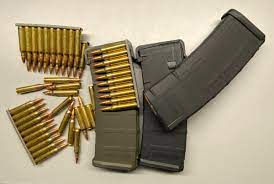
On Friday, July 17, the U.S. Court of Appeals for the Third Circuit, sitting en banc, struck down New Jersey laws criminalizing possession of semi-automatic rifles and restricting possession of certain large-capacity magazines (“LCMs”), holding that both violate the Second Amendment. This marks the first time a federal appeals court has struck down a state ban on assault weapons—a timely development as the Supreme Court is set to consider whether similar bans on semi-automatic weapons violate the Second Amendment this fall.
In Association of New Jersey Rifle and Pistol Clubs et al. v. New Jersey, the Third Circuit heard consolidated Second Amendment and Fifth Amendment Takings challenges against New Jersey. Plaintiffs challenged the assault firearms provision of 1990 N.J. Sess. Law Serv. Ch. 32 (“Act”), enacted in the wake of a school shooting. The Act criminalizes knowing possession of an unlicensed, operable “assault firearm,” defined as 30 named models of semi-automatic rifles, pistols, shotguns, and any firearm that is “substantially identical” to a listed model. The law provides an exception to the ban, allowing a state court to grant an “assault firearm” license upon determining that “the public safety and welfare” require granting the license. Since the law’s enactment in 1990, no individual has ever received one.
Plaintiffs also challenged a 2018 amendment to the Act’s LCM provision, which bars possession of magazines capable of holding 10 or more rounds of ammunition absent a license for an “assault firearm.” Previously, the Act prohibited magazines capable of holding more than 15 rounds. Once the amendment took effect, individuals possessing magazines holding more than 10 rounds had four options: (1) voluntarily surrender the magazines to the State; (2) transfer the magazines to someone holding an “assault firearm” permit; (3) render the magazines permanently inoperable; or (4) permanently modify the magazines to accept 10 or fewer rounds. The amendment included exceptions for firearms purchased before its effective date that either had a fixed magazine capacity of up to 15 rounds or accepted only a magazine with a capacity of up to 15 rounds that could not be modified.
Lower Court Ruling
In 2018, the Association of New Jersey Rifle & Pistol Clubs and two of its members sued the State’s Attorney General and three police officials, arguing that the amended LCM provision violates the Second Amendment and the Fifth Amendment’s Takings Clause. The District Court for the District of New Jersey denied Plaintiffs’ motion for a preliminary injunction and granted summary judgment to Defendants in 2019. The Third Circuit affirmed both rulings. Plaintiffs petitioned for certiorari. After deciding New York State Rifle & Pistol Association v. Bruen, 597 U.S. 1 (2022), the Supreme Court granted the petition, vacated the Third Circuit’s judgment, and remanded the case for reconsideration in light of Bruen. The Third Circuit then remanded the case to the district court.
On the day the Supreme Court decided Bruen, the Firearms Policy Coalition (along with two individual plaintiffs) challenged the Act’s assault firearms provisions on Second Amendment grounds. One week later, the Association of New Jersey Rifle & Pistol Clubs and two of its members filed their own Second Amendment challenge to the same provision.
The district court consolidated the three cases, resolving all in a single opinion. In that 2024 opinion, the district court limited its analysis of the assault firearms provision to Colt AR-15s, reasoning that the parties’ evidence focused largely on that model and, given the limited nature of that evidence, the Act’s regulation of other firearms raised issues the court was not equipped to examine. Applying Bruen’s framework, the court held the ban on Colt AR-15s is “inconsistent with our Nation’s historical tradition of firearm regulation” and therefore “cannot stand.” Judge Sheridan determined that the provision functioned “effectively as the total prohibition on a commonly used firearm for self-defense . . . within the home,” making it impermissible under District of Columbia v. Heller, 554 U.S. 570 (2008).
On LCMs, however, the court reached a different result: although LCMs qualify as “arms,” it found a historical tradition supporting their restriction, consistent with the Second Amendment. The court also held the LCM ban did not violate the Takings Clause under Circuit precedent.
Before the Third Circuit
Judge Freeman authored the majority opinion—joined by Judges Hardiman, Bibas, Porter, Matey, Montgomery-Reeves, and Bove—striking down both restrictions solely on Second Amendment grounds. Because each provision violated the Second Amendment, the majority elected not to address Plaintiffs’ LCM Takings challenge on constitutional avoidance grounds. The Third Circuit remanded constitutional questions regarding the Act’s other assault weapons provisions to the district court.
Several members of the court filed separate opinions: Judge Matey and Judge Montgomery-Reeves authored concurrences, Judges Phipps and Mascott concurred in part and in judgment, Judge Chung concurred in part and dissented in part, and Judge Shwartz, Judge Krause, and Judge Smith each authored dissents.
Semi-Automatic Rifles Holding
Although the district court’s ruling addressed only Colt AR-15s, the majority found that the Act’s provisions covering all semi-automatic rifles violated the Second Amendment. The court reasoned that, given the common features of Colt AR-15s and semi-automatic rifles generally, the record contained sufficient information to address all semi-automatic rifles the Act covered. Some criticized the majority’s choice to expand the scope of weapons governed by the opinion. Judge Shwartz, for example, called the move contrary to the party-presentation rule and “the necessary restraint demanded by Article III.
Moving to substantive analysis, the majority found that the Second Amendment’s plain text covered Plaintiffs’ conduct, satisfying Bruen step one. Applying subsidiary questions from Wolford v. Lopez, 609 U.S. ____ (2026), the majority explained that (1) the consolidated Plaintiffs are among “the people” covered by the Second Amendment, and (2) New Jersey’s law restricts the keeping and bearing of semi-automatic rifles. The court also held that (3) semi-automatic rifles qualified as arms, noting that even the narrowest Founding-era definition of “arms” encompassed all firearms. The court reserved Heller’s “common use” analysis for Bruen step two, which this post discusses in more detail below.
The majority concluded that New Jersey failed Bruen’s second step, which requires the government to show the challenged law is consistent with historical tradition. After relying on circulation data to determine that semi-automatic rifles were in common use for lawful purposes, the majority likened the Act’s provision to the laws at issue in Heller and Bruen. The court explained that both cases make clear “bans or broad prohibitions on possessing or carrying of a class of weapons in common use for lawful purposes fail to find support in our Nation’s tradition of firearm regulation . . . even when the regulations are passed with the intention of reducing gun violence.”
First and foremost, the court noted that the Founding era is “the primary time period for the analogical inquiry.” While the court acknowledged post-ratification practice could be “evidence of Founding-era principles,” it ultimately “cannot create a new tradition or contradict Founding-era practices.” Accordingly, although the state relied upon Antebellum and Reconstruction-era regulations on Bowie knives, slungshots and clubs, pistols, and revolvers, the court deemed them irrelevant to the inquiry because they occurred too far from the Founding. Moreover, none of these regulations, the court explained, imposed an outright ban on a class of weapons in common use for lawful purposes. Rather, the categorical restrictions dealt only with weapons commonly associated with criminal activity.
The Founding-era analogues upon which New Jersey did rely—namely, late-1700s gunpowder-storage laws—were also insufficient. This is because, the court explained, Founding-era gunpowder-storage laws aimed to promote fire safety rather than address firearm violence, and the Act’s semi-automatic rifles ban does nothing to promote fire safety. Lastly, because New Jersey’s law addressed societal concerns over weapons misuse—a concern present since the 18th century—the court determined New Jersey’s provision fell “into the category of cases where ‘the historical analogies . . . are relatively simple to draw,’” instead of Heller’s “novel issue” category “calling for a ‘more nuanced approach.’”
The majority’s treatment of New Jersey’s historical analogies drew criticism from nearly all corners of the bench. Concurring in part and in the judgment, Judge Mascott called the majority’s rigid choice between 1791 and 1868 as the starting point for Second Amendment analysis unnecessary for such a broad, longstanding right. Judge Chung, concurring in part and dissenting in part, argued that historical analogues addressing restrictions on weapons not commonly worn would be more appropriate. Judge Shwartz’s dissent countered that, like the historical ban on Bowie knives, banning semi-automatic rifles imposes no burden on self-defense because New Jersey residents may still lawfully keep and bear other firearms. She added that technological advances since the Founding mean no relevantly similar historical analogues exist for these weapons, which would allow the court to take a more “nuanced” approach. Judge Krause’s dissent echoed similar concerns, noting: “Firearms from the Founding era are about as closely related to semi-automatic rifles as a horse and buggy is to an F-150 truck . . . it would be absurd to elide their modern and historic technologies and capabilities.”
LCM Holding
The majority held that New Jersey’s LCM restriction passed Bruen step one, concluding that LCMs fell within the plain text of “arms.” Relying on Bruen’s recognition that the general definition of “arms” covers modern instruments that facilitate self-defense, the majority rejected the State’s argument that LCMs fell outside Heller’s Founding-era definitions of arms. In rejecting New Jersey’s argument that the LCM amendment was a restriction on rounds rather than a flat ban, the majority likewise stated, “nothing in [the] text of the Second Amendment suggests that the capacity of a magazine bears on whether it receives constitutional protection.” Finally, the majority determined that “the Second Amendment does not limit ‘Arms’ to the minimum equipment necessary to operate a weapon,” rendering the availability of alternative equipment immaterial to the analysis.
Judge Krause’s dissent called the majority’s inclusion of LCMs within the definition of “arms” inconsistent. She pointed out that the majority relied on the literal dictionary definition of “arms” when including semi-automatic rifles within that term, but ventured “beyond this dictionary definition to conclude that magazines—surely a component of a firearm but otherwise harmless when not properly inserted and loaded—fall within the scope of the Second Amendment.”
At Bruen step two, the majority found that, given that AR-15s and similar weapons typically come with standard twenty- or thirty-round magazines and are commonly used for lawful purposes, LCMs passed the common use test. The majority rejected New Jersey’s historical analogues on the same grounds as above.
Common Problems with “Common Use”
The “common use” test stems from the Supreme Court’s decision in Heller (which drew the term from the otherwise overruled United States. v. Miller, 307 U.S. 174 (1939)) and extends the Second Amendment’s protection only to weapons “in common use” for “lawful purposes.”
What is “common”? What is “use”? Courts are split on whether the “common use” inquiry belongs at Bruen’s first or second step. Courts and litigants also disagree about exactly what “common use” means, and how to measure it. Here, the Third Circuit measured common use by the prevalence of weapons in circulation today. With regard to semi-automatic rifles, the Third Circuit relied on the district court’s findings that there are “24 million AR-15s and similar sports weapons in circulation.” It likewise recognized that these semi-automatic rifles “typically come standard with twenty- or thirty-round magazines,” and that there are “over 100 million 30-round AR-15 magazines in circulation” when determining the common use of LCMs.
But does “common use” turn on a weapon’s—or model’s—market share? Should it? Should it depend on how many guns, total, are in circulation? What’s the appropriate denominator? Is it households? Individuals? Or should “common use” depend on evidence that a model is actually used for self-defense? Do we rely only on instances in which the gun was actually fired? Should we include brandishing in self-defensive uses as well?
And does it matter whether the guns are owned for any lawful purpose (e.g., hunting, sport shooting, collecting), or only for self-defense? How do we measure that? Is it subjective intent of the buyer that matters? Or how often specific models are actually used in self-defense incidents?
The Third Circuit’s decision in Association of New Jersey Rifle and Pistol Clubs et al. v. New Jersey is, in many ways, a case study of these tensions.
Is “common use” a Step 1 or Step 2 question? The en banc majority placed common use at Bruen’s second step. The court treated Bruen’s reference to common use at step one—“that handguns are weapons ‘in common use’ today for self-defense”—as merely resolving an uncontested threshold issue of whether they are “arms” under the plain text. Rather, it read Bruen’s use of the phrase “common use” in evaluating historical tradition—specifically, explaining even if “handguns were considered ‘dangerous and unusual’ during the colonial period, they are indisputably in ‘common use’ for self-defense today”—as evidence that the “common use” test belonged at step two.
Placing “common use” at step two may align more with Wolford’s suggestion that step one is an easy hurdle for challengers to clear—specifically, that if a law implicates the “plain text” of the Second Amendment, it is “presumptively unconstitutional.” But, as Judge Shwartz’s dissent pointed out, Wolford can guide an alternate reading of where common use belongs because, there, the Supreme Court “indicated that whether ‘Arms’ are protected by the Second Amendment based on their ‘customar[]y’ use for ‘defensive’ purposes must be assesses at Step One.” Additionally, placing common use at step two risks setting the step-one bar too low. As Judge Krause’s dissent argues, moving common use to step two opens the door for “even some weapons of mass destruction” to satisfy step one “as long as they may be grasped, hoisted, and shouldered.”
Moreover, placing common use at step two shifts the burden onto the government to refute it. This is particularly challenging where courts, as in this case, take a permissive view of what common use entails. As discussed, the majority relied on circulation data, citing studies that purport to show there are 24 million assault rifles and over 100 million 30-round AR-15 magazines in circulation. Under the party-presentation rule, the court may rely only on the record developed by the parties when making decisions. Because New Jersey offered no competing data, the court explained, it had to rely on Plaintiffs’ evidence.
“Lawful purposes.” The majority also took a broad view of lawfulness, recognizing target shooting, hunting, and pest control as lawful purposes alongside self-defense. It likewise rejected New Jersey’s evidence of disproportionate criminal use, reasoning that such misuse “may still represent a small fraction of those weapons’ overwhelmingly lawful use.”
This approach places heavy emphasis on circulation data, which, as Judge Chung’s partial concurrence and dissent notes, can be unreliable: the 24-million figure itself rests on a survey with a disputed “methodology and reliability,” extrapolated from just 4,665 responses drawn from a “cultivated pool of individuals.” Moreover, as Judge Krause’s dissent points out, “[c]irculation data reveals only how many units of a weapon manufacturers have pumped into the marketplace, not how many people have actually chosen to keep and bear the weapon.” That, she explains, incentivizes manufacturers to flood the market so weapons secure constitutional protection before legislators can regulate them. Fear that a weapon could become common, meanwhile, may cause legislators to pass hasty regulations, which could hinder “the development of useful technologies before their risks could be assessed.” This emphasis on circulation likewise diminishes the impact of competing data, such as the evidence New Jersey offered of semi-automatic rifles’ disproportionate criminal use. It may also undercut the democratic process. As Judge Krause’s dissent explains, the majority’s focus on circulation “disregard[s] the democratic will of the People of New Jersey.
What to Watch
The Third Circuit’s opinion ventures into unsettled waters, and ambiguities over where in the Bruen framework “common use” belongs, and what it entails, are not going away. Indeed, the petitions of Viramontes and Grant, the cases the Court is set to consider this fall, raise similar questions. Of note, Judge Montgomery-Reeves (concurrence) and Judge Krause (dissent) both argued that the Third Circuit should have waited for the Court to weigh in before deciding this case. Despite these uncertainties, one takeaway is clear: how courts define and apply “common use” has major implications for cases involving categorical weapons bans.

