

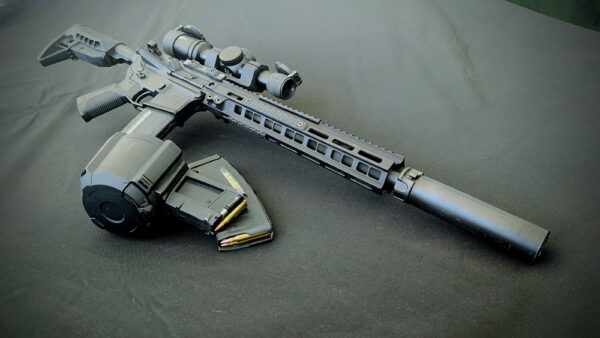
Virginia gun owners are getting a clear look at how far the Commonwealth is willing to go to defend its new ban on so-called “assault firearms” and standard-capacity magazines.
In Crump v. Katz, plaintiffs John Crump, Gun Owners of America, Gun Owners Foundation, Virginia Citizens Defense League, and Virginia Citizens Defense Foundation are seeking a preliminary injunction against SB749, Virginia’s newly enacted restriction on commonly owned semi-automatic firearms and magazines holding more than 15 rounds.
The defendant, Colonel Jeffrey Katz, Superintendent of the Virginia State Police, has now filed his opposition. The brief does more than argue that SB749 should remain in effect while the case moves forward. It takes direct aim at the idea that Virginia’s own Constitution protects an individual right to keep and bear arms.
Virginia’s central argument is that Article I, Section 13 of the Virginia Constitution is not an individual Second Amendment-style right at all. According to the Commonwealth, Section 13 is a “collective, militia-tethered right,” meaning the right to keep and bear arms is tied to militia service rather than individual self-defense.
The state leans heavily on the wording of Section 13, which says:
“That a well regulated militia, composed of the body of the people, trained to arms, is the proper, natural, and safe defense of a free state, therefore, the right of the people to keep and bear arms shall not be infringed; that standing armies, in time of peace, should be avoided as dangerous to liberty; and that in all cases the military should be under strict subordination to, and governed by, the civil power.”
Virginia’s argument turns on the word “therefore.” The Commonwealth claims that because the right-to-arms language is joined to the militia language by “therefore,” the right is merely a consequence of the militia clause and not a free-standing guarantee for individual citizens.
The brief also argues that the right-to-bear-arms clause was added in 1971, not at the Founding, and that the court should look to the 1971 ratification history rather than simply applying modern Second Amendment doctrine. The Commonwealth points to legislative debates from that period, claiming sponsors said the language created “no additional rights” and would not interfere with gun control laws.
That is the legal path Virginia wants the court to take: separate Article I, Section 13 from the Second Amendment, treat it as narrower than the federal right, and then conclude that SB749 does not violate it.
The state also pushes back against the plaintiffs’ reliance on federal cases such as Heller and Bruen. Virginia admits those cases may be informative, but says they do not control the meaning of the Virginia Constitution. In the Commonwealth’s view, state courts do not have to treat Section 13 as coextensive with the Second Amendment.
That is a major claim. If accepted, it would leave Virginia gun owners with far less protection under their own Constitution than they have under the federal Second Amendment.
.apc-product-compare-list td.apc-product-image {
max-width: 149px;
}
.apc-product-compare-list img {
max-width: 100%;
}
.apc-product-compare-list td.apc-product-name {
max-width: 35%;
}
.apc-product-compare {
max-width: 100% !important;
margin-top: 20px;
margin-bottom: 20px;
}
table.apc-product-compare-list {
width: 100%;
text-align: center;
}
.apc-product-name a {
text-decoration: none;
font-weight: 500;
font-size: 20px;
}
.apc-product-brand a {
text-decoration: none;
font-weight: 700;
font-size: 22px;
}
.apc-product-price>span {
white-space: nowrap;
}
span.apc-sale-price {
display: block;
color: #FD7F03;
font-size: 19px;
font-weight: 700;
text-decoration: inherit;
}
span.apc-original-price {
font-size: 15px;
font-weight: 400;
text-decoration: line-through;
color: #848484;
}
.apc-product-compare-list td {
padding: 5px;
vertical-align: middle;
}
.apc-product-url .apc-arrow-right {
border: solid black;
border-width: 0 5px 5px 0;
display: inline-block;
padding: 10px;
transform: rotate(-45deg);
-webkit-transform: rotate(-45deg);
border-color: #FD7F03;
}
Live Inventory Price Checker
|
|
PSA Sabre AR-15 “M4A1″ FN CHF CL 16” Upper w/ Quad Rail and Vertical Grip |
Palmetto State Armory |
|
|
|
|
PSA Sabre AR-15 “M4A1″ CHF CL 14.5” P&W Upper w/ Quad Rail & Vertical Grip |
Palmetto State Armory |
|
|
|
|
PSA Sabre AR-15 “M4A1″ CHF CL 14.5” P&W Upper w/ Surefire Warcomp, Quad Rail and Vertical Grip |
Palmetto State Armory |
|
|
|
|
PSA Sabre AR-10 Upper Forged 18″ 6.5 Creedmoor Mid-Length 15″ Knurled Slant Rail w/ Sabre Compensator |
Palmetto State Armory |
|
|
The Commonwealth then argues that even if the court applies a Bruen-style test, SB749 still survives because the banned firearms and magazines are supposedly outside the scope of protected arms.
Virginia says “large-capacity” magazines are not “arms” at all. The brief calls them accessories, not weapons, because a magazine does not fire a projectile by itself. The state argues a firearm can still function for self-defense without a magazine over 15 rounds, so those magazines do not receive constitutional protection.
That argument should sound familiar. Anti-gun states have been using the same “accessory, not arms” theory to defend magazine bans around the country. The problem is obvious: a modern semi-automatic firearm depends on magazines to function as designed. Treating the magazine as constitutionally irrelevant is just a convenient way to regulate around the firearm itself.
Virginia also claims that so-called “assault firearms” and large-capacity magazines are not in common use for lawful self-defense. The brief argues that AR-15-style rifles are “weapons of war,” not ordinary defensive arms, and says they are more like M16s than handguns.
The Commonwealth cites federal appellate decisions upholding similar bans and relies on expert declarations claiming AR-style rifles and larger magazines are disproportionately tied to mass shootings and dangers to law enforcement. It also argues these firearms are “dangerous and unusual,” a category the government says falls outside constitutional protection.
The state does not simply say SB749 is a modest regulation. It argues that some of the most popular semi-automatic rifles in America are not protected arms, that magazines over 15 rounds are accessories, and that Virginia’s own right-to-arms provision does not protect individual gun owners in the way the Second Amendment does.
Virginia’s opposition also argues that SB749 fits within a historical tradition of regulating dangerous weapons. The brief points to laws involving trap guns, Bowie knives, machine guns, and older magazine restrictions. That is the state’s attempt to satisfy Bruen while also telling the court Bruen should not really drive the state constitutional analysis.
If the court accepts Virginia’s argument, the state could claim Article I, Section 13 offers little independent protection for individual gun owners. The Commonwealth could then treat the right to arms as something tied to a government-recognized militia purpose, while dismissing modern semi-automatic rifles and standard-capacity magazines as too dangerous for ordinary citizens.
Gun owners should be watching closely. The preliminary injunction motion is set to be heard this Friday, June 12, 2026, and the court’s ruling could determine whether SB749 is blocked before it takes effect or whether Virginia gun owners are forced to live under the new restrictions while the case continues.
For gun owners, this is not just a procedural hearing. It is the first major test of whether Virginia courts will treat the state’s right-to-arms provision as a real protection for individual citizens or allow the Commonwealth to narrow it into a militia-only guarantee while banning some of the most commonly owned rifles and magazines in America.
Virginia Judge Blocks State Police From Enforcing Universal Background Checks
About Duncan Johnson:
Duncan Johnson is a lifelong firearms enthusiast and unwavering defender of the Second Amendment—where “shall not be infringed” means exactly what it says. A graduate of George Mason University, he enjoys competing in local USPSA and multi-gun competitions whenever he’s not covering the latest in gun rights and firearm policy. Duncan is a regular contributor to AmmoLand News and serves as part of the editorial team responsible for AmmoLand’s daily gun-rights reporting and industry coverage.