


In the ongoing study of the effectiveness of handguns as a defense against bears, there are over 200 documented cases. Of those, 184 involve only handguns. The others are combination situations where other deadly force was used in addition to handguns. Of the 184 cases, 161 include information about the number of shots fired. In 23 cases, the number of shots is not known.
The data is likely skewed by unavoidable selection bias. The data is limited to cases that are documented. There is a strong selection bias against cases that do not involve dramatic outcomes or human injury, or that happen far from any civil authority. Those cases are not likely to be reported or recorded in a way that is accessible. Consider a hypothetical:
A bear acts aggressively toward a person who is hiking. Not wanting to kill the bear, for whatever reason, they fire a warning shot or shots. The bear runs off. There is very little drama, almost no news value, and virtually no reason to report the incident to any authority. There is a strong selection bias against successful uses of warning shots.
One way to guard against selection bias is to include every documented case where a handgun was fired in defense against a bear. This policy was formulated at the beginning of this study and is in effect.
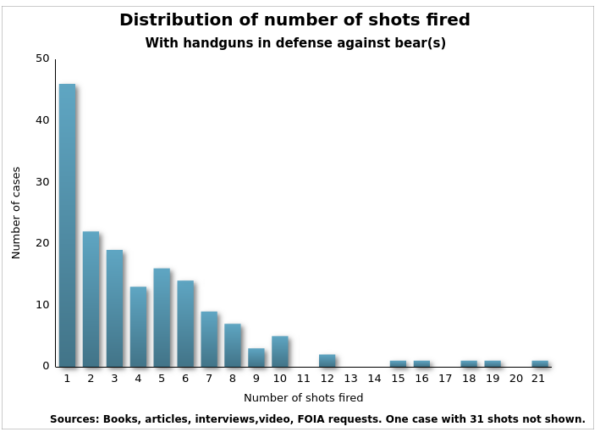
Of the 161 cases where a handgun has been fired in defense against a bear or bears, and the number of shots is known or reasonably inferred, the distribution of the number of shots fired per case is as follows:
- 1 shot – 46 cases or 28.6% of the cases where the number of shots is known. 8 cases involved a warning shot. One of the warning shots killed a bear. In one case where one shot was fired, killing the bear, two warning shots were fired with a .22 rimfire rifle. Those shots were not effective. It was decided to include that case with other cases where only one shot was fired from a handgun. The other six warning shot cases were successful.
- 2 shots – 22 cases or 13.7%. There were 13 cases where warning shot(s) were fired. In seven cases, the warning shots were successful, at least temporarily. In eight cases, the warning shots were unsuccessful. There were three cases where the warning shots were both successful (temporarily) and unsuccessful. In one case it could not be determined if the the shots were effective in stopping the bear; in one case the warning shots were not effective, and no bear or human was injured. Because the warning shots were ineffective, the case, involving a .44 magnum and a polar bear is one of the four failures of the firing of a handgun in defense against a bear or bears.
- 3 shots – 19 cases or 11.8%. Warning shots were fired in 6 cases. The warning shots were successful in three cases and did not work in three cases. There was one failure, where three shots fired from a .357 magnum did not stop the attack by a grizzly bear. It is likely the bear was not hit.
- 4 shots – 13 cases or 8.1%. Two cases involved two handguns. Warning shots were fired in four cases. 1 warning shot worked for a while. Warning shot failed in all four cases.
- 5 shots – 16 cases or 9.9%. Warning shots were fired in four cases. The warning shots worked in two cases, one temporarily, and failed in three cases. There was one case where it could not be determined if the handgun shots stopped the attack, and 1 failure with a .38 caliber revolver and a black bear.
- 6 shots – 14 cases or 8.7%. Warning shots were fired in five cases. They worked in four cases and did not work in two cases. 1 warning shot worked temporarily. One case was a failure against a polar bear with a .22 rimfire handgun.
Six shots or fewer were fired in 80.1% of known documented cases. There have not been any documented failures where more than six shots were fired.
- 7 shots – 9 cases or 5.6%. Warning shots were fired in two cases. One worked, one did not work.
- 8 shots – 7 cases or 4.3%. One case involved two handguns. No cases where warning shots were fired.
- 9 shots – 3 cases or 1.9%. No cases involved warning shots.
- 10 shots – 5 cases or 3.1%. Warning shots fired in one case. The warning shots did not work.
- 12 shots – 2 cases or 1.2%. No warning shots were fired.
- 15 shots – 1 case or .6%. No warning shots were fired.
- 16 shots – 1 case. No warning shots, two handguns involved.
- 18 shots – 1 case. No warning shots were fired.
- 19 shots – 1 case. No warning shots, three handguns involved.
- 21 shots – 1 case. No warning shots, three handguns involved.
- 31 shots – 1 case. No warning shots, two handguns involved.
There were no cases involving 11 shots, 13, 14, 17, 20, 22-30 shots ,or more than 31 shots in the cases documented as of this writing.
There were 23 cases where the number of shots was not reported. Two of those cases involved two handguns. Four involved warning shots. 1 warning shot worked, two did not work, and the effect of the warning shot(s) was unknown in one case.
Handguns Proven 98% Effective in 205 Documented Bear Attacks
About Dean Weingarten:
Dean Weingarten has been a peace officer, a military officer, was on the University of Wisconsin Pistol Team for four years, and was first certified to teach firearms safety in 1973. He taught the Arizona concealed carry course for fifteen years until the goal of Constitutional Carry was attained. He has degrees in meteorology and mining engineering, and retired from the Department of Defense after a 30 year career in Army Research, Development, Testing, and Evaluation.