

Ask most people whether the armed citizen should carry a handheld light (HHL) or a weapon-mounted light (WML), and you’ll usually get a quick answer: pick one, or just get both. I don’t think either answer is very helpful, because neither one tells you why, or when, or what job each light is actually doing for you.
So let me give you my honest take, developed over years of on-the-job experience, attending numerous low-light training courses (and teaching a few myself), testing this stuff against a shot timer, and, yes, using a light for real on my own street one summer night (more on that later).
For the armed civilian, the handheld light is the essential tool. It is the foundation of your entire low-light plan. The weapon-mounted light is a genuinely useful piece of gear, but it plays a supporting role, and it solves a much narrower set of problems than most people assume. If you take nothing else from this article, take that order of priority.
Let me walk you through the reasoning, because the “why” here matters a whole lot more than the conclusion.
The Two Jobs a Light Does in Defensive Encounters
Every light in a defensive context is doing one of two jobs:

- Finding and identifying. Searching a dark space to answer one question: is there a threat here or not? Is that shape a person, and if it is, is that person actually a threat, or is it a family member, a neighbor, or the dog? If they are a threat, how do I know that? Are they holding a weapon? Or is that a phone? Or worse…an off-duty cop’s badge?
- Illuminating and dominating. Once you’ve identified a threat and made the decision to act, putting light on that target so you can see clearly, denying the subject of their own vision, place accurate rounds, and assess their effect.
Almost the entire low-light problem lives in that first job. Before you ever press a trigger, you have to see, identify, and decide. And that first job is one you must never perform with a light bolted to your gun, because a weapon-mounted light points wherever your muzzle points. If you search with a WML, you are pointing a loaded gun at every single thing you illuminate, including the people you most need to not point a gun at. That fact alone tells you the handheld light has to be your primary searching tool.
Why the Handheld Light Is the Essential Tool
A handheld light lets you do the single most important thing in a low-light encounter without pointing your firearm at it. You can keep the gun in a ready position, or holstered entirely, and independently light up a doorway, a corner, a parked car, or a person, all without muzzling any of it. That separation of light and muzzle isn’t a minor convenience. It’s the whole reason the handheld exists as a defensive tool.
There’s a legal dimension here too, and it’s worth saying plainly. Before you’re justified in pointing a gun at someone, you generally need to have identified a threat. Illuminating and identifying a potential threat with a handheld light, before the gun ever enters the equation, isn’t just tactically sound. It’s very likely part of what keeps your actions legally defensible. Leading with a handheld light builds that identification step into your process by default.

And then there’s the piece people underestimate the most: the sheer power of taking away someone’s vision. A bright, tightly focused, high-candela beam in the eyes at close range is genuinely overwhelming. It’s disorienting. It buys you time and initiative, and it denies your adversary the information they need to act against you. This almost always starts with the handheld, and in most encounters the right answer is simply to get that powerful beam on the subject and keep it there throughout. Don’t overthink it. A dominant beam held steady on a person’s face is doing an enormous amount of work for you, and there’s a very real chance it deters or de-escalates the whole situation before it ever becomes a shooting.
So the picture for the concealed carrier looks like this. You identify and dominate a potential threat with a powerful handheld light in your support hand. If deadly force becomes necessary, you keep that light right where it is, draw with your primary hand, and shoot one-handed. You never lose visual control of the subject, and you never stop denying them their vision. That’s the model I recommend every armed citizen build around.
A Real-World Example: My Own Street
The power of the handheld light was demonstrated right on my own street.
One evening last summer my oldest children came in from the car to tell me they’d spotted a couple of men on the street they didn’t recognize, all dressed in dark clothing. We got the younger kids to bed, and I decided to take a walk around the block like I sometimes do. As I rounded the final corner toward home, I saw two men standing between my motorhome in the driveway and my son’s car on the street. I couldn’t tell exactly what they were up to, but they were clearly loitering, and they picked up on me right away and started to close the distance, playing it cool like they were just two guys out for a stroll.
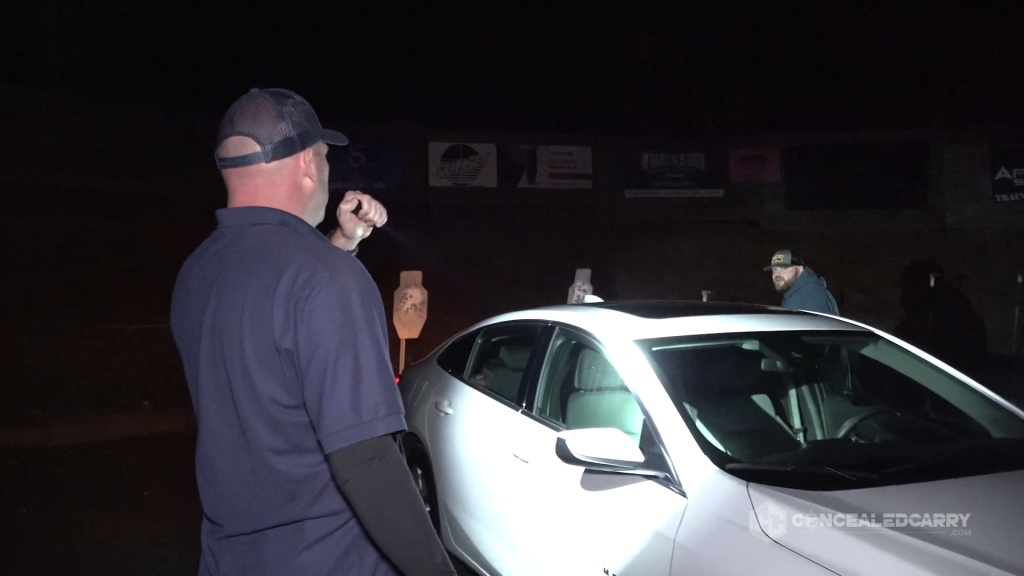
I drew my flashlight from my pocket with my support hand—at the time a Modlite OKW, a light with a very powerful, tightly focused beam—and side-stepped into the street to get a better angle on them. I lit up the ground near the closest guy, and the intensity of it caught him off guard instantly. Both were in hoodies and facemasks on a warm summer night. These guys were up to no good.
“Hey, can I help you?” I asked, with some authority in my voice.
“Nah man, we’re good,” the first one said, still drifting toward me.
I put the beam right on their faces. They squinted and threw their hands up to shield their eyes. One of them snapped, “Yeah, you can put your light away!”
“No,” I told him, “I’m going to keep my light right on you, and you can get out of here. I know my neighbors, and YOU DON’T BELONG HERE.”
I watched their hands the whole time. One had his hands buried in his hoodie pockets, the other kept his near his waistband, and my own right hand was inching toward my gun. For a moment I thought it might escalate. But they broke off, cussing at me the whole way, and disappeared around the corner. I called non-emergency dispatch, reported them, and went inside.
About an hour later I stepped back outside to have a look around, and there they were again, briskly walking the cross street, this time carrying items. I recognized it immediately as a burglary that had just happened. Even at close to 100
feet, my light was still plenty effective. I put the beam on them and yelled, “I SEE YOU! THE COPS ARE ON THEIR WAY! GET OUT OF OUR NEIGHBORHOOD!”
They dropped what they were holding and ran. A nice set of downhill skis they’d dumped in a neighbor’s bush were recovered, and I was able to locate the owner. I was grateful that night that I had the power of light, and that no other defensive tool or level of force was required.
That is the handheld light doing exactly what it does best.
The Transition Myth
The version of low-light shooting that gets sold most often goes like this: you search with your handheld, you find a threat, you draw your pistol, and then you transition to your weapon-mounted light to do the actual shooting. It sounds tidy. In practice it’s very close to a fantasy, and I want to be direct about why.
First, it’s slower. In my own testing, transitioning from a handheld to a weapon-mounted light consistently takes more time than simply keeping the threat lit with the handheld and drawing to a one-handed shooting position. With my current level
of skill, on average, the transition to WML adds at least 0.5 seconds in the time until the first shot. It would not surprise me if for most folks that was closer to a second or more.
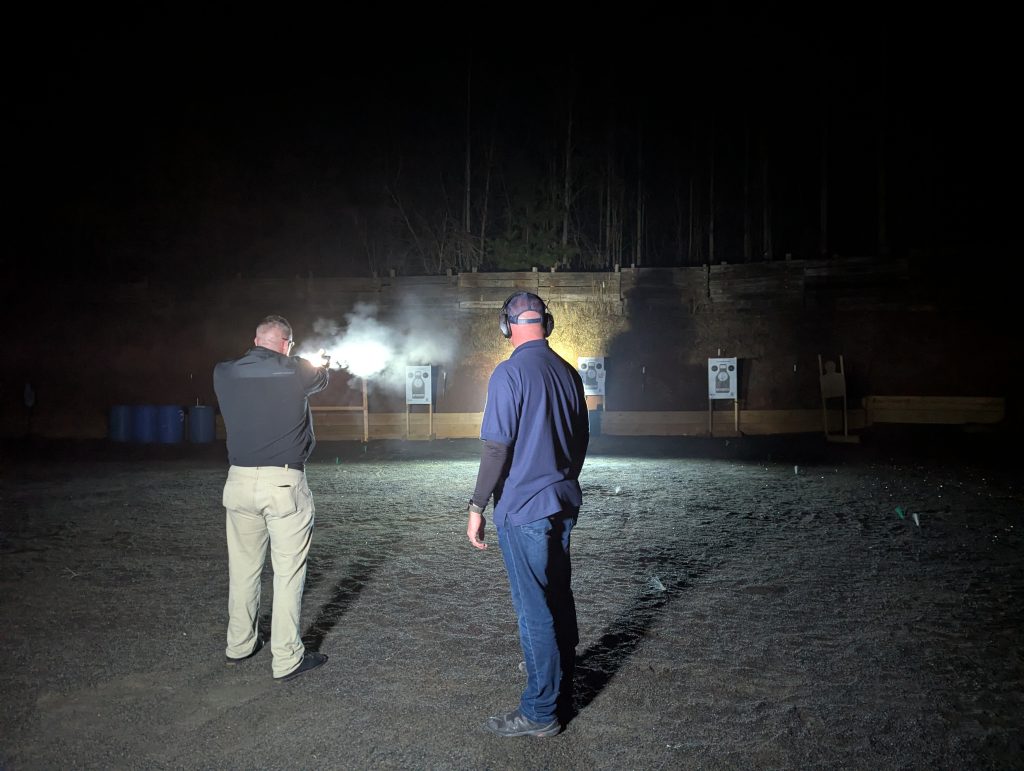
Second, there’s a moment during that transition where you have no light on the threat at all. In the instant you’re moving from the handheld to the gun-mounted light, the handheld light comes off and/or the beam leaves the subject. For that moment in time, you lose visual control of them, and just as importantly, you hand them their vision back. If you’re already dominating them with overwhelming lumens and candela, why give any of that up?
Third, and maybe most important, the transition dramatically raises the motor-skill and mental-bandwidth cost of everything you’re doing. Now you’re coordinating a light hand-off, a draw, and a light activation, under stress, in the dark, against a threat. Most people simply cannot pull that off reliably under pressure without a tremendous amount of dedicated, repetitive practice, to the point that it runs on autopilot. If you haven’t put in that work, building your plan around the transition is building it on something that will very likely fail you when it counts.
Keep it simple. Light the threat with the handheld, and shoot one-handed if you have to. That is faster, it maintains constant visual dominance, and it asks far less of you when your brain is running at redline.
The one argument that opponents of the above approach make is that shooting one-handed is disadvantaged. In response to that, I say, “Sounds like a good reason to practice one-handed shooting.” Okay, that’s a little tongue-in-cheek, but in all seriousness, as my friend John Correia and others have well-documented, one of the most important factors in coming out ahead in a fight is getting the first shot AND HIT in the “meaty bits” of your adversary as soon as possible. My decision about my recommended approach is based on this. If trying to transition between handheld and weapon-mounted adds a minimum of 0.5 seconds, that’s an extra half-second before I can get ANY hits on the threat. Plus with a little practice, you can be quite skilled and less disadvantaged than you would think.
So Where Does the Weapon-Mounted Light Fit?

None of this means a WML is useless. It absolutely has a place, and I run one in the right context. I’d put it squarely in the “nice to have” category, and there are several legitimate reasons an armed citizen might choose to carry one.
The clearest case for a WML is the situation where you genuinely have only one hand available. You might be holding a child, or physically pushing a loved one behind you and out of the line of fire. Your support arm might be injured. You might be working a door, a phone, or a light switch at the exact moment things go bad. In those moments you can’t hold a handheld and run the gun, and that’s precisely when a weapon-mounted light earns its keep, because it gives you light and a firearm from a single hand. These situations are real, but they’re the exception, not the everyday default, and they fit the “just in case” scenario perfectly.
The WML also has far more application in home defense than in daily carry. On your own known ground, with a long gun or pistol staged and ready, a mounted light makes a lot of sense.
Beyond that, there are practical reasons to run a WML on a carry gun that have nothing to do with the mythical transition:
- You only have one defensive pistol. If it’s your single gun, you may simply prefer a light on it 100% of the time rather than mounting and dismounting a light every time you carry and then stage it at night.
- Comfort. Some people carry a WML-equipped gun more comfortably, because the light spreads the pressure of the holster against the body over a larger surface area.
- Concealment and holster design. Some carriers actually conceal better with a WML setup, thanks in part to the additional “keel effect” (as termed by Jon Hauptman of PHLster) a good light-bearing holster provides below the belt line. The extra real estate below your beltline acts like the keel of a boat, resisting the gun’s tendency to tip and flop away from the body, which can make the whole rig ride tighter and more stable.
If a WML setup is the direction you go, the holster matters enormously, and not every company does that well. This is where I’ll point you to our own sub-brand, KSG Armory. The Revere light-bearing holster is a purpose-built AIWB design for carrying a light-equipped pistol concealed, and it’s even optimized for the PHLster Enigma if that’s your setup. It’s exactly the kind of holster that lets you take advantage of that keel effect instead of fighting your gear.
Those are all valid, honest reasons to put a light on your carry gun. Just be clear with yourself about why you’re doing it. Choose a WML because it keeps a light on your only pistol, or because it carries better for you, or because it covers those genuine one-handed edge cases. Don’t choose it because you’re planning to search, identify, draw, and transition to it in a dark encounter. And whatever you do, never search with it.
The Light Characteristics That Actually Matter
Whether we’re talking handheld or weapon-mounted, a handful of features genuinely matter for defensive use, and a couple that get marketed hard really don’t.
Simplicity of operation. A defensive light needs to be simple to run under stress, when your fine motor skills are degraded and your attention is a hundred other places. It should not require multiple taps, presses, or a scroll through modes to get bright light on demand. My colleague Jacob learned this one the hard way. In a low-light carbine class with Kyle Lamb, he was running a rifle-mounted light with a brightness-adjustment button, and over the two-day course he accidentally dialed his own light down about ten times without realizing it. It’s a perfect illustration of the lesson: variable brightness is a lovely feature on an administrative light, but on a light you’re betting your life on, it can turn into a liability.
Momentary vs. constant-on. A momentary function (light on while you hold pressure, off when you release) is a good feature to have, and plenty of excellent shooters build their technique around it. I’ll be honest with you, though: I don’t really rely on it anymore. I mostly just click the light on and click it off. I’ve found I can do that just as fast as running momentary, and for me it’s more reliable. Figure out what works for you, but don’t assume momentary is mandatory.
Strobe. I’ve never found a significant enough tactical advantage to a strobe in a self-defense context. It can be disorienting, but not nearly as much as people imagine. Where strobe can help is signaling: if you’re trying to mark your location for someone at a distance, a flashing beam is more noticeable. So it’s not worthless. It’s just not a defensive feature I would count on.
Lumens vs. candela. This is the one most people have backwards. Lumens measure total light output; candela measures the intensity of the center of the beam, which is what actually drives how far and how hard that light throws. Lumens matter up to a point, but once you’re past a reasonable floor (I’d call it about 500 lumens as a minimum), candela becomes far more important for defensive use. Here’s why. You can have a 2,000-lumen light, but if all that output is spread into a wide, soft flood, it won’t concentrate enough intensity to take away an adversary’s vision or to punch through a photonic barrier.
What’s a photonic barrier? It’s any competing or intervening source of light between you and what you’re trying to see: a porch light, oncoming headlights, a streetlight, glare off a pane of glass, or even a flashlight in the other person’s hand. That competing light washes out your vision and hides detail. A light with high candela concentrates its intensity into a tight beam that can overpower that competing light and let you see through it and past it. Raw lumens won’t do that if the beam is too diffuse. For a defensive light, I’d treat roughly 18,000 candela as a practical minimum, and more is better. A tight, intense beam beats a big, soft one every time for our purposes.
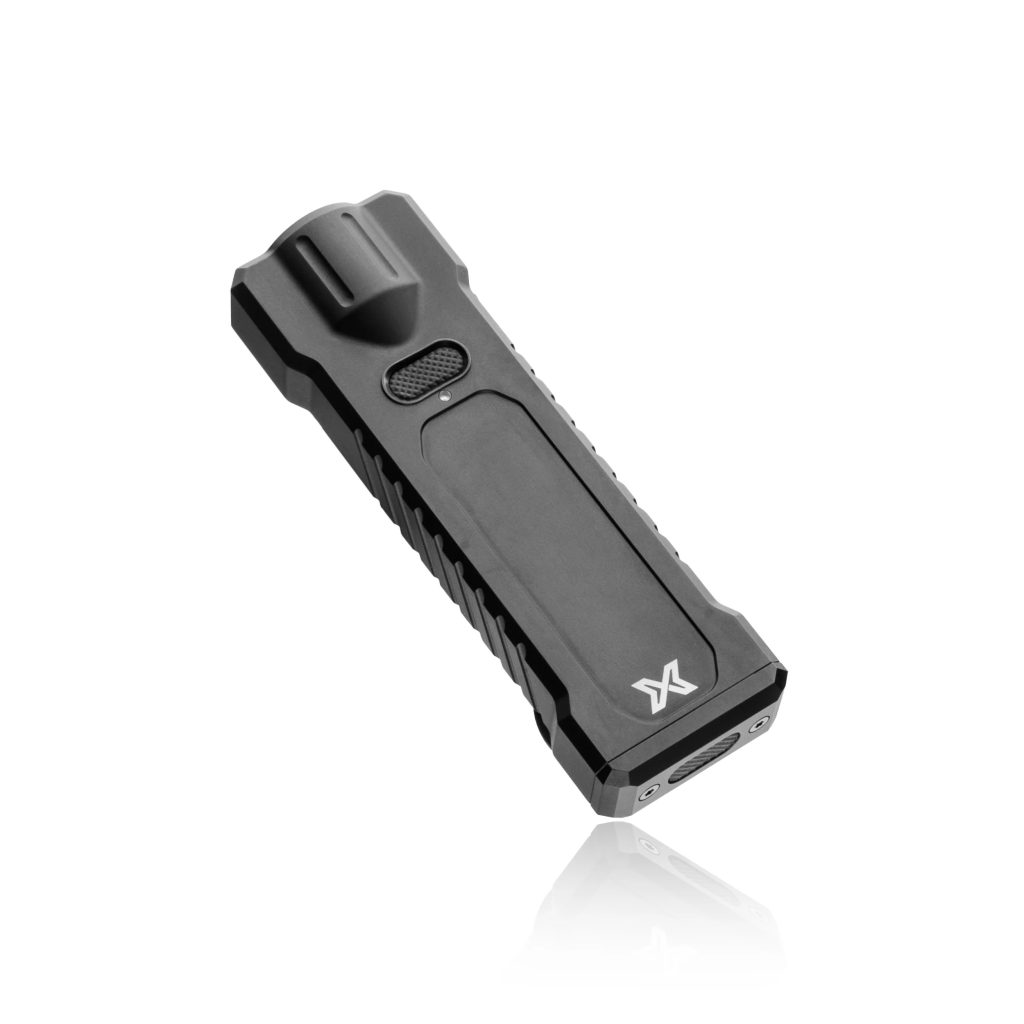
What I actually carry. I carried a Modlite OKW for years (that’s what was in my hand the night I described above), and I have nothing bad to say about it. But my everyday carry light these days is the Noxon Anark, and I carry it because it hits every mark I just laid out. On high it puts out 1,000 lumens and a full 18,000 candela, right at the numbers I recommend for a defensive light. The controls are about as simple as it gets: a dual-button interface with a dedicated high-output button and a separate low-output “admin” button, so there’s no scrolling through modes to find the light you need (and both buttons offer momentary and constant activation, so you can run it however you prefer). It’s slim, it rides easily in a pocket, and it charges off USB-C.
That dual-button design also quietly solves an old problem. The traditional advice was to carry two handheld lights, one dedicated defensive light kept at full charge and a second “admin” light for finding your keys under the seat so you don’t run the important one down. That’s not bad advice, but a light like the Anark folds both roles into one package: full defensive output on one button, a long-running low mode on the other, and a USB-C port so you just keep it topped off. One light, two jobs, always ready.
None of This Works Without Training
I’ll say what I always say: the tool is only half of it. Slapping a light on your gun, or dropping one in your pocket, is easy. Using it well under stress is not, and it takes real training and repetition.
The good news is that most of this is free to practice. Working your light into dry practice at home is easy, and you shouldn’t have any trouble stacking up meaningful reps. Here’s what I’d prioritize building:
- Fast, no-look access to your handheld light. You should be able to grab and deploy your HHL quickly, without looking down and without fumbling for it. This is foundational, and most people neglect it entirely.
- One-handed shooting. If your support hand is holding a light on the threat, your shooting is one-handed. Practice it until it’s genuinely competent, not just something you’ve tried a few times.
- The transition, but only if you’re committed to it. If you intend to run a WML and ever transition to it, you have to drill that transition to the point of unconscious competence. If you can’t do it in the dark, under stress, without thinking about it, don’t count on it in a fight.
The Bottom Line
A handheld light is an essential defensive tool. Every concealed carrier should own one, carry one, and be skilled with it. That light should meet basic performance standards: simple operation, enough lumens (500 or more), and enough candela (18,000 or more) to dominate an adversary’s vision and cut through photonic barriers. You should be able to access it fast, without looking, and you should be competent shooting one-handed while it’s in your support hand.
You are absolutely welcome to add a weapon-mounted light on top of that, and there are good reasons to do so: home defense, genuine one-handed situations, running a single pistol, comfort, or a better-riding holster. Just add it as a “just in case,” and for those specific jobs. Don’t build your low-light plan around drawing in the dark and transitioning to it, because that plan is slower, it costs you visual control at the worst possible moment, and it asks you to complete complex motor tasks under stress.
Light the threat with the handheld. Keep it there. Draw and shoot one-handed if you have to. Master that, and you’ll be miles ahead of the overwhelming majority of armed citizens who have never thought this through at all.
What did I miss, or where do you see it differently? Sound off in the comments below. And if you want to go deeper on this, come check out our Defense After Dark video course filmed with expert instructor, Dan Brady.
*This post is updated and was originally published in 2018*

