

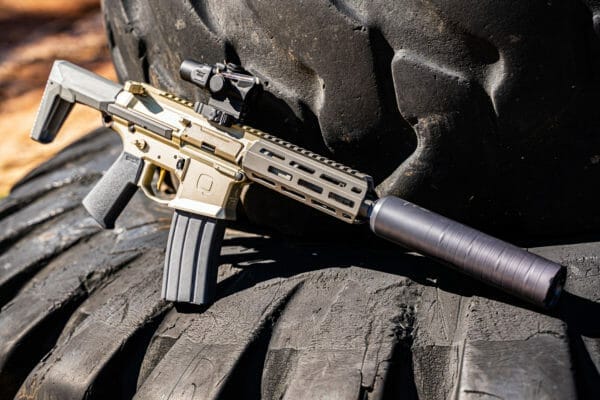
The Bureau of Alcohol, Tobacco, Firearms and Explosives (ATF) unveiled new guidance after a Texas district court blocked National Firearms Act (NFA) restrictions on short-barreled rifles (SBRs), short-barreled shotguns (SBSs), suppressors, and any other weapons (AOWs).
The case, Silencer Shop Foundation v. Bureau of Alcohol, Tobacco, Firearms and Explosives (ATF), challenged the constitutionality of NFA restrictions on SBRs, SBSs, suppressors, and AOWs after Congress passed the One Big Beautiful Bill (OBBB) Act. The OBBB Act lowered the tax-stamp fee for those items from $200 to $0. By eliminating the tax-stamp fee, the plaintiffs argued, the restrictions became unconstitutional. Under the taxing power, a tax must generate revenue, and the Supreme Court upheld the NFA as a tax statute in 1937. A $0 tax lacks a revenue-generating purpose and is therefore unconstitutional.
Multiple gun-rights organizations sued. Gun Owners of America (GOA), Gun Owners Foundation (GOF), the Firearms Regulatory Accountability Coalition (FRAC), B&T USA, Silencer Shop Foundation, SilencerCo, and Palmetto State Armory (PSA) sued in Silencer Shop Foundation v. ATF. Another case, Jensen v. ATF, was consolidated with it. That case was brought by the Firearms Policy Coalition Action Foundation, the Citizens Committee for the Right to Keep and Bear Arms (CCRKBA), and the Texas State Rifle Association (TSRA).
Judge James Wesley Hendrix ruled for the plaintiffs and rejected the defense’s argument that the special occupational tax (SOT) satisfies the tax-revenue requirement. The defendants also argued that the NFA falls under the Commerce Clause. The judge rejected that argument. He found the restrictions unconstitutional and issued an injunction against enforcing the law against current and future members of the suing organizations, leading to suppressors being transferred on a Form 4473 for the covered parties. The judge would have issued a nationwide injunction, but could not because of the Supreme Court’s ruling in Trump v. CASA.
The Department of Justice has decided not to appeal. In a September 24, 2026 letter to Senate Judiciary Chairman Chuck Grassley, Solicitor General D. John Sauer wrote that the department “has determined not to file an appeal” in Silencer Shop Foundation v. ATF. DOJ filed that letter with the court on October 1, and the 60-day window to notice an appeal closed on October 5 with no appeal and no stay request.
The August 5 judgment is now final as to these parties. The decision does not widen the injunction. It still runs to the named plaintiffs, members of the organizational plaintiffs, and, for the commercial plaintiffs, their customers. It does not repeal the NFA, and it does not cover machine guns, destructive devices, or the special occupational tax. Judge Hendrix gave DOJ until October 12 to answer a motion from plaintiff states on whether the injunction reaches those states more broadly.
On October 9, ATF tried to close the gap left by the injunction. In an open letter to all federal firearms licensees and the public, and in a companion FAQ, the Bureau said it will stop enforcing the NFA making, transfer, and registration rules for SBRs, SBSs, silencers, and AOWs against everyone, not just the plaintiffs.
The policy took effect the same day. ATF said the party-limited order created “inequity and disuniformity,” and that it would use enforcement discretion to apply the same treatment nationwide.
Under that policy, ATF will no longer require prior approval to make or transfer those four categories of items. First, it will no longer require registration in the National Firearms Registration and Transfer Record. It will not enforce the bans on making, receiving, transferring, or possessing them unregistered. Finally, it will not enforce the NFA marking rule for them, and it will not enforce 26 U.S.C. § 5861(j), the ban on transporting an unregistered NFA firearm in interstate commerce. That last point matters for dealer-to-dealer shipments, repairs, out-of-state range trips, and moves.
The non-enforcement is narrow. Machine guns and destructive devices remain taxable and fully regulated. Illegally imported NFA firearms and firearms with obliterated serial numbers remain illegal under §§ 5861(k) and 5861(h). People engaged in the business of manufacturing, importing, or dealing in these items must still pay the special occupational tax. A dealer who is not an SOT cannot treat the new policy as a license to deal in them.
These items also remain firearms under the Gun Control Act. A licensee transferring a silencer or an AOW to an unlicensed buyer must still complete a Form 4473, run a NICS check unless an exemption applies, and keep the record. The buyer still has to be a resident of the state where the licensee does business, with the usual limited exceptions. No one may transfer any of these items to a person he knows, or has reasonable cause to believe, is prohibited from possessing a firearm. Unlicensed individuals may make or transfer them without a Form 1, but they still may not engage in the business, transfer them across state lines, or transfer them to a prohibited person.
SBRs and SBSs are the exception inside the exception. The Gun Control Act, at 18 U.S.C. § 922(b)(4), still bars a licensee from selling or delivering a short-barreled rifle or short-barreled shotgun unless the Attorney General specifically authorizes it. For decades, an approved Form 4 was that authorization. Judge Hendrix did not enjoin the GCA provision, and ATF says no non-NFA approval process exists yet. The Bureau says it is writing forms and regulations to create one. Until those rules are in place, ATF will not enforce § 922(b)(4). Transfers to state and local governments for official use remain lawful anyway, under the government exception in 18 U.S.C. § 925(a).
Interstate travel is split the same way. ATF will not enforce the NFA’s interstate-transport ban on an unregistered silencer or AOW. An SBR or SBS is different. Even if it is unregistered, the owner must still file a Form 20 before taking it across state lines, because 18 U.S.C. § 922(a)(4) is a GCA requirement and ATF is still enforcing it.
Registration is now voluntary. ATF will keep the registry and will still approve Forms 1, 2, 3, and 4 for anyone who wants an item in it.
A pending application can be withdrawn, and a registered item can be removed, by writing the NFA Division at [email protected]. The same address is how a dealer clears an item off NFA inventory after transferring it on a Form 4473. ATF warns that once an item is removed, it cannot be put back on the registry unless the Attorney General declares an amnesty.
Manufacturers do not get a full pass. A company making these items still needs the proper GCA manufacturer’s license and must serialize them. A silencer manufacturer in business before November 20, 2026, must also register with the State Department under the International Traffic in Arms Regulations. Dealer-to-dealer interstate transfers of silencers and AOWs no longer require a Form 3. One may still be filed voluntarily. A manufacturer who receives an unregistered silencer for repair may ship it back across state lines. ATF says it will not treat that shipment as a § 5861(j) violation.
State law is the remaining hazard, and ATF is explicit that it will not resolve it.
Most states require NFA items to be lawful under federal law or registered under the NFA. The Bureau will not say whether an item held under the injunction, or under this enforcement policy, counts as lawfully held or registered for those state statutes. Some states impose no extra controls, particularly on silencers. A minority ban most or all NFA items outright, and neither the injunction nor ATF’s discretion touches those bans. The GCA still prohibits a licensee from transferring a firearm in violation of state or local law. A willful violation can bring federal criminal penalties and license revocation. ATF’s advice to a dealer who is unsure is to get legal advice and check with the relevant state and local authorities.
The FAQ also flags the risk that the policy is reversible. Congress could put a tax back on these items. A court could dissolve or overturn the injunction. The Department could rescind the guidelines. Federal law does not automatically grandfather an unregistered NFA firearm, and it does not generally allow one to be registered after the fact. The Attorney General can declare an amnesty of up to 90 days, or grant certain forbearances, but is not required to do either. That decision, ATF says, would be made if and when the injunction is dissolved.
About John Crump
Mr. Crump is an NRA instructor and constitutional activist with more than 26 years of experience in networking and cybersecurity for major Fortune 100 companies. John has written about firearms, the Constitution, and cybersecurity, and has interviewed people from all walks of life. John lives in Northern Virginia with his wife and sons. Follow him on X at @right2bear, or at www.crumpy.com.

