

SIG shrunk the MPX around a 3.5-inch barrel, creating an ultra-compact 9mm that’s impressive, specialized and not without compromise.
Editor’s Update: This SIG MPX Copperhead review has been updated to clarify the original configuration tested, correct outdated technical information and account for later Copperhead variants and changes surrounding pistol braces. Ryan’s original hands-on testing, observations and Report Card grades have been preserved.
The SIG MPX Copperhead takes an already compact pistol-caliber platform and shrinks it considerably. Built around SIG’s MPX operating system, the original Copperhead combined a 3.5-inch barrel, short-stroke gas piston and rotating bolt in a package weighing roughly 4.5 pounds. That size is the entire point of this gun, but it’s also responsible for some of its biggest compromises.
The Copperhead I tested is the early 3.5-inch FDE configuration with its integral muzzle device and Pivoting Contour Brace. Later Copperhead configurations have differed, so that’s an important distinction when discussing features, suppressor compatibility and accessories. After spending time shooting it, I came away impressed by how much SIG managed to fit into such a small platform. I also found a few areas where making the MPX this compact comes at a cost.
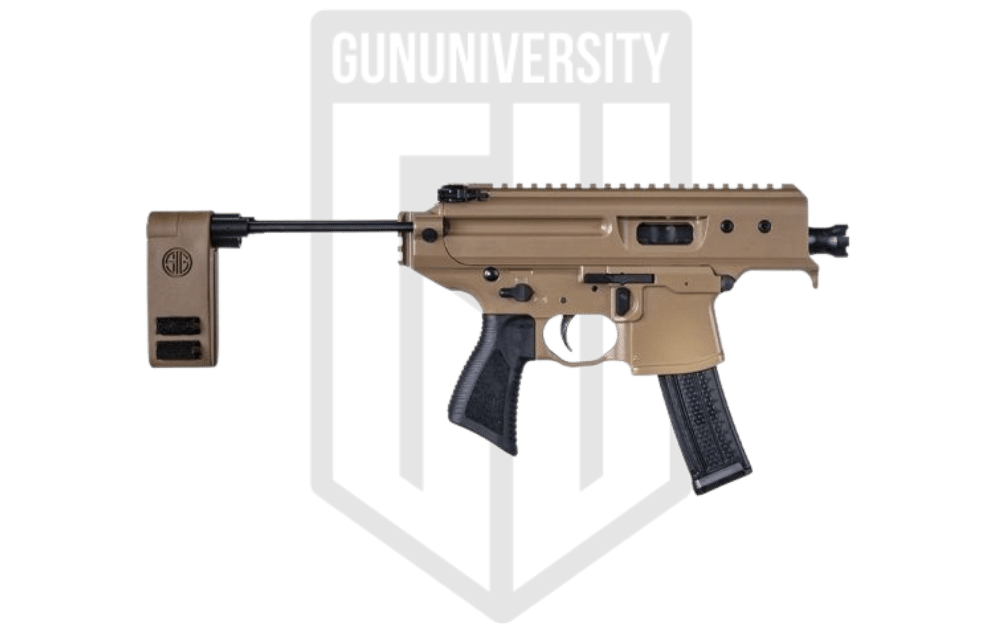
Sig MPX Specs
- Host Platform Sig
- Caliber 9mm
- Operating System Short-stroke gas piston
- Bolt Fully locked rotating bolt
- Barrel Length 3.5 inches
- Weight 4.5 pounds
- Overall Length 14.5 inches
- Capacity 20 rounds
What is the Sig MPX Copperhead?
SIG introduced the MPX Copperhead in 2019 as an ultra-compact addition to the MPX family. Despite its AR-like controls and appearance, the MPX doesn’t operate like a traditional direct-impingement AR. Instead, it uses a short-stroke gas-piston operating system with a fully locked rotating bolt. Keeping the recoil system within the receiver also eliminates the need for a traditional AR buffer tube.
The original Copperhead pushed that architecture into an exceptionally small package. Its 3.5-inch barrel, monolithic upper and compact rear brace assembly resulted in an overall length of roughly 14.5 inches and an unloaded weight of about 4.5 pounds. The controls remain familiar to shooters accustomed to an AR-style layout. The MPX uses ambidextrous controls, a centrally located non-reciprocating charging handle and a full-length top Picatinny rail for mounting an optic.
The tradeoff is space. The Copperhead has very little of it forward of the receiver, which limits accessory mounting and puts the support hand unusually close to the muzzle. On a platform this short, keeping your hand properly positioned becomes particularly important.
Sig MPX Copperhead Features
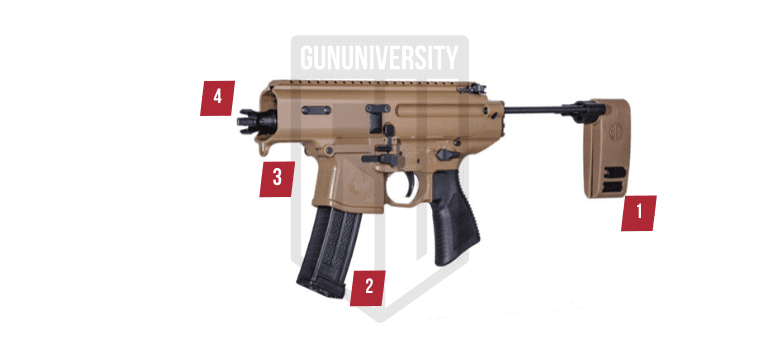
1 Rapid Deploy PCB Brace
When fully extended, this brace rotates to allow the user the ability to contour with the pistol itself.
2 20 Round Magazine
The Copperhead’s reduced magazine only adds to its conceal ability and deployability.
3 Integrated Flash Hider
With the Copperhead’s integrated flash hider, the crown of the barrel is protected and the overall length is kept short.
4 Ultra-Short Integrated 3 1/2 Inch Barrel
This barrel is designed for maximum deployment in all situations.
Sig Mpx Copperhead Review – Our Take
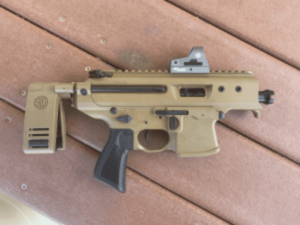
The first thing the Copperhead gets right is size. This is an exceptionally compact MPX, and SIG managed to shrink the platform without abandoning the controls and operating system that make the larger MPX appealing.
The ambidextrous controls are particularly useful. Anyone accustomed to an AR-style layout will recognize the safety, magazine release, bolt controls and charging handle without much adjustment.
The monolithic upper also gives you a continuous top rail, which is important because the Copperhead makes much more sense with a compact red dot than traditional iron sights. Rail space around the handguard is extremely limited, but that’s one of the tradeoffs for making the gun this short.
The small dimensions become more noticeable when you start shooting. There’s very little room for the support hand, and careful hand placement matters on a firearm with such a short front end. Despite its size, recoil is very manageable. The MPX’s short-stroke gas-piston system gives the Copperhead a different feel from many simple blowback 9mm platforms. The gun stays controllable and is genuinely fun to shoot quickly.
That compactness wasn’t entirely positive for me. I’m a bigger shooter, and I found the tiny dimensions less comfortable than a standard MPX. That’s not necessarily a fault. It’s the central tradeoff of the Copperhead. If minimum size is the goal, it delivers. If it isn’t, a larger MPX gives you considerably more room to work. But how does the Copperhead perform as a whole? More importantly, does making the MPX this small compromise its usefulness?
Reliability and Range Performance
When it comes down to it, the Copperhead proved itself more than capable during my time with it. Reliability was excellent, and I experienced no issues that made me question the platform. Accuracy was also more than adequate for a firearm built around such a compact package. The short barrel doesn’t make the Copperhead difficult to shoot accurately at the distances where a platform like this makes the most sense.
The controls remain one of the strongest parts of the MPX design. They’re familiar, easy to reach and quick to operate. Combined with the manageable recoil, they make the Copperhead surprisingly easy to run quickly despite its abbreviated dimensions.
Size Is Both the Advantage and the Compromise
The Copperhead’s biggest strength is also where I found its biggest limitation.
One final note: I’m a bigger guy (with an even bigger head), and the Copperhead’s extremely small size made it a little difficult for me to shoot well. I prefer the standard MPX. So much so that it made our list of Best Pistol Caliber Carbines,but that’s because I’m not looking for the smallest package.
If minimum size is the priority, the Copperhead delivers. If it isn’t, a larger MPX gives you considerably more room to work.
Barrel and Suppressor Compatibility
The 3.5-inch barrel is central to what makes the Copperhead so compact, but the muzzle configuration deserves some clarification. The early Copperhead I tested uses an integral muzzle device. That prevents simply removing the muzzle device and attaching a suppressor, and it remains one of my biggest complaints about this particular configuration. SIG’s original 2019 announcement confirms that configuration used a 3.5-inch barrel with an integrated muzzle brake.
Not every Copperhead was configured the same way. Later 3.5-inch Copperhead variants were offered with threaded barrels and removable muzzle devices. American Rifleman tested one of those later configurations with a suppressor installed. If suppressor compatibility matters, don’t assume every Copperhead is identical. Verify the barrel and muzzle configuration of the specific gun you’re considering. For the original test gun in this review, however, the integral muzzle device remains a legitimate limitation.
A Note About the Pistol Brace
Federal treatment of stabilizing braces has changed substantially since this Copperhead was originally reviewed. ATF’s 2023 brace rule was subsequently vacated, and in May 2026 ATF proposed formally rescinding the regulatory changes made by that rule. ATF also notes that the classification of a particular firearm still depends on whether its configuration meets applicable statutory definitions. Because federal and state requirements can change, owners should verify current laws before altering the Copperhead’s configuration.
Sig MPX Copperhead Review: Pros and Cons
- Extremely compact MPX platform
- Short-stroke gas-piston operation
- Excellent ambidextrous controls
- Full-length optic rail
- Strong reliability during testing
- Can feel cramped for larger shooters
- Premium price
- Original integral-muzzle configuration limits suppressor options
RELIABILITY |
Ran reliably throughout my time with it and gave me no reason to question the MPX operating system. |
A+ |
ACCURACY |
Delivered more than enough practical accuracy for the close-range role its extremely compact dimensions suggest. |
A |
ERGONOMICS |
The ambidextrous AR-style controls are excellent, but the extremely short front end can feel cramped, particularly for larger shooters. |
B+ |
VALUE |
The Copperhead is expensive, but it packages the MPX operating system and controls into a highly specialized and unusually compact platform. |
A+ |
Customization |
The top rail makes optic mounting easy, but the monolithic handguard and extremely limited forward space restrict customization compared with larger MPX configurations. |
B |
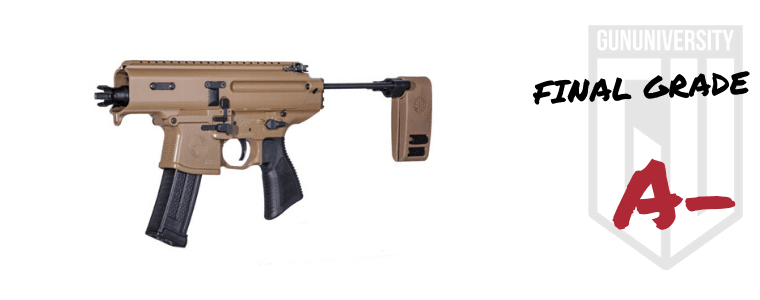
Our Grade
A-
Reviewed by Ryan Cleckner
Reader’s Grade
A
Based on 14 Reviews
Your Grade
Do You Own This Gun? Leave A Review
Success Your Grade Has Been
Added To Our Reader’s Score
We use email to verify the accuracy of our reviews. We promise to never spam you.
Starter Pack
Reccommended Accessories
Accessories for the SIG MPX Copperhead
Final Thoughts
The SIG MPX Copperhead makes the most sense when you judge it by what it was designed to do: make the MPX platform extremely small. It succeeds. The 3.5-inch barrel, compact receiver and short overall package make this a very different experience from shooting a standard MPX. At the same time, SIG retained the short-stroke gas-piston operating system, familiar controls and full-length top rail that make the larger platform appealing.
The compromises are just as obvious. There’s very little room for your support hand or accessories, and my early Copperhead’s integral muzzle device limits suppressor options. Larger shooters may also find the tiny dimensions less comfortable than a standard MPX.
None of that changed what I liked about it. The Copperhead was reliable, controllable and genuinely fun to shoot. I still prefer the larger MPX for my own use, but that’s because minimum size isn’t my priority. If compactness is the reason you’re looking at the Copperhead in the first place, that’s exactly where this little MPX earns its keep.
Frequently Asked Questions
Is the SIG MPX Copperhead a PCC?
The Copperhead belongs to SIG’s pistol-caliber MPX family, but the 3.5-inch semiautomatic configuration reviewed here was sold as a pistol rather than a traditional pistol-caliber carbine.
How long is the SIG MPX Copperhead barrel?
The original SIG MPX Copperhead reviewed here uses a 3.5-inch barrel with a 1:10 twist rate.
Is the SIG MPX Copperhead direct blowback?
No. The MPX uses a short-stroke gas-piston operating system with a fully locked rotating bolt, distinguishing it from many blowback-operated 9mm platforms.
Can you suppress a SIG MPX Copperhead?
It depends on the configuration. The early Copperhead tested in this review has an integral muzzle device that limits suppressor attachment. Later 3.5-inch Copperhead configurations were offered with threaded barrels and removable muzzle devices.
What magazines does the SIG MPX Copperhead use?
The Copperhead uses SIG MPX-pattern 9mm magazines. The original configuration reviewed here shipped with a compact 20-round magazine.
Is the SIG MPX Copperhead the same as the MPX K?
No. Both belong to the MPX family, but the original Copperhead uses an extremely short 3.5-inch barrel and monolithic upper. MPX K configurations differ in barrel length, handguard and muzzle configuration.

