

Editor’s Note: IWI phased the original Tavor SAR out of its U.S. product line after the X95 arrived, but the SAR remains popular on the used market. We updated this review with verified specifications and history, current product information, refreshed links and additional context comparing the SAR with the X95.
The Tavor SAR helped turn the bullpup from an oddity into a serious option for American rifle buyers. When IWI US introduced it in 2013, shooters got a 16.5-inch barrel in a rifle measuring just over 26 inches overall.That was the whole appeal of the bullpup. Move the action and magazine behind the trigger, and you can retain a rifle-length barrel without the overall length of a conventional rifle.
The SAR wasn’t perfect, though. Its heavy trigger and unconventional magazine release required some adjustment, particularly for shooters accustomed to AR-pattern rifles. IWI eventually introduced the X95 with several changes to the original design and announced in 2017 that it would phase the SAR out of its U.S. product line. That makes this IWI Tavor SAR review more interesting today. The rifle is no longer the newest Tavor, but plenty remain in circulation. The question now is how well the original SAR holds up and whether it still makes sense next to the X95.

Tavor SAR Specs
- Barrel Length 16.5″
- Caliber 5.56 NATO
- Sights Integral Folding Front and Rear
- Action Gas-Operated Semi-Automatic
- Overall Length 26.1″
IWI Tavor SAR Background
The Tavor SAR reached the U.S. commercial market in 2013, not 2014 as an earlier version of this review stated. The rifle brought IWI’s established Tavor bullpup architecture to American shooters in a semiautomatic commercial configuration. The bullpup layout places the action and magazine behind the trigger rather than in front of it. That allows the SAR to use a 16.5-inch barrel while keeping overall length to approximately 26.1 inches.
The SAR operates with a long-stroke gas-piston system and uses standard AR-15/M16-pattern magazines. The 5.56 NATO version also uses a cold-hammer-forged, chrome-lined barrel with a 1:7 RH twist. IWI followed the SAR with the Tavor X95 in the U.S. market in 2016.
The newer rifle retained the bullpup concept while changing several controls and ergonomics, including the magazine release and charging-handle location. Consumers increasingly favored the newer design, and IWI announced in September 2017 that it would phase the original SAR out of its U.S. product line. Today, that makes the SAR primarily a legacy and used-market rifle rather than a current-production alternative to the X95.
IWI Tavor SAR Features
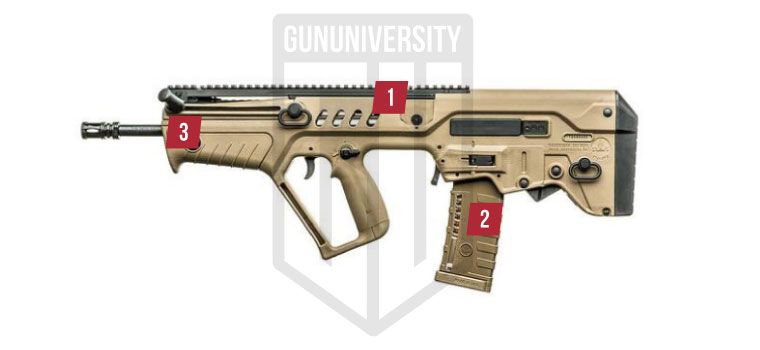
1 Full-Length Top Rail
The SAR’s top rail provides mounting space for an optic while also incorporating folding front and rear sights. The factory irons fold into the rail when not needed
2 AR-Pattern Magazine Compatibility
The 5.56 SAR accepts standard AR-15/M16-pattern detachable magazines. That’s much more useful than the current feature calling its included magazine a “high capacity magazine.”
3 16.5-Inch Cold-Hammer-Forged Barrel
The reviewed 5.56 NATO SAR uses a 16.5-inch cold-hammer-forged, chrome-lined barrel with a 1:7 RH twist.
Tavor SAR Review – Our Take
The IWI Tavor SAR is the bullpup rifle that really got me to consider using a bullpup. Sure, the Steyr AUG has been around for a while and it’s a great gun but it was always a bit of a novelty for many people (me included). The Tavor SAR is a serious-use bullpup rifle. Now, we at Gun University are more partial to the next iteration of the IWI Tavor, the IWI Tavor X95 for the reasons below:
What we love about the Tavor: It’s a capable bullpup rifle run off of a piston system with a forward-mounted charging handle – it already solves three of the complaints I have about AR-15 style rifles:
- AR rifles need a buffer-tube buttstock thereby requiring the action of the rifle to be forward of your firing hand and increasing the overall length of the rifle,
- The standard AR design is a direct impingement gas system that blows the exhaust gasses into the action, and
- AR rifles require you to move your head and bring your hand back in order to charge/operate the bolt.
So, piston-driven for reliability and bullpup design so that you can get a short overall length but the velocity of a regular barrel AND you can charge/operate the bolt with your support hand without moving your position on the rifle!!?!?? What’s not to love?
Well, the manual of arms takes some getting used to if you’re more familiar with AR-style rifles. Trust me, I still am not as fast with mag changes on a Tavor as I am with an AR-style rifle.
My biggest complaint about the ergonomics/controls of this rifle is the mag release! Instead of reaching for a new magazine with your support hand while you release the magazine with your firing hand (fast), the Tavor SAR requires you to use your support hand to grab the empty/old magazine to reach the release and THEN go dig for the new magazine. It’s a bit of a pain and it’s one of the main reasons we like the X95 vs the SAR.
One characteristic of the original SAR that’s difficult to miss is the trigger. Bullpup triggers have to connect the trigger itself with a fire-control system positioned farther rearward in the rifle, and the original SAR developed a reputation for a heavy factory pull. That isn’t just subjective. Period testing measured factory SAR triggers at around 11 pounds, although individual rifles can vary. Reviewers generally found the pull heavy but more usable than the number alone might suggest.
The aftermarket eventually provided alternatives for shooters who wanted a different trigger feel, but the heavy factory trigger remains part of the original SAR experience. The Tavor SAR is nice, but we strongly recommend getting the IWI X95 instead. The X95 retains what I like about the SAR while addressing several of the controls and ergonomics I prefer to see changed.
IWI Tavor SAR vs. X95
The X95 didn’t abandon the concept behind the SAR. It refined it. Both use a compact bullpup layout, but IWI changed several aspects of the rifle when developing the X95. Among the most noticeable differences are the magazine release, charging-handle location, fore-end configuration and fire-control system.
For Dave, the magazine release is the big one. The X95 places the control in a location that’s more familiar to shooters accustomed to an AR-style manual of arms, while the SAR requires the support hand to work farther rearward. That’s one reason Dave prefers the X95.
IWI’s own sales eventually told a similar story. The company said consumers embraced the X95’s improvements after its 2016 release, and in 2017 IWI announced that it would phase out the SAR and concentrate on the X95. That doesn’t make the SAR a bad rifle. It makes the X95 the evolution of a design that had already proved successful.
Tavor SAR Pros and Cons
- Compact Bullpup Design – A 16.5-inch barrel in a rifle just over 26 inches long.
- Reliability – The SAR established a strong reputation for durability.
- Standard Magazine Compatibility – Accepts widely available AR-15/M16-pattern magazines.
- Built-In Iron Sights – Folding front and rear sights are integrated into the top rail.
- Magazine Release – The rearward location requires a different reload technique than an AR.
- Heavy Factory Trigger – Period testing confirms that the original SAR trigger can be quite heavy.
- Weight and Balance – The bullpup layout puts substantial mass toward the rear of the rifle.
- Discontinued – Buyers are now largely looking at used examples.
Reliability |
Super reliable |
A+ |
Accuracy |
Good enough for a battle rifle but not an “accurate rifle” |
C |
Customization |
Full picatinny rail for optics sights but not much else to upgrade/change |
B- |
Ergonomics |
Easy to shoot and operate – except for mag changes |
B |
Value |
Good value, but the X95 is better |
B |
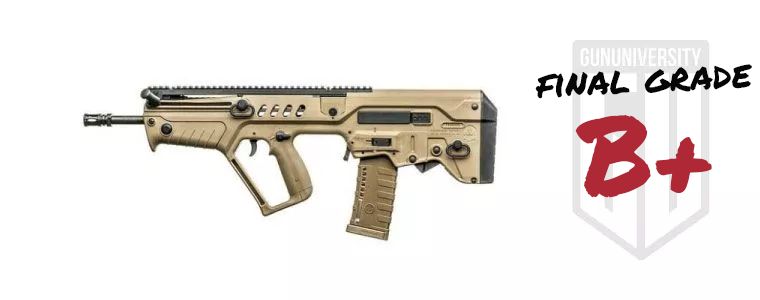
Our Grade
B+
Reviewed by Dave Chesson
Reader’s Grade
A
Based on 8 Reviews
Your Grade
Do You Own This Rifle? Leave A Review
Success Your Grade Has Been
Added To Our Reader’s Score
We use email to verify the accuracy of our reviews. We promise to never spam you.
Starter Pack
Recommended Accessories
IWI Tavor SAR Accessories and Upgrades
Final Thoughts
The Tavor SAR matters for more than being the rifle that came before the X95. It helped prove there was a serious U.S. market for a modern bullpup that wasn’t simply a curiosity at the range. Its strengths haven’t disappeared. You still get a 16.5-inch barrel in a rifle barely over 26 inches long, a proven long-stroke piston system, common magazine compatibility and the durability that helped establish the Tavor name.
Its shortcomings haven’t disappeared either. The trigger is heavy, the magazine release requires a different manual of arms and the X95 improved several of the things Dave likes least about the SAR. That doesn’t make the SAR irrelevant. The X95 may be the more refined Tavor, but the SAR is the rifle that made a lot of American shooters—including Dave—start taking the bullpup seriously.
Frequently Asked Questions
Is the IWI Tavor SAR discontinued?
Yes. IWI US announced in September 2017 that it was phasing the original Tavor SAR out of its U.S. product line after consumers increasingly moved to the newer X95.
When was the Tavor SAR introduced in the United States?
IWI US introduced the Tavor SAR to the U.S. market in 2013. An earlier version of this review incorrectly listed 2014.
What caliber is the IWI Tavor SAR?
The rifle reviewed here is chambered in 5.56 NATO. The SAR platform was offered in additional configurations during its production life, so used buyers should verify the exact rifle they’re considering.
What magazines does the Tavor SAR use?
The 5.56 NATO Tavor SAR accepts standard AR-15/M16-pattern detachable magazines.
How long is the Tavor SAR?
The reviewed 16.5-inch-barreled SAR measures approximately 26.1 inches overall. That’s one of the primary benefits of its bullpup layout: a conventional rifle-length barrel in a much shorter overall package.
What’s the difference between the Tavor SAR and X95?
The X95 retained the SAR’s basic bullpup concept but changed several controls and ergonomics. Among the most noticeable differences are the magazine-release arrangement, charging-handle location, fore-end and fire-control system. IWI introduced the X95 to the U.S. market in 2016 and subsequently phased out the original SAR.
Is the Tavor SAR reliable?
The SAR developed a strong reputation for reliability, and Dave’s experience with the rifle reflects that. As with any used firearm, however, the condition and maintenance history of the individual rifle matter.
Is a used Tavor SAR still worth buying?
It can be, particularly for someone who specifically wants the original Tavor SAR. Buyers should compare its condition and price with the newer X95 and decide whether they prefer the SAR’s controls and configuration.
IWI Tavor X95 Review: X95 vs SAR [UPDATED]
KelTec KS7 Review: Five Years With the Bullpup 12 Gauge
Best Bullpup Rifles & Shotguns [ 2026]
Other Bullpup Rifles of its Class to Check Out
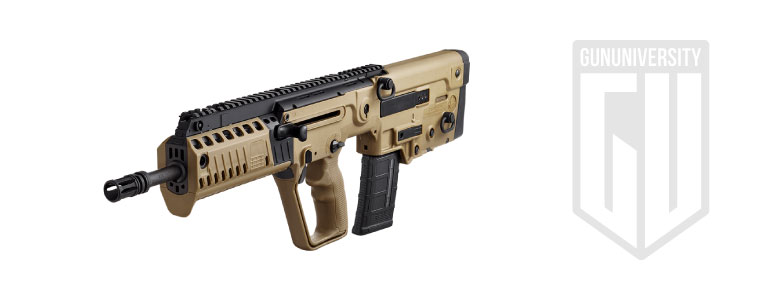
IWI Tavor X95
The Tavor X95 has by far earned the Best Overall Bullpup Award. You can see below why we made that decision.
Reader’s Grade
A
Based on 70 Reviews
Your Grade
Do You Own This Gun? Leave A Review
Success Your Grade Has Been
Added To Our Reader’s Score
We use email to verify the accuracy of our reviews. We promise to never spam you.
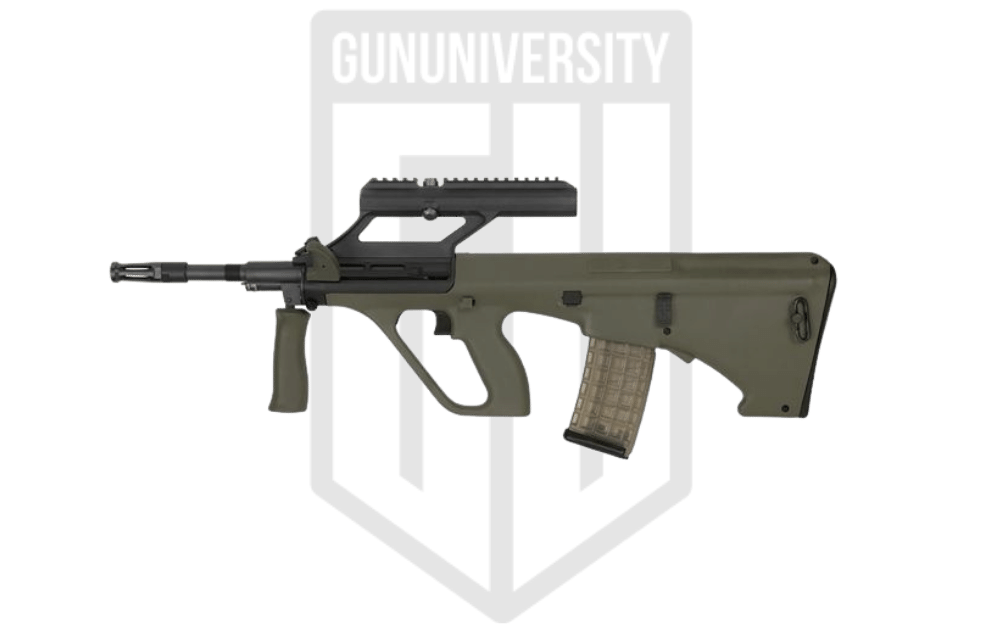
Steyr Aug A3 M1
The Aug is a modular firearm and comes in many configurations to include those that fire in the open bolt position as light machine guns.
Reader’s Grade
B+
Based on 19 Reviews
Your Grade
Do You Own This Gun? Leave A Review
Success Your Grade Has Been
Added To Our Reader’s Score
We use email to verify the accuracy of our reviews. We promise to never spam you.
Reader’s Grade
A-
Based on 39 Reviews
Your Grade
Do You Own This Rifle? Leave A Review
Success Your Grade Has Been
Added To Our Reader’s Score
We use email to verify the accuracy of our reviews. We promise to never spam you.

