

Editor’s Note: This article was originally written and tested by Travis Pike. It has been substantially updated and rewritten by Karen Hunter to reflect today’s PCC and pistol conversion kit market, current products, terminology, accessories, and legal considerations. Pike’s original hands-on testing, range results and observations have been preserved and are identified where relevant.
PCC vs Roni sounds like a simple comparison until you start looking at what each one actually is. One is a complete firearm. The other takes a handgun you already own and gives it an entirely different interface.That distinction matters even more today because both categories have evolved. PCCs have become more refined, and the conversion-kit side has moved well beyond the early Micro Roni that started this conversation.
Pike’s earlier article stated, “I originally approached this as a Roni review. Once I spent time with one, though, the bigger question became obvious. If I want the stability, additional ,contact points and easier handling of a larger platform, should I convert a handgun I already own or just buy a dedicated PCC?”
That question still makes sense today. The hardware on both sides is simply better.

CAA 2.0 Gen 2 Glock
The MCK(Micro Conversion Kit) by CAA is a lightweight, rugged chassis system made of aluminum and polymer that transforms compatible handguns into stable, carbine-style platforms.
What Happened to the Micro Roni?
Shooters still call them Ronis, but CAA’s current conversion systems have evolved into the MCK, or Micro Conversion Kit, family.
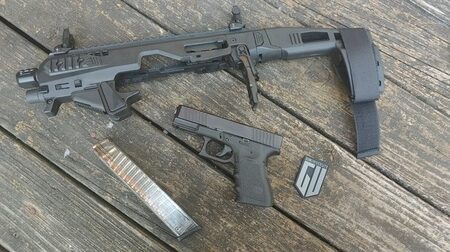
The basic idea hasn’t changed. A compatible handgun fits inside a chassis that adds more structure around the pistol, a charging system, additional rail space and more points of contact with the gun.
CAA currently supports several generations, including the MCK 1.0, MCK 2.0, MCK 3.0 and MCK EVO 4.0. The EVO takes the concept considerably further with broad handgun compatibility and a fully ambidextrous AR-style charging system.
That is a different animal from the older Roni used in our original testing.
The MCK 3.0 also accommodates pistols with slide-mounted optics, something earlier generations could not always do. Current MCK generations differ considerably in optic, suppressor and handgun compatibility, so buyers need to match the chassis to the exact pistol and setup they intend to use. The Roni concept didn’t disappear. It grew up.
What Counts as a PCC?
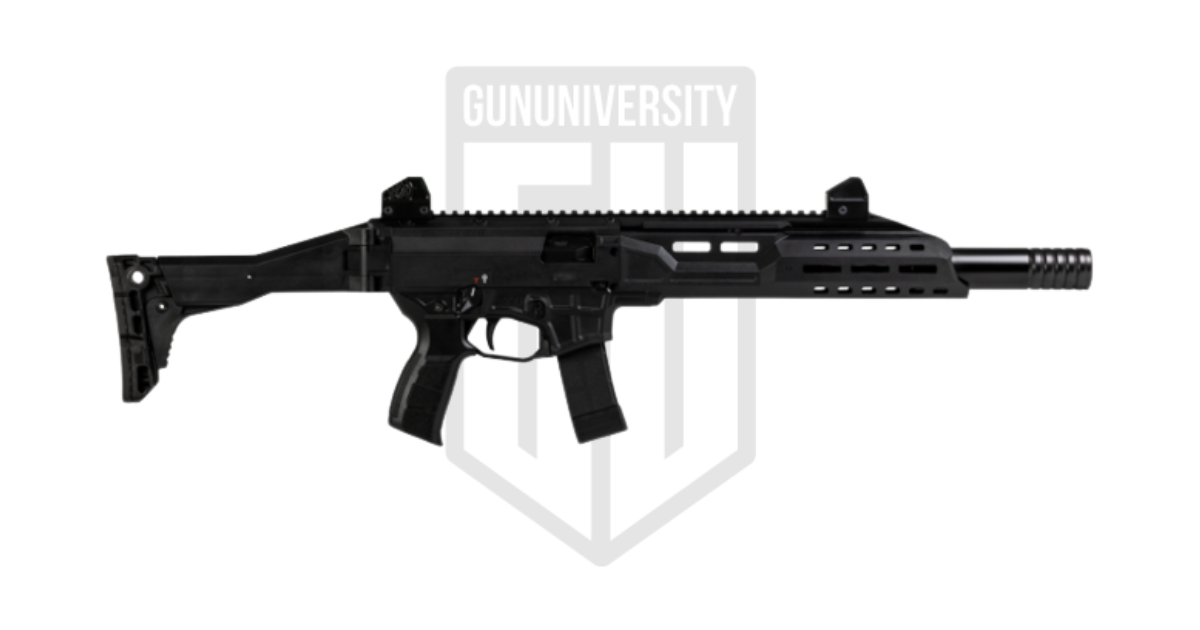
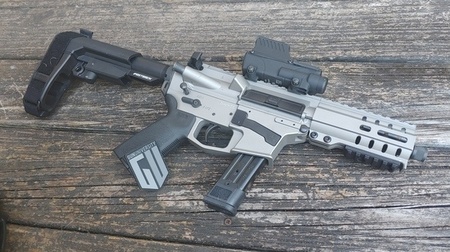
PCC stands for pistol caliber carbine.
Think CZ Scorpion 3+ Carbine, KelTec SUB2000 Gen3, SIG MPX PCC and the almost endless assortment of AR-pattern 9mm carbines.
Firearm enthusiasts also tend to use PCC as a catch-all for compact pistol-caliber platforms, even when the firearm in question isn’t technically a carbine.
For this comparison, the distinction is simpler. We’re comparing a purpose-built pistol-caliber firearm against a conventional handgun installed inside a conversion chassis.
That difference affects almost everything else, including controls, accuracy, recoil, optics and even ammunition performance.PCC operating systems aren’t all the same, either. Straight blowback remains common because it’s simple and proven. CMMG takes a different approach with its Radial Delayed Blowback system, while the SIG MPX uses a gas-operated system. Those differences become noticeable once you start shooting them side by side.
A Quick Word About Configuration and the Law
This comparison needs one legal clarification because a chassis, brace and stock aren’t interchangeable terms.
ATF’s 2023 stabilizing-brace rule was challenged in federal court and has been vacated or enjoined across multiple jurisdictions. On May 6, 2026, ATF issued a proposed rule that would remove the brace-specific language added to the federal regulatory definition of a rifle in 2023.That proposal is not a final rule, and it does not eliminate the underlying federal definitions governing rifles and short-barreled rifles.
Under federal law, whether a firearm is considered a rifle depends in part on whether it is designed and intended to be fired from the shoulder. A rifle with a barrel shorter than 16 inches falls within the federal definition of a short-barreled rifle. Federal law also addresses weapons made from rifles that fall below applicable barrel or overall-length thresholds.
The important point for an MCK or similar conversion chassis is that the complete firearm configuration matters. Calling an attachment a brace, stabilizer or conversion chassis does not, by itself, determine how the assembled firearm will be classified. State and local laws can impose additional restrictions. Shooters should verify the laws governing their exact firearm and configuration before assembling or modifying it.
With that out of the way, let’s get back to the guns.
PCC vs Roni: What’s the Big Difference?
When it comes to comparing the two, there’s a number of factors you’ll need to take into consideration.
Cost: What Do You Already Own?
This is still one of the strongest arguments for a conversion chassis. If you already have a compatible Glock, SIG, Smith & Wesson, or another supported handgun, an MCK builds around something that’s already in your safe. You’re buying a chassis instead of another complete firearm.
If you’re starting from scratch and need both the handgun and conversion kit, the math changes quickly. At that point, you’re spending enough money that a complete PCC deserves a serious look. Street prices move too frequently to hang this comparison on one number. The better question is whether you already own the host pistol. If you do, the MCK has a legitimate cost advantage. If you don’t, compare the complete cost of both setups before deciding.
Ergonomics: Purpose-Built Has an Advantage
This is where the dedicated PCC starts pulling ahead. A PCC was designed around its controls from day one. A conversion chassis has to work around controls originally designed for a handgun.
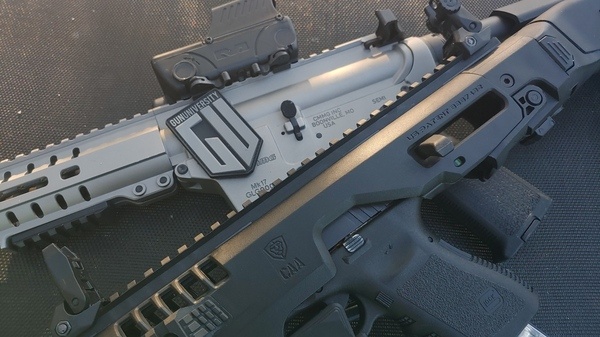
In Travis Pike’s original Roni testing, that compromise was noticeable. The chassis made it harder to get high grip, interfered with easy access to the slide stop, and made the magazine release less convenient. The Roni wasn’t uncomfortable. It simply couldn’t hide the fact that there was still a handgun living inside it.
Current MCK generations address some of those shortcomings with revised chassis designs and improved charging systems. The EVO 4.0 goes further by incorporating an ambidextrous AR-style charging system. Still, a good PCC usually feels more natural during reloads, charging and other manipulations because every control was designed as part of the same gun.
Every dedicated PCC I’ve handled, which includes the MPX, Banshee, Scorpion, SUB 2k, and Hi-Point carbine, has better ergonomics than a Roni equipped PCC. The Roni isn’t terrible by any means, but compromises are to be expected with this setup.
Stashability: Travis Made Up the Word, We’re Keeping It
Travis called this category “stashability” in the original article. It’s too fitting to drop. This is where the conversion chassis becomes genuinely interesting.
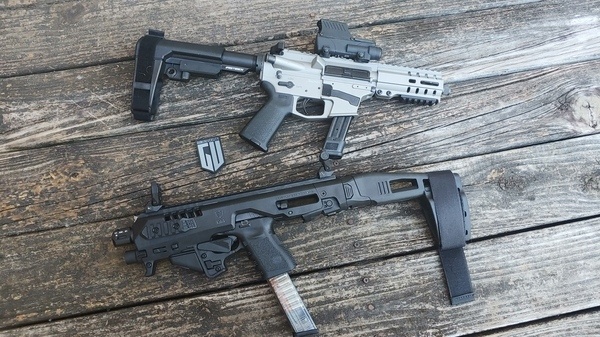
Travis called this category “stashability” in the original article, and it still describes one of the MCK’s biggest advantages, you don’t have to store or transport another complete long gun. A dedicated PCC is exactly that, a separate firearm. Even compact and folding models still require their own secure storage and take up more space than a handgun.
An MCK works differently. The chassis itself isn’t replacing your handgun. You can transport or store the empty chassis separately, then install a compatible pistol when you want the added stability and handling benefits of the larger setup. That can make a difference when space is limited. A handgun and compact chassis are easier to work into a range bag or other secure storage than many dedicated PCCs. When you’re finished, the pistol can come back out and return to its normal role.
There’s an obvious storage reminder here, though. A vehicle isn’t a gun safe. The MCK may give you more flexibility in how you transport and store your gear, but the firearm itself still needs to be properly secured. That’s really the MCK’s advantage in this category. It isn’t simply smaller. It gives you the option of keeping the chassis and firearm separate instead of storing another complete gun.
Accuracy, Optics, and Zeroing
Travis found something during the original Roni testing that remains particularly relevant. With an optic mounted to the chassis, removing and reinstalling the Glock resulted in a measurable point-of-impact shift. He generally saw about an inch of movement at 50 yards, with the largest shift measuring approximately 1.3 inches.
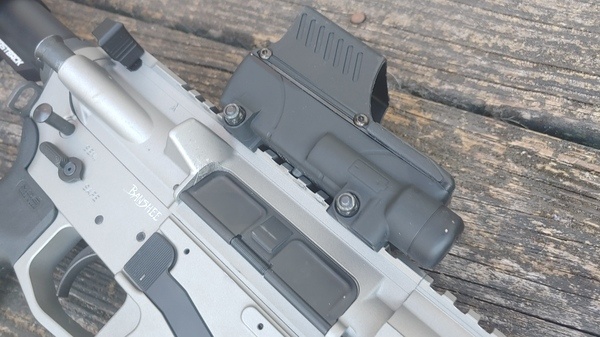
Those numbers belong to the particular Roni and Glock combination he tested. They shouldn’t be treated as a guarantee that every Roni or MCK will shift by the same amount. However, the mechanical reason behind the observation is sound. With a chassis-mounted optic, the optic stays attached to the chassis while the barrel remains part of the removable handgun. Removing and reinstalling the pistol means relying on the gun returning to precisely the same relationship with the chassis-mounted optic.
CAA now acknowledges the same concern with optics mounted to the MCK’s external Picatinny rail. The company advises shooters to quick-check or re-zero the sight after removing and reinstalling the handgun. A dedicated PCC doesn’t have the same relationship. The barrel and receiver-mounted optic stay together.
Modern MCKs give shooters another option. The MCK 3.0 accommodates compatible handguns equipped with slide-mounted red dots. In that configuration, the optic stays with the pistol. As for actual groups, Travis’s original testing showed a different result. The Roni produced groups around 2 to 2.5 inches at 25 yards. The CMMG Banshee Mk17 used for comparison produced groups under an inch. The chassis didn’t suddenly make the Glock barrel mechanically more accurate. It gave the shooter more stability and made the pistol easier to shoot accurately.
That’s an important distinction.
Ballistics: Same 9mm, Different Barrel
One part of the original article needed a definite update. Firing the same cartridge doesn’t automatically make a handgun in an MCK and a PCC ballistically identical. Installing a Glock into an MCK doesn’t change the Glock’s barrel length. The cartridge is still being fired through the handgun barrel.
A carbine-length PCC may give that same load considerably more barrel to work with. Depending on the ammunition, that can produce additional muzzle velocity. That doesn’t mean every 9mm load gets faster every time barrel length increases. Powder, bullet weight, and load design all affect the result.
The KelTec SUB2000 Gen3 in 9mm, for example, uses a 16.15-inch barrel. Compare that with a typical compact or duty handgun barrel and you’re working with two very different barrel lengths. Same caliber? Yes. Automatically identical ballistics? No.
Reliability: Don’t Forget the Host Gun
Travis encountered occasional ejection issues with an earlier Roni. An empty case could become trapped between the pistol and chassis. Later versions opened the ejection area, and the chassis he tested later ran without issues with both a Glock 19 and a Glock 17. Current MCK systems have changed substantially since those early Ronis, so it wouldn’t be fair to use an old malfunction as evidence that today’s EVO will behave the same way.
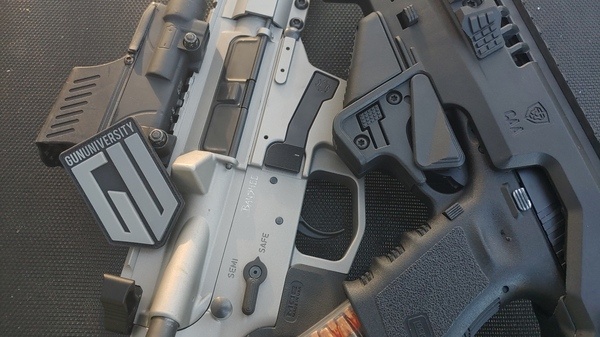
Another variable is the conversion chassis, the host pistol. You’re putting an additional structure around a firearm with a slide that needs enough room to cycle properly. Fit and compatibility matter. Modified handguns deserve extra attention. CAA advises against using ported barrels, ported slides and compensators inside its MCK chassis. Hot gases venting into the polymer chassis can cause damage, while compensators may create clearance problems.
A pistol running flawlessly on its own doesn’t automatically mean every modified configuration will work inside a chassis. A dedicated PCC removes that particular compatibility equation, although reliability still varies between individual guns and designs.
Recoil and Shootability
We’re talking about pistol calibers, so neither platform should be confused with a hard-recoiling rifle. That doesn’t mean they all feel alike. Travis noted more movement from the Roni than he initially expected. That’s understandable when you remember there’s still a handgun slide cycling inside the chassis.
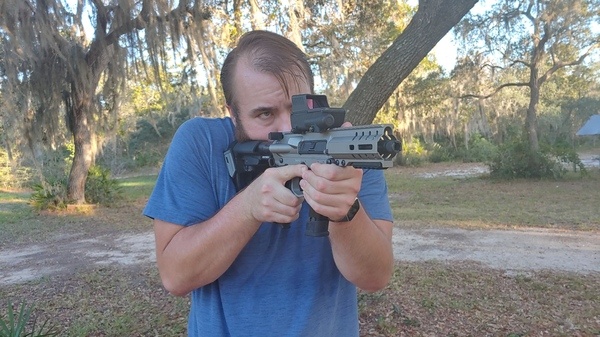
Straight-blowback PCCs can have a surprisingly abrupt recoil impulse as well. Nine millimeters themselves are mild, but a heavy blowback bolt moving back and forth makes its presence known. This is why the operating system matters. CMMG’s Radial Delayed Blowback system delays the action from opening and allows the firearm to operate without the same heavy bolt associated with conventional straight blowback.
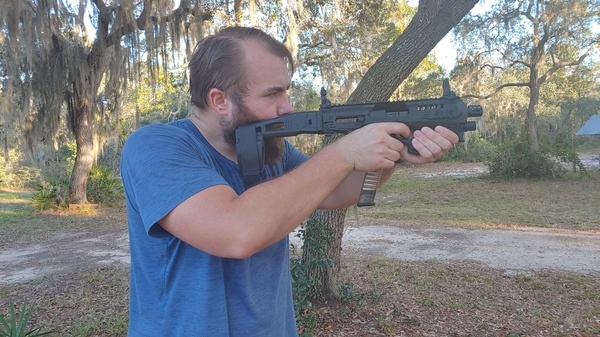
Shoot several PCC designs side by side, and the difference becomes much easier to appreciate. Travis also found the Roni had more recoil and muzzle rise than the Micro Scorpion he used for comparison. The difference became greater against systems such as the CMMG Banshee and SIG MPX. The MCK remains considerably easier to stabilize than shooting the host handgun by itself. A good dedicated PCC, however, generally provides better geometry and more room for the support hand.
Suppressors: This One Has Changed
The original article gave the PCC suppressor capability. At the time, that made sense. Today, it needs qualification. Current MCK generations provide suppressor options that weren’t available with older Roni configurations. CAA lists the MCK 2.0 and MCK 3.0 as suppressor-compatible within model-specific diameter limits. The EVO 4.0 can also accommodate suppressor use when paired with a 9-inch-or-longer aftermarket barrel to provide the required clearance.
A dedicated PCC still tends to make suppressor setup easier. You’re usually working with a suppressor-ready firearm rather than trying to provide clearance through a chassis surrounding a handgun. The PCC retains the practical advantage, but suppressor use is no longer automatically off the table with an MCK.
Accessories That Make Sense for Both
Accessories That Make Sense for Both
Frequently Asked Questions
Is a Roni the Same Thing as a PCC?
No. A Roni or MCK is a conversion chassis that uses a separate handgun as the firearm. A dedicated PCC is a complete firearm designed around a pistol-caliber cartridge. They can fill similar roles, which is why shooters frequently compare them, but mechanically they are very different.
Are People Still Using Roni and MCK Conversion Kits?
Yes. CAA continues developing the concept and currently supports multiple MCK generations, including the EVO 4.0. The latest designs offer broader handgun compatibility and features that weren’t available when the original Micro Roni became popular.
Are PCCs Still Popular?
Absolutely. Current guns such as the KelTec SUB2000 Gen3, CZ Scorpion 3+ Carbine, SIG MPX PCC and CMMG’s pistol-caliber offerings show that manufacturers are still invested in the category. Competition, training, recreational shooting and shooters who simply like pistol-caliber long guns continue to give PCCs a place in the market.
Does an MCK Make a Pistol More Accurate?
It can make the handgun easier to shoot accurately, but it doesn’t change the mechanical accuracy of the barrel. The chassis adds stability and additional points of contact, which can help the shooter produce better groups.
Will an MCK-Mounted Optic Hold Zero After Removing the Handgun?
Don’t assume perfect zero retention. CAA acknowledges that an optic mounted to the MCK’s external Picatinny rail can experience a minor zero shift after removing and reinstalling the handgun. Travis Pike observed the same phenomenon during Gun University’s original Roni testing. Checking zero after removing and reinstalling the handgun is a smart practice.
Can I Use a Pistol With a Red Dot Inside an MCK?
It depends on the MCK generation and exact pistol configuration. The MCK 3.0 was designed to accommodate compatible pistols equipped with slide-mounted optics. Always verify your exact handgun, optic and chassis combination before ordering.
Can You Suppress an MCK?
Some current configurations can be suppressed. CAA lists suppressor compatibility for the MCK 2.0 and MCK 3.0 within model-specific diameter limits. CAA also lists the EVO 4.0 as suppressor-compatible when paired with a 9-inch-or-longer aftermarket barrel for proper clearance. Check the specifications for the exact chassis before putting the system together.
Is an MCK or Roni Automatically an SBR?
No. The chassis by itself does not determine whether the completed firearm is classified as a short-barreled rifle. Under federal law, the classification depends on the complete firearm and whether it meets the statutory definition of a rifle and, if so, a short-barreled rifle. ATF also states that simply labeling an attachment a stabilizing brace does not categorically determine the firearm’s classification. Because the exact configuration matters, shooters should verify current federal, state and local requirements before assembling or modifying an MCK-equipped firearm.
Starter Pack for Both Options
Eye Protection: RADIANS – T-85 5 Lens Interchangeable Shooting Glass Kit
Hearing Protection: Walkers Game Ear Razor Slim Passive Earmuff
Cleaning and Lubrication Kit: Real Avid/Revo Master Cleaning Station Universal Gun Cleaning Kit
First Aid Kit: Dark Angel Medical S.P.E.A.R. (Special Purpose Emergency Aid Rig) Trauma Kit
Final Thoughts – Which One Makes More Sense?
If I’m choosing strictly by shooting performance, I’m going with the dedicated PCC. That’s not particularly surprising. A PCC was designed from the beginning to do this job. The controls make more sense, the optic and barrel remain together, suppressor setup is usually easier, and there are fewer compatibility questions to work through. But shooting performance isn’t the only reason someone buys an MCK. If there’s already a compatible handgun in your safe, the equation changes. The MCK lets you use a pistol and magazines you may already own while giving that handgun a completely different interface.
That’s a legitimate advantage. Travis reached essentially the same conclusion when he originally tested the Roni against a PCC. The dedicated PCC was the better pure shooting platform, but the Roni offered versatility a conventional carbine couldn’t match. Years later, that hasn’t really changed. What has changed is the equipment. Today’s PCCs are more varied, and current MCK systems address several shortcomings found in the early Roni designs.
For me, the PCC still wins when I want a dedicated gun. The MCK makes more sense when the goal is to add another capability to a handgun already sitting in the safe. That’s really what the PCC vs Roni decision comes down to. One was built specifically for the job. The other lets a gun you already own take on another one.
Here are some additional PCCs to check out!

